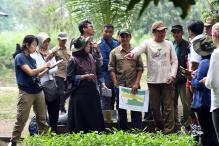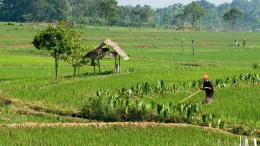


A UNU-IAS side event at the 17th session of the Conference of the Parties to the United Nations Convention to Combat Desertification (UNCCD COP17) explored how sustained investment in landscape and territorial governance can support conservation, restoration and equity goals. Held on 17 August 2026 in Ulaanbaatar, the event was co-organized by the International Partnership for the Satoyama Initiative (IPSI), EcoAgriculture Partners, the 1000 Landscapes for a Billion People Initiative,; CGIAR, UNDP the Yolda Initiative and Ambition Loop.
Suneetha M Subramanian (Research Fellow and Academic Associate) introduced IPSI, a global partnership promoting sustainable management of socio-ecological production landscapes and seascapes (SEPLS). She emphasized that maintaining these landscapes requires continuous and coordinated human management. Effective governance can help to reconcile competing claims among land users and bridge traditional and formal management systems.
Max Levy (Project Manager, EcoAgriculture Partners) presented the briefing note The True Cost of Governance in Integrated Landscape Approaches. Drawing on evidence from 30 integrated landscape initiatives, the publication finds that while funding is often available for implementation activities, the recurring governance functions that enable stakeholders to coordinate, make decisions and adapt over time remain under-recognized and underfunded.
A panel discussion addressed coordination of landscape activities and approaches to financing governance. Speakers highlighted challenges facing rangelands and pastoralist systems in Ethiopia, Kenya and Tanzania, including policy fragmentation, tenure ambiguity, invasive species and insufficient recognition of mobility. Experiences from Morocco and Türkiye illustrated challenges related to civil society capacity and cross-jurisdictional coordination, alongside progress in developing inclusive governance structures.
Panellists stressed the need to invest in the institutions, relationships and coordination mechanisms that underpin long-term action. Engin Yilmaz (Executive Director, Yolda Initiative) discussed ongoing efforts to establish a multi-stakeholder steering committee in Türkiye to support collaborative planning by decision-makers in coastal communities, including small-scale fishers and the private sector. Fiona Flintan (Rangelands & Pastoralism Scientist, CGIAR) highlighted the concept of “investable landscapes”, which focuses investment on a shared vision for a landscape rather than on isolated projects. Wangu Mwangi (Senior Advisory Council, Ambition Loop) emphasized transparency and accountability, including making overlapping initiatives more visible to strengthen coordination.
Bhushan H. Sethi (Steering Committee Member, 1000 Landscapes for 1 Billion People) highlighted the role of public finance in providing continuity for landscape governance. Terence Hay-Edie (Programme Advisor, UNDP) emphasized investing in and strengthening customary governance systems rather than replacing them with new administrative structures.
The discussion underscored the need for continued collaboration between institutions to build the evidence base and financing pathways needed to sustain landscape and territorial governance over the long term.
Collaboration with the Government of Mongolia
During negotiations at COP17, Shinobu Yume Yamaguchi (Director, UNU-IAS) held a bilateral meeting with Munkhtamir Batbayar (Vice-Minister of Environment and Climate Change, Government of Mongolia) to discuss strengthening collaboration between Mongolia and UNU-IAS in biodiversity conservation and sustainable development. The exchange focused in particular on enhancing the participation of Mongolia in IPSI, which the country joined in 2018.