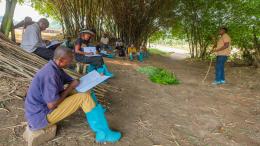


On 15 July 2026, UNU-IAS held a side event at the 2nd Global Nature Positive Summit in Kumamoto, Japan, examining how landscape approaches can advance a nature-positive world through collaboration between governments, businesses, researchers and local communities. The session highlighted practical experiences from Japan and innovative approaches to integrating biodiversity conservation with sustainable local development.
Opening the event, Maiko Nishi (Visiting Research Fellow, UNU-IAS; Professor, Nihon University) outlined the need to consider landscape approaches from the perspectives of on-the-ground practice, research, the private sector and international cooperation. Ichiro Hama (Programme Coordinator, UNU-IAS) emphasized that landscapes should be understood as integrated social-ecological systems that require coordination between stakeholders with diverse objectives to address biodiversity loss while supporting local livelihoods. He introduced the International Partnership for the Satoyama Initiative (IPSI) as a network promoting knowledge exchange and collaboration on landscape approaches worldwide.
Presentations showcased examples of nature-positive implementation at the local level. Kazuki Harada (The Nature Conservation Society of Japan) presented the Japan Nature Positive Approach, which supports municipalities in implementing biodiversity assessments, setting targets and indicators and applying adaptive management. Mr. Harada highlighted collaborative initiatives in Minakami Town, Gunma Prefecture, where the local government, businesses and civil society organizations are working on forest restoration, satoyama and wildlife management, sustainable tourism and timber use.
Hirotsugu Odagiri (Professor, Tohoku University) introduced the Nature Positive Development Society Co-Creation Hub, which translates research into practice through biodiversity monitoring using environmental DNA (eDNA), data platforms, demonstration projects with local governments and capacity development for local practitioners. The initiative also supports natural capital assessment and collaboration with the finance sector.
A panel discussion examined opportunities and challenges associated with adopting landscape approaches from the perspectives of businesses, local practitioners and researchers. Speakers emphasized that achieving the goal of Nature Positive relies on partnerships that leverage the strengths of diverse stakeholders through ongoing dialogue, knowledge exchange and collaboration across sectors and levels. They also highlighted the role of accessible technologies, such as eDNA monitoring, which engage local communities in biodiversity conservation.
Takuya Hasegawa (Fisherman Japan) highlighted that farmers, foresters and fishers are often the first to experience the impacts of environmental degradation while facing limited financial and human resources for biodiversity conservation. He stressed the importance of supporting local leaders who can connect stakeholders and drive nature-positive initiatives.
Yoji Natori (Professor, Akita International University) explained that satoyama landscapes have evolved through generations of interactions between people and nature. He noted that demographic and socio-economic change had made traditional management systems increasingly difficult to maintain, highlighting the need to combine traditional knowledge with science, education and new institutional arrangements.
The event complemented the broader outcomes of the summit, which concluded with the adoption of the Kumamoto Declaration. Among its key commitments, the declaration calls for a just transition that safeguards nature while enhancing local livelihoods, promoting social equity and empowering marginalized communities, recognizing the Satoyama model as an example of conserving nature in harmony with human activities.