On 26 October 2026, a UNU-IAS side event at the 2026 UN Biodiversity Conference (CBD COP17) explored how local communities can contribute to global biodiversity goals, sharing experiences from Phase 4 of the Community Development and Knowledge Management for the Satoyama Initiative (COMDEKS) programme.
Opening the panel discussion, Rissa Edoo (Partnerships Specialist, UNDP) presented progress under COMDEKS, a flagship programme of the International Partnership for the Satoyama Initiative (IPSI) that supports community-led biodiversity conservation and sustainable livelihoods. More than 100 projects have been funded, with nearly 900,000 hectares of land under improved management and 30,000 hectares of seascapes under sustainable management. These initiatives have helped increase income for more than 8,000 people.
Ichiro Hama (Programme Coordinator, UNU-IAS) highlighted integrated landscape approaches as a way to address interconnected challenges, including biodiversity loss, climate change and food security. He discussed IPSI's role in facilitating knowledge exchange and connecting local experiences with national and global biodiversity goals. Ulrika Åberg (IUCN) emphasized that Indigenous Peoples and local communities should be recognized as partners, rights holders and conservation leaders. She underscored the importance of inclusive governance and sustained support, including through recognition of other effective area-based conservation measures (OECMs).
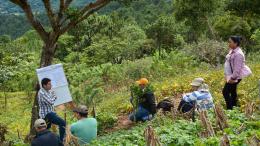
Examples from Armenia, Kyrgyzstan and Morocco illustrated these approaches in practice. In Armenia, community initiatives combining habitat restoration and sustainable livelihoods attracted government funding for an irrigation project that restored approximately 160 hectares of abandoned farmland. In Morocco, participatory assessments helped communities identify priorities for landscape resilience. Experiences from Kyrgyzstan highlighted how traditional knowledge, environmental education and sustainable livelihoods can support biodiversity conservation.
Discussing how to scale local action, panellists identified three priorities: exchanging lessons and good practices, strengthening scientific evidence on socio-ecological production landscapes and seascapes (SEPLS), and aligning local efforts with the Kunming-Montreal Global Biodiversity Framework (GBF) and national biodiversity strategies and action plans (NBSAPs). They further underscored the need for stronger recognition, evidence and investment in capacity development and partnerships.
In closing remarks, Naohisa Okuda (Head of Programme, UNU-IAS) stressed the importance of ensuring that successful local initiatives inform national strategies and global decision-making rather than remaining isolated examples. Fumiko Fukuya (Secretariat of the Convention on Biological Diversity) highlighted the need to document and communicate COMDEKS experiences to inform national policy processes and NBSAP implementation, particularly as countries assess progress towards the GBF at COP17.