

In October 2025, UNU-IAS co-organized a series of side events during technical meetings under the Convention on Biological Diversity (CBD) in Panama City. The meetings advanced discussions on implementing and monitoring the Kunming–Montreal Global Biodiversity Framework (GBF). They comprised the 27th meeting of the Subsidiary Body on Scientific, Technical, and Technological Advice (SBSTTA-27) and the first meeting of the Subsidiary Body on Article 8(j) and Other Provisions of the Convention on Biological Diversity Related to Indigenous Peoples and Local Communities (SB8J-1).
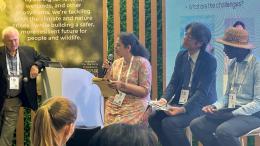
Across three side events UNU-IAS highlighted the work of the International Partnership for the Satoyama Initiative (IPSI), showcasing community-based approaches and tools that support biodiversity conservation and sustainable resource management in socio-ecological production landscapes and seascapes (SEPLS). The sessions brought together governments, researchers, Indigenous Peoples and Local Communities (IPLCs) and youth groups to explore how knowledge from local actors, stronger governance systems and coherent policy environments can strengthen GBF implementation. Discussions highlighted three overarching insights:
Stronger integration of diverse knowledge systems is needed
Participants emphasized that scientific, local and traditional knowledge must be woven together more effectively to support evidence-based biodiversity governance. Speakers reflected on the importance of open and collaborative scientific practice, drawing from conversations of the 6th Science Policy Forum for Biodiversity at CBD COP16 in Cali, Colombia. This includes expanding opportunities for transdisciplinary research and socio-cultural approaches to support the implementation of multilateral environmental agreements (MEAs).
Policy coherence and coordinated multi-stakeholder collaboration are crucial
Panelists from government agencies, financial institutions and international organizations underscored that progress on the GBF depends on aligning priorities across sectors. Identified challenges related to data gaps, financing and coordination between policy, research and implementation actors. Strengthening coherence, from local to international levels, was identified as key to enabling more informed and context-sensitive biodiversity policies.
Community-led monitoring plays an increasingly important role
A central theme across the events was the importance of strengthening community-led monitoring and decision-making systems, particularly those led by IPLCs. Speakers presented practical tools that can help bridge local knowledge with national and global biodiversity processes. Suneetha Subramanian (Research Fellow, UNU-IAS) presented the Indicators of Resilience in Socio-ecological Production Landscapes and Seascapes (SEPLS), illustrating how communities can assess socio-ecological resilience and contribute data aligned with the SB8J agenda. Maurizio Farhan Ferrari (Senior Policy Advisor, Forest Peoples Programme) introduced the Indigenous Navigator, a human-rights–based monitoring system that generates community-owned data relevant to multiple GBF indicators. Paule Gros (BiodivEarth) shared insights from BiodivEarth's efforts to integrate local assessments into global socio-ecological monitoring frameworks, including the development of a community of practice involving stewards of resilient landscapes, with UNU-IAS researchers contributing to its advancement.
* * *
Together, these discussions underscored the critical contributions of IPLCs in achieving the GBF targets. By integrating scientific and traditional knowledge, promoting coherent governance and strengthening community-based monitoring, the UNU-IAS events highlighted practical pathways to advance inclusive, evidence-informed biodiversity action.