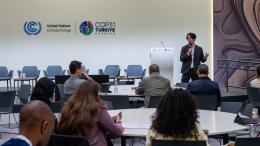
On 16 December 2026, a UNU-IAS session at the 2026 UN Climate Change Conference (UNFCCC COP31) explored the potential of nature-based solutions (NbS) for advancing urban climate adaptation and mitigation, as well as just transitions. Held as part of the 8th Capacity-building Hub at COP31, the session engaged more than 50 urban policymakers, practitioners, researchers and youth leaders.
The session, Urban Nature for Climate Resilience: Nature-based Solutions for Adaptation, Mitigation and Just Urban Transitions, was delivered by Juan Pastor-Ivars (Research Fellow and Academic Associated, UNU-IAS) through a lecture and a series of interactive exercises. These activities engaged participants to unpack the concept of NbS and how it could be applied to challenges in their cities and communities — such as plastic pollution and household waste, and discussed potential nature-based solutions.
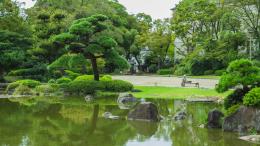
Dr. Pastor-Ivars examined issues of climate justice in urban contexts, highlighting challenges such as rising housing costs, citizen engagement and environmental burden shifting. He called for a whole-of-city approach, whereby policies holistically address issues of urban planning, public health, water management, food systems, transport, economy and labour. A holistic framework for nature-based solutions is needed, bringing together traditional knowledge, sustainability and well-being. Dr. Pastor-Ivars also shared examples of successful urban nature restoration initiatives in Brazil, Canada; France, Japan, South Africa and Ukraine. He introduced the Sustainable Urban Nature project, implemented by the UNU-IAS Operating Unit Ishikawa/Kanazawa (OUIK), which is reconnecting people and nature in Kanazawa, Japan.
The session encouraged policymakers and practitioners to undertake inclusive engagement with communities to agree on shared local definitions of NbS. Green commons should be mapped and supported as assets for climate adaptation and disaster risk reduction. Shared governance of commons is critical, including administrations, owners, experts and citizens, with sustained funding beyond project cycles.