For three decades, the world has discussed climate change through two pillars. Mitigation: cut what causes it. Adaptation: prepare for what is coming.
Both stand on a third pillar that keeps getting missed. The count.
How much was promised, and how much arrived? Whom did it protect? Of every dollar Africa’s resources earn, how much stays at home? Without those numbers, a promise cannot be kept, because nobody can see whether it was.
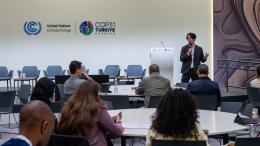
The UN climate talks, COP31, opened on 9 November in Antalya, Türkiye, and run until 20 November. African governments have come with clear priorities. The positions belong to them. This article is about the number under each position, because that is the work of our Institute.
UNU-INRA is the United Nations University’s institute in Africa, based in Accra. We ask one question of every natural resource: of each dollar it earns, how many cents stay at home, in wages, local suppliers, taxes and ownership? We call that share the keep rate.
We did not come to Antalya empty-handed. In October, in Accra, our Institute and UNU Global Health opened a workshop for African negotiators on the indicators that measure adaptation. The same month, at the invitation of Ghana’s Ministry of Environment, Science and Technology, we sat with Ghana’s negotiators and left two short briefs, on carbon and on the just transition. And a member of our team is in Antalya now, providing technical evidence on trade to African negotiators.
Here are Africa’s five priorities, each in three lines: what Africa needs, where our research enters, and what COP31 should not miss.
First, ambition matched by support. The World Meteorological Organization reported on 9 November that the world was 1.47°C warmer from January to September 2026 than before industrial times. As warming rises, so does the bill.
Africa needs: the support the Paris Agreement provides for. Its Article 4.5 recognises that more support allows higher ambition.
Our entry: at COP30, countries agreed to triple adaptation finance by 2035. Yet the Chair of the African Group of Negotiators has said that nobody is sure of the baseline the tripling starts from. You cannot triple a number nobody has written down. We work on that starting line.
COP31 should not miss: a baseline and a yearly path, written in figures.
Second, closing the gap between promise and action. African countries keep raising the ambition of their climate plans. The first global stocktake, in 2023, still found gaps between what is promised and what is done.
Africa needs: to see which actions happened and which did not.
Our entry: a drain recorded as built is not the same as a drain that carries water away from a kitchen. A government receives from us a page, for its own budget lines, of what was recorded as spent beside what is working on the ground. Young African researchers gather it, and that government sees it first.
COP31 should not miss: a gap can only be closed where it is measured.
Third, finance that grows, at a fair price. Much climate finance reaches Africa as loans. ONE Data found that the average interest rate on lending to African countries rose from 2.7 per cent in 2020 to 5.1 per cent in 2024. On a $100 million loan, that is $2.4 million more in interest every year.
Africa needs: more finance, more of it as grants, and loans priced on what Africa actually holds.
Our entry: a lender charges for what it cannot see. Forests, farmland, fish and minerals rarely appear in the record a lender reads. We count what a country holds and keeps, in a form a lender can read.
COP31 should not miss: the price of money decides how far every climate dollar goes.
Fourth, trade that helps climate action. Africa wants one-sided climate trade measures assessed under Article 3.5 of the UN Climate Convention, which says climate measures should not become a disguised restriction on trade.
Africa needs: rules judged on evidence, and room to build its own industries.
Our entry: a count, product by product. In 2025, the European Union’s own import records show EUR 2.64 billion of cocoa from Ghana, and EUR 113.7 million of the Ghanaian goods under the EU’s new carbon border charge. The cocoa is 23 times larger. So for Ghana, the rule that matters most is the one on deforestation, not the one on carbon. That single count tells a negotiator where to spend her time.
COP31 should not miss: a working way for countries to bring such evidence to the table.
Fifth, a just transition built on development. Africa’s transition means energy for every home, decent jobs, stronger local industry and a fair share of the value of its minerals.
Africa needs: to keep more of what its resources earn.
Our entry: proof that a decision can change this already exists. In February 2025, the Democratic Republic of the Congo suspended cobalt exports, and in October 2025 it moved to quotas. By December 2025, buyers in China were paying 100 per cent of the cobalt metal price for Congo’s cobalt hydroxide. Same metal. New decision. More of its value. We ask the next question: how many of those cents stayed in the country, and how many became jobs paid above the legal minimum wage?
COP31 should not miss: value added is not value kept. A transition is just when the share kept at home goes up.
Five priorities, and one balanced outcome that holds them together: progress on cutting emissions matched by progress on adaptation, finance and technology. One method runs under all of them. Count where we start. Count what arrives. Count what stays.
None of this is a case against anyone. Donors want to show results. Africa wants to show need. The same count serves both, and a number both sides can read makes every promise easier to keep.
Our research is finished only when a decision has changed and been measured again. Every figure goes first to the government that can act on it, with its right of reply printed beside ours. Next year the talks come to Africa, when Ethiopia hosts COP32. Antalya can send the world there with the starting lines already drawn.
Count It. Keep It. Convert It. Circulate It.
My grandmother never agreed to a debt she could not mark on her tally stick. A promise you cannot count, she used to say, is a promise you cannot collect.
If there is one thing you remember, let it be this: the climate talks have two pillars, and both stand on a third. Count, and the other two can hold.
Africa is not poor. Africa is uncounted.
Any ministry, university or partner that wants to know its own keep rate can write to me at richard.munang@unu.edu to work with us.
Dr. Richard Munang is Director of the United Nations University Institute for Natural Resources in Africa (UNU-INRA), Accra.