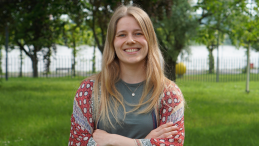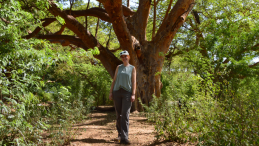


Who: Lisa Hartmann, Senior Research Associate, Environmental Vulnerability & Ecosystem Services (EVES) Division at UNU-EHS
When: 13 - 22 April 2026
Where: Olango Island and Oriental Mindoro, Philippines
Why: Scoping mission and data acquisition for loss assessment of biodiversity and ecosystem services
Climate change is causing losses that go far beyond damaged infrastructure or economic costs. Around the world, communities are also experiencing impacts on biodiversity, cultural heritage, well-being and relationships with nature. In the Philippines, one of the countries most affected by climate change and disasters, researchers from UNU-EHS are working with local partners and communities, within the FRAME-ECO project, to better understand how these losses are experienced and how they can be reflected in climate research and policy.
How come your project works in the Philippines?
The Philippines is one of the countries most affected by climate change and disasters, while at the same time being highly biodiverse, with many communities depending directly on nature and its resources. This makes it a crucial place to explore how climate impacts are affecting both ecosystems and the people connected to them, including losses that cannot easily be measured economically. The Philippines is also very active in the field of loss and damage, especially when it comes to biodiversity and ecosystem services. The Department of Environment and Natural Resources (DENR) and the Center for Conservation Innovation (CCI) have been pioneering work in this area. It is also a core research area at UNU-EHS, where we are developing a framework to assess losses of biodiversity and ecosystem services.
How did you carry out your field work?
The project focuses on three case study sites across the Philippines, each shaped by different climate impacts. On the island of Catanduanes, the research looks at the impacts of Typhoon Uwan, while on Olango Island the focus is on sea level rise. In Mindoro, the work explores how drought affects people’s relationship with nature and the different values nature holds for them. The field mission combined meetings with local government units, environmental and disaster risk reduction offices and national institutions to exchange data needed for biodiversity and loss assessments. A central part of the fieldwork was also engaging directly with the Indigenous Irayan Mangyan communities in Mindoro through discussions led in the local language by local partners. These conversations focused on how communities experience changes in nature, what nature means to them and how environmental change affects cultural values and connections to place – dimensions of loss that are often overlooked because they are difficult to measure.
What did you learn while you were there?
We learned that the impacts of climate change on the Irayan Mangyan, who have a close relationship with nature, are far more multifaceted than what is often captured in assessments. One community leader described how persistent drought is causing rivers in the forest to dry out. These rivers were once places where families would catch shrimp, have picnics and share stories together. With the decline of water and the disappearance of shrimp, these visits have stopped, reducing time spent together as families and disrupting the transfer of knowledge between older and younger generations.
Another takeaway was how research is conducted matters just as much as what is being studied. The fieldwork would not have been possible without strong local partnerships that enabled trust and exchange, ensuring that this was not an extractive process. Allowing people to speak in their own language and share stories rather than only responding to structured questions also revealed much more about their lived realities and what truly matters to them.
How can these lived experiences of loss be reflected in climate research and policy?
The challenge now is to take those stories and make them part of a framework for assessing non-economic loss and damage related to biodiversity and ecosystem services. Because biodiversity or relationships to nature cannot simply be reduced to a number, there is ongoing work in the global research community to define how such losses can be understood and reported by countries, including in contexts like applications to the Fund for Responding to Loss and Damage. The aim is to better capture what is being lost, since only then can these losses be adequately addressed. The research on Nature’s Contributions to People and the diverse values of nature, particularly among Indigenous communities, helps to reveal impacts that go beyond material losses such as crops or freshwater, and extend into health and mental well-being, sense of place and belonging, spirituality, identity and future opportunities.