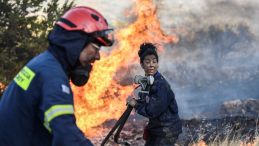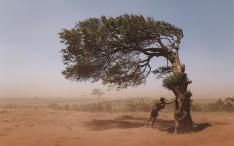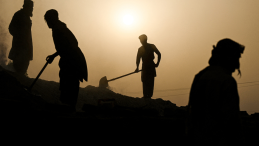


Across the world, from Australia to the Americas, wildfires are occurring with greater frequency and intensity. This trend is driven by a combination of factors, including climate change, land-use change, urbanization and even the ways we have historically managed the fires themselves. Wildfires have become one of the most visible and devastating signs of an era defined by changing environmental risks. Their variability is also increasing as regions with historically low fire risk become more exposed and the lengths of fire seasons extend. For these reasons we tend to view fires only as disasters, but they are also often a natural part of many ecosystems and their complex processes. Understanding the impacts and benefits of fires is an important step in realigning humanity’s relationship with nature.
Here are five facts on wildfires:
Fire is an essential, natural part of many ecosystems
Fires can play an important role in maintaining biodiversity and ecosystem functions. They occur in a variety of ecosystems such as forests, grasslands, tundras and even wetlands. Some plants, grass and tree species are adapted to fire and depend on it for reproduction. For example, chaparral, a highly flammable shrub that thrives in Mediterranean climates, relies on periodic fires for regeneration. Some pine species, like the Jack Pine, require heat from fire to release seeds from their cones. Fire also enriches soils by returning nutrients and creates habitat for wildlife, including birds that nest in fire-scarred trees. Fires are also nature's way of clearing out vegetation overgrowth, which can contribute to more intense wildfires.
Climate change does not cause wildfires, but increases fire risks
Climate change is increasing wildfire risk, primarily due to the burning of fossil fuels, which releases CO2 into our atmosphere and warms our planet. That warming increases the Earth's surface temperatures, which dries out vegetation that fuels flames once a fire is ignited. Though fires start with a spark, from nature or human sources, climate change plays a major role in ripening the conditions which make our environment more susceptible to burning. Furthermore, as extreme heat increases and droughts worsen, fire seasons are becoming longer and more intense. Climate change is contributing to large fires known as "mega fires", which are fires 40,000 hectares (100,000 acres) or bigger. These fires have led to a cascade of impacts such as economic costs, health risks from smoke and contribute to CO2 emissions.
Human activities are contributing to worsening wildfires and destruction
In addition to burning fossil fuels, other human activities drive an increase in wildfire risk and destruction. Urbanization, for instance, is a major factor contributing to wildfire risk. Firstly, increasing urbanization and development pushes human settlements and infrastructure closer to wild lands, increasing the wildland-urban interface (WUI) and fire risks for communities. In recent years, catastrophic wildfires have occurred in this zone, such as the Los Angeles wildfires in 2025 and the wildfires in Chile in 2026 and 2024. Additionally, in many places rural to urban migration has led to the abandonment of farmland and open grazing land, which served as a buffer for fire. This has allowed abandoned arable lands to be covered with forests and shrubs, increasing available fuel for fires.
Fire science and fire ecology are key to understanding fire risks
Fire is a complex hazard. Fire science and fire ecology help us understand fire behavior and fire as an ecosystem function. Therefore, there are a few basic things to help understand wildfires. For instance, the “fire triangle”, which is the combination of fuel (i.e, materials that burn), heat (e.g., lightning) and oxygen (i.e., air or wind) that make up the key elements of fire. Additional elements such as terrain, fuel types, available fuel to burn, temperature and ecosystem composition can define wildfire risk. Topography, for example, is extremely important in understanding fire behavior, as fire travels fastest uphill, making places with steep terrain and wind, such as mountains, hillsides, ridgelines and canyons, dangerous for fires.
We can manage fire with fire
One of the best tools to prevent and manage wildfire risk is fire itself. Management strategies have often focused on fire suppression, which can counterintuitively increase fire risk. This happens because when a small or medium-sized fire is put out in an area, fuel in unburned areas accumulates overtime– leaving an abundance of fuel to burn for future fires. However, in recent years, there has been a broader shift in sustainable land management strategy and policy towards prescribed fire activities, where fire is intentionally started under controlled circumstances. Such techniques were pioneered and used by indigenous populations across the world for centuries, often used as a tool to maintain trails and help selected plants grow. These fire management practices help to reduce fuel loads, create mosaic landscapes with natural fuel breaks and promote ecological diversity.