

In Buenos Aires, the rapid expansion of informal settlements has left neighbourhoods like Villa 20 with limited access to public spaces, vegetation and essential urban infrastructure. Yet these same communities are demonstrating how nature-based solutions can drive social and environmental transformation.
In the article “Integrar los espacios verdes para transformar barrios marginados de Buenos Aires” (“Integrating green spaces to transform marginalized neighbourhoods in Buenos Aires”), published in El País in December 2025, UNU-EHS senior expert Flávia Guerra highlights how community-driven initiatives are reshaping the city’s most vulnerable urban areas.
Through the Transformative Urban Coalitions (TUC), residents, urban practitioners and researchers work together to co-create solutions that bring shade, biodiversity, safety and dignity to neighbourhoods historically overlooked by public investment. These collective actions show that urban climate solutions must start with people and that greening the city can become a powerful lever for reducing inequalities.
Read the full Spanish op-ed here. A translation into English can be found below.
Integrating green spaces to transform marginalised neighbourhoods in Buenos Aires
A group of residents from Villa 20, one of the largest informal settlements in the Argentine capital, has designed green spaces that help mitigate the effects of climate change.
When the sun beats down on Villa 20, one of Buenos Aires' largest informal settlements, heat rises from the streets and dense humidity climbs up the bare brick walls, tin roofs and cables criss-crossing from one side to the other, an architecture born of urgent decisions. The spring afternoon stretches on, the neighbourhood bustles with activity, but darkness reigns in the labyrinthine corridors and houses. There, where concrete flourishes and narrow streets are filled with stagnant water, a group of residents has organised to design green spaces that help mitigate the effects of climate change, even though they face multiple challenges.
Mariana Aguirre remembers every heatwave in recent years. “We try to survive”, she says. “The power goes out, there is no water, there is no shade, there is no air”, she describes. Like her, more than 20,000 inhabitants of the 50-hectare settlement located south of the Argentine capital live in overcrowded conditions, without adequate infrastructure or green spaces.
The area was urbanized in the last decade. More than 1,600 new homes were built in low-rise buildings, basic services were installed and streets were opened to integrate the neighbourhood with the rest of the city. In the rest of the settlement, interventions were made to improve the most precarious buildings, although these were insufficient, according to Aguirre. But urbanization neglected the construction of parks and trees to help reduce temperatures, absorb storm-water and provide spaces for leisure and recreation.
In 2022, researchers from the International Institute for Environment and Development (IIED-Latin America) and the United Nations University Institute for Environment and Human Security (UNU-EHS) designed an Urban Lab, together with local authorities and the community, to implement nature-based solutions, actions that address the challenges of climate change and incorporate green infrastructure, such as flower beds (gardens), trees, vertical plants and vegetable gardens.
However, at first, the community was resistant to the proposal. Laura Arévalos, a resident of the villa for 30 years, did not believe it was necessary to incorporate the environmental dimension. “They talked to us about trees, and we just wanted them to build more houses”, says the teacher, who now lives in one of the new flats in an area named Barrio Papa Francisco. “Instead of green spaces, we wanted more square metres of houses”, she recalls.
But over time, she and other residents understood the importance of including an “environmental perspective” in the urban development. First, they wanted to guarantee habitability, “that the whole neighbourhood had electricity and water”, she points out. When they saw concrete making its way into streets and pavements, they understood the value of greenery, ventilation and shade.
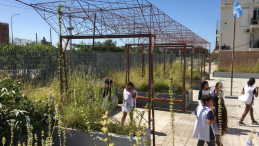
The first step was to identify strategic areas where specific interventions could be made, explains Jorgelina Hardoy, coordinator and senior researcher at IIED-Latin America. “We began to dream up a set of solutions that would integrate green and blue”, she says. Green infrastructure was applied to passageways, streets, squares and the playground of a school attended by children living in the settlement itself.
During the project, native and climbing plants, flower beds, rain gardens and trees were installed. “We replaced impermeable soils and worked with recyclable materials built by the residents themselves”, she explains. In addition, training was provided to ensure the project's sustainability over time. “An environmental tour of the neighbourhood was created”, explains Hardoy.
Flávia Guerra, senior expert at UNU-EHS and co-author of the paper “Nature-based solutions for climate change adaptation and resilience in informal urban settlements”, acknowledges that not all solutions have been found, but that this is a positive and successful first step that could be expanded to other settlements in the future.
“A major challenge for the design of public policies of this nature is the lack of data showing the value of nature-based solutions. It brings climate and environmental benefits, but also new knowledge to the residents themselves”, she points out.
In 2024, the project was recognised at COP29 in Baku, where IIED-AL's work to combat the impacts of worsening heatwaves on the residents of Villa 20 was highlighted.
“There aren't enough green spaces for the whole neighbourhood”.
Although squares, flower beds and green corridors were added to mitigate heat and flooding, most of the improvements were concentrated in the recently urbanised area. Although the small squares do not have enough trees, there is little grass and poor maintenance, as is the case with the pergolas and climbing plants, which makes it difficult for the community to use them on a daily basis. Residents point to the responsibility of the local municipal authorities, whom they blame for the neglect of the area.
Furthermore, in the rest of Villa 20, “the massif”, as the residents call it, green infrastructure is almost non-existent and the possibility of applying this type of solution is lower due to the lack of space. “We design solutions within the possibilities of resources, available physical spaces and progress of works”, explains Hardoy. “Strategic areas for intervention and concrete actions were identified”, summarizes the expert.
Mabel Mamani, a resident and coordinator of a community dining hall, says that “green spaces do not reach the entire neighbourhood”. She is upset about the neglect of essential infrastructure works for the neighbourhood and public spaces. “On a hot day, people try to cool off however they can; not everyone has air conditioning”, she says.
Mariana Aguirre believes that the biggest challenge is to guarantee drinking water and incorporate green spaces in the inner courtyards of the most crowded areas, where homes, without access to natural light or adequate ventilation are connected by narrow corridors that make the air unbreathable on hot days and flood when it rains.
“There are neighbours who don't have water. We need quality public services and to plant trees to absorb moisture. We need ventilation and vegetation”, says Nelson Callejas, another neighbour. For Arévalos, it is essential that the state guarantees the maintenance of these spaces. “The neighbours themselves cut the grass and water the trees. Everything is done by hand”, he laments.
Guerra points out that implementing natural solutions is a challenge in countries in the Global South, where informal settlements have similar characteristics. The specialist explains that these are low-cost projects, with little or no technological implementation, and can be implemented by the community itself. “They could be applied in other cities by adapting the tools”, she emphasizes.
For Hardoy, it is key that redevelopment projects incorporate a climate perspective. “You have to look at everything as a whole. It is feasible and does not mean that building parks means neglecting access to drinking water”, she says.
In Villa 20, residents oscillate between disappointment at broken promises and demands for housing improvements, and hope that green areas will multiply. “After so much struggle, there are many things we haven't achieved, and it's frustrating”, laments Mamani.
“We are leaving a mark for the younger ones to continue”, reflects Arévalos. He concludes: “We all want parks. Imagine a little greenery in the middle of a heatwave. Deep down, we want to have the same things that other neighbourhoods in Buenos Aires have”.