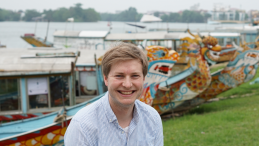


Who: Nico Fricke, Research Associate, Urban Futures and Sustainability Transformation (FAST) Division at UNU-EHS
When: 28 – 31 July 2026
Where: Mostar and Sarajevo, Bosnia & Herzegovina
Why: Mission to review project findings and conduct stakeholder workshops
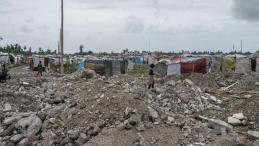
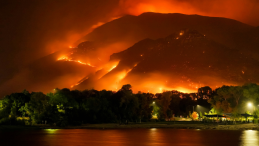
Bosnia & Herzegovina faces substantial risks from natural hazards, including floods, earthquakes, landslides, droughts and wildfires. In recent years, these hazards have caused loss of life and extensive damage to homes, infrastructure and essential services, highlighting the need for better understanding of where risks are greatest and how they can be reduced. As part of the SAFER-BiH project supporting disaster risk management and spatial planning in the country, UNU-EHS researchers are working to identify areas and communities that are particularly exposed to risk.
UNU-EHS Research Associate, Nico Fricke, recently conducted a field mission to the country to hold a workshop and discuss research results with local stakeholders.
What brought you to Bosnia & Herzegovina why is it an important place to study?
Bosnia & Herzegovina faces substantial risks from a range of natural hazards, most notably floods, earthquakes, landslides, droughts and wildfires. This makes it a relevant case for understanding how these hazards interact with human activities, such as urban development, and how they can affect people and communities. In October 2024, for example, flash floods and landslides resulted in the deaths of 27 people and caused extensive damage to homes, infrastructure and essential services. This was one of the main reasons why the Ministry of Construction and Spatial Planning of the Herzegovina-Neretva Canton reached out for assistance in conducting a risk assessment to improve spatial planning and disaster risk reduction efforts.
How did you carry out your work on your field mission?
The mission focused on two key components. First, as part of the project, we developed a risk index covering municipalities across the country, combining 43 different indicators from publicly available databases into an overall risk score for each municipality. We presented these findings at a workshop in Sarajevo, where we brought together representatives from different national agencies to discuss how our work could build on and improve existing initiatives.
Second, we held a local workshop in Mostar, the capital of the Herzegovina-Neretva Canton, where we discussed and confirmed the main risks and possible solutions for the Canton with local experts. This helped us make sure that our work responds to the needs of people and communities on the ground. Both workshops included discussions about the research and the data behind it, as well as observations in the field that were relevant to our work.
What did you learn while you were there?
While the initial project idea focused mainly on earthquake and flood risks, we learned that the impacts of other hazards are becoming increasingly relevant too. Especially in the face of climate change, wildfires and droughts are serious threats to ecosystems, people and their livelihoods, particularly during the summer months. Additionally, stakeholders highlighted that landmines left from the Bosnian war in the mid-1990s continue to pose a serious danger.
Another takeaway was that our research helped us better understand which people and communities are more vulnerable to risks, and what resources they have to cope with them. This includes factors such as socioeconomic status, access to critical infrastructure and health services, alongside the hazards themselves and the people and places exposed to them. These aspects are important for a comprehensive approach to managing risk, and the workshops showed that stakeholders are very interested in taking them into account.
Much of the project is about helping people make better decisions in preparing for disasters. How can your research make the difference in practice?
Based on the conversations and fruitful exchanges during the mission, we found that the risk assessment we have conducted is just the starting point for broader efforts towards greater resilience and sustainability in the region. The subnational risk index will support government agencies, non-governmental and international organizations, and donors in identifying where and on which issues action is most needed to reduce disaster risks in Bosnia & Herzegovina. Our local risk assessment for Herzegovina-Neretva Canton also provides concrete policy recommendations, such as areas where nature-based solutions could be introduced. These recommendations will directly feed into the development of a new spatial plan by the Ministry of Construction and Spatial Planning that takes disaster risks into account.
Suggested citation: "In the Field with Nico Fricke: Assessing Flood and Earthquake Risks in Bosnia & Herzegovina," United Nations University, UNU-EHS, 2026-08-26, https://unu.edu/ehs/article/field-nico-fricke-assessing-flood-and-earthquake-risks-bosnia-herzegovina.