

Science can explain how and why our world is changing, but communicating that science is what can help people understand why it matters, and what they can do about it.
Arianna Flores Corral, a science communicator at UNU-EHS, learned how storytelling is an essential part of that process. From communicating climate science to creating human stories with communities in Mexico, she works to connect scientific knowledge with people's emotions, experiences and motivations.
Why does science need stories?
Science that is piled up in books or scientific journals is work wasted. It stays in a scientific bubble of scientists talking to scientists, like talking in an echo chamber.
Science communication helps science make an impact. To illustrate, there is the story of when Alexander Fleming discovered penicillin's antibacterial effect. He did so many years ago and published his findings in a scientific journal. It took ten years until it was read by someone that actually realized what his discovery meant. Imagine how many people could have been saved if that important science had been distributed differently.
Why do people connect more easily with stories than with scientific findings?
Because we are humans, and we connect with emotions. Data often does not have that aspect that makes you relate to it. As a science communicator, I always ask what gets people interested in a scientific number or piece of data. The answer can be if it affects someone directly, or if it affects the people that they know or even love. So, in short, good science communication makes that link human.
How can science communication move beyond simply explaining science?
I think at the moment that you start creating narratives and stories. Just communicating science is easy. It is just showing the numbers and explaining what is happening.
But when you incorporate stories or people or photos or something visual – something that would make people care – that is when you give this a human link and go from explaining science to engaging people.
Can you give an example of how storytelling can create that human connection?
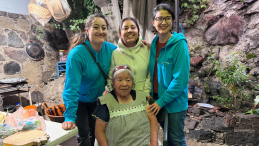
In 2025, we created a human story featuring a community in Xochimilco, Mexico, for the Interconnected Disaster Risks report about creating deep change.
The story was extremely successful. It was shown at film festivals and at COP 30 in Brazil, and it won two awards. In 2026 we travelled back to Xochimilco to close the circle by giving back the voices to the people who lent them to us. It was such a beautiful experience to be able to tell them how inspired people around the world had been by their story.
How do you communicate difficult issues like climate change without creating hopelessness?
We usually try to inspire people and create hope. Topics like climate change are complicated and complex. It can give people anxiety when we only focus on the disaster part.
So, what we always try to do is focus more on the solutions and on what we can do to create change. For example, if there is a disaster and people have been impacted, there is also the question of what comes next. I think most of our communication products are based on that. What is next? What can you do about it?
Structural transformation cannot happen unless there is inspiration and motivation behind it. People need to feel the need, or need to feel that they want to do something about it, because change is difficult. I think humans in general do not like change. So, to motivate someone to change, you actually need to go a bit deeper and relate at an emotional level.
What can scientists learn from storytellers?
Scientists can learn how to make people relate to their science, because the way the science is talked about is also a story. Why are you interested in this research? What did you learn? What was the most interesting part? Here too, it is essential to try to connect with an audience at a deeper and human level. You do not just want people to remember a number. You do not just want them to know, you want them to act.
What do you want people to feel after engaging with your work?
To feel inspired. Everything that we do, we do thinking that someone somewhere will see it and it will spark something in them.
From inspiring people to get more knowledge, to act, or to connect with other people – everything that I do, I do thinking that at least one person will be inspired.