

Background and Rationale
The world is entering a decisive moment for global public health. The COVID-19 pandemic, recurrent outbreaks, climate-sensitive health threats, antimicrobial resistance, and persistent inequities in access to vaccines, diagnostics, therapeutics, surveillance, and emergency response capacities have exposed structural weaknesses in the current global health architecture. While important reforms have been advanced over the past years, incremental adjustments alone will not be sufficient. The challenge today is not merely to patch existing systems, but to reimagine how global public health is governed, financed, and delivered.
The adoption of the WHO Pandemic Agreement represents an important political milestone. The ongoing negotiations on the Pathogen Access and Benefit-Sharing system -as an annex to the Treaty- need to be completed before May 27. The adoption of the Annex is a condition sine qua non for the operationalization of the Treaty. The PABS wil reinforce equity as a fundamental principle. The Annex should secure equitable access through enforceable, predictable, and operational mechanisms that ensure timely access to the benefits derived from pathogen sharing, including vaccines, diagnostics, therapeutics, technology, knowledge, and regional production capacity, without doing harm to the research and development ecosystem.At the same time, global public health is being challenged by a changing financing landscape. Official development assistance is declining sharply, and many low- and middle-income countries face unsustainable debt burdens that constrain their capacity to invest in health systems, preparedness, surveillance, laboratories, and emergency response. In this context, debt relief, debt restructuring, and new fiscal and financial mechanisms are not peripheral to health security; they can be central to creating the fiscal space required for development, including domestic resource mobilization for public health.
This side event will explore how regional approaches might be a missing pillar of a reimagined global public health architecture. As emerging research shows, regions are not simply intermediaries between national governments and global institutions. They are political, operational, and technical spaces where shared risks can be addressed more effectively, where pooled capacities can be built, and where countries can exercise greater autonomy while contributing to global solidarity. Experiences such as Africa CDC, regional initiatives in Asia and in the Caribbean, and emerging proposals for Latin America offer important lessons on how regional platforms can strengthen preparedness, response, accountability, and equity.
A future global health architecture must therefore connect health, finance, development, and regional cooperation. The discussion will explore the principle of subsidiarity: responsibilities should be allocated to the level at which they can be most effectively, equitably, and accountably delivered. National governments must remain at the center of public health responsibility; regional platforms can provide coordination, pooled capacity, shared intelligence, and operational support; and global institutions should provide stewardship, norms, political legitimacy, and mechanisms for redistribution and accountability. This rebalancing of power between national, regional, and global levels is essential for a more equitable and effective global health system.
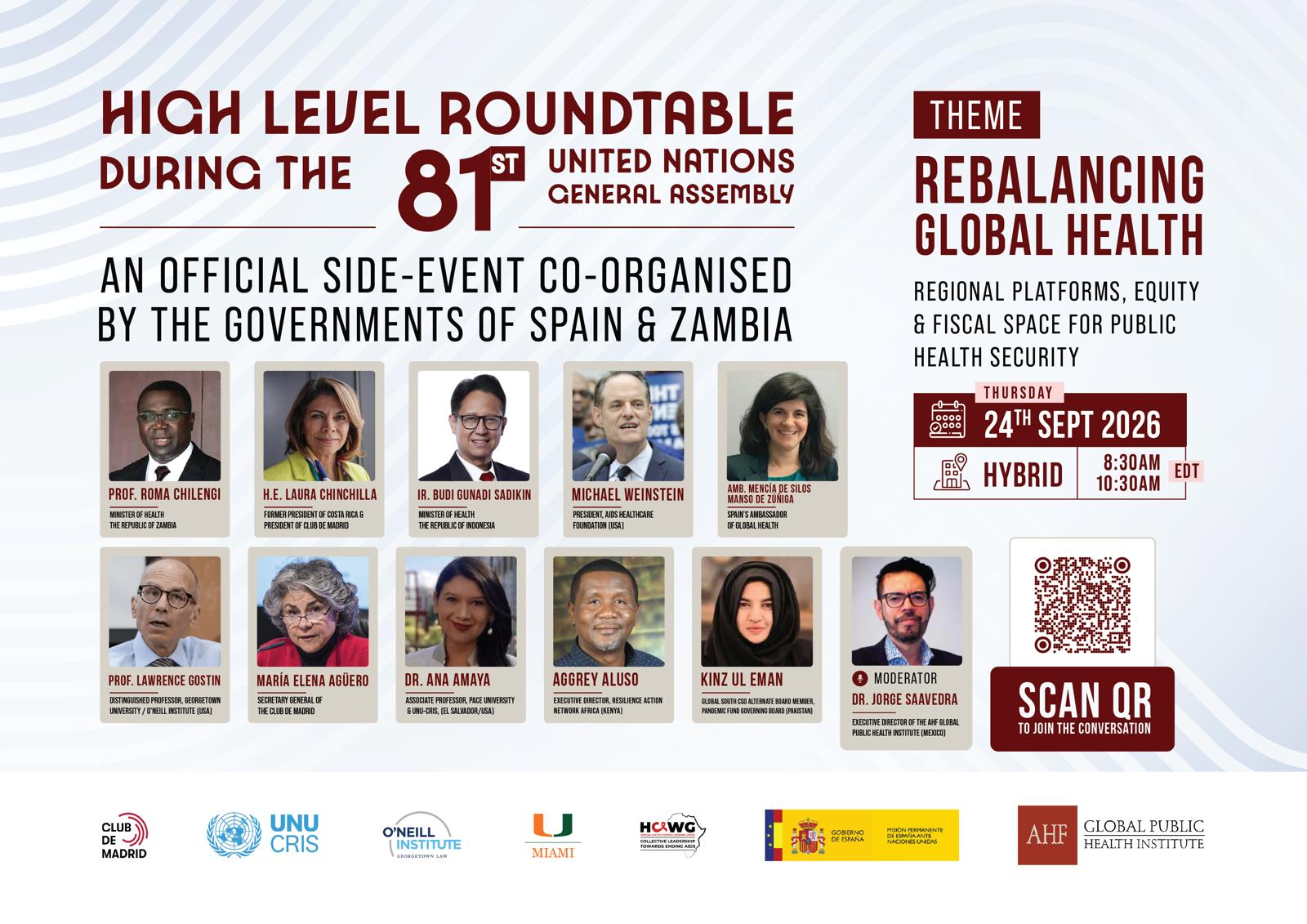
This side event will take place, on the margins of the 2026 United Nations High-Level Meeting on Pandemic Prevention, Preparedness and Response, presenting an opportunity to provide a complementary multi-stakeholder space to examine how to translate the political commitments stemming from the political declaration into tangible actions. Informed by what the evidence shows works to address pandemic prevention, preparedness and response, the event will highlight the importance of strong regional institutions, cross-regional cooperation, and clearly defined responsibilities across national, regional, and global levels, particularly in the current context. Framing essential preparedness and response functions, including surveillance, laboratory networks, workforce development, research and development, technology transfer, manufacturing capacity, and rapid emergency response, as layered public goods can help clarify who should finance, govern, and deliver them. By bringing Member States together with regional organizations, international institutions, technical experts, academia, civil society, financing partners, and other relevant stakeholders, the event will help connect high-level political commitments with the institutional arrangements and operational capacities required for equitable and sustainable delivery.
Objectives
The side event will seek to:
1. Advance a high-level political conversation on the need to reimagine global public health architecture beyond incremental reform.
2. Position regional platforms as essential instruments for preparedness, response, equity, and public health delivery.
3. Discuss how the Pandemic Agreement and the PABS Annex can operationalize equity through predictable access, benefit-sharing, regional capacity, and accountability.
4. Explore how debt relief, debt restructuring, and fiscal space can support national and regional investments in health and development.
5. Advance the understanding of pandemic prevention, preparedness, and response capacities as layered public goods with national, regional, and global dimensions, and clarify the corresponding responsibilities for their financing, governance, and delivery.
6. Identify opportunities for South-South cooperation across Africa, Asia, Latin America and the Caribbean, and Europe.
Proposed Format
A 90-minute high-level roundtable dialogue combining political leadership, technical expertise, and regional experience.
Target Audience
The event will convene a diverse, multi-stakeholder audience, including Government representatives, ministers, ambassadors, and senior representatives of Member States; United Nations entities and specialized agencies; regional and subregional organizations and public health institutions; international financial institutions, development banks, global health initiatives, and philanthropic organizations; experts in epidemiology, pandemic preparedness, global health law, governance, financing, and public goods; academic and research institutions; civil society, community, and youth representatives; and technical and private-sector partners working on surveillance, laboratories, research and development, technology transfer, manufacturing, supply chains, and emergency response.
Expected Outcomes
The event is expected to contribute to:
1. A shared political understanding of regionalization as a core pillar of a new global public health architecture.
2. Stronger recognition of pandemic prevention, preparedness and response as a national, regional, and global public good.
3. Greater visibility of the role of regional platforms in operationalizing equity, preparedness, and response.
4. A clearer connection between Pandemic Agreement implementation, PABS, regional capacity, and equitable access.
5. A policy conversation linking ODA decline, debt relief, fiscal space, and sustainable public health financing.
6. Identification of potential champions for future work on regional public health platforms.
7. A foundation for continued collaboration among governments, regional actors, academic institutions, civil society, and technical partners.