

Our generation will be scrutinized with exceptional fierceness by those coming after us, for decisions taken now will have profound consequences for them in terms of lives saved or lost – Call to Action of the World Future Council
By Neshan Gunasekera, World Future Council and Daouia Chalali, UNU-CPR
Today (20 May 2026) the highest decision-making body in the United Nations (UN), the UN General Assembly (UNGA), will allow the Government of Vanuatu to table a Resolution calling upon all members to support, through consensus, implementation of the historic Advisory Opinion on climate change delivered by the International Court of Justice (ICJ) in July 2025.
The ambition is to endorse and improve the consensus reached on 29 March 2023, when the General Assembly requested that the ICJ provide an Advisory Opinion (AO) on responsibility of states on climate change and its adverse effects on present and future generations. The AO transformed the way in which the broader parameters of international law, including through the application of customary principles of international law, compliment the best available scientific knowledge to open a new era for achieving climate justice this century. The AO states very clearly: climate action is not a political choice, but a legal duty; an opportunity to keep our promises across generations – a cardinal principle of international law recognized through the principle Pacta Sunt Servanda.
As climate litigation cases increase around the world, this Advisory Opinion further strengthens the use of intergenerational equity as a key principle to interpret international law. This confirms a trend observed in recent national cases such as in South Korea in 2024 that declared a government carbon neutrality act as unconstitutional. There is also momentum at the regional level as focus shifts toward the African continent, with a proceeding before the African Court of Human and People’s Rights on an Advisory Opinion on Climate Change, to be heard later this year.
Youth leadership: a commitment to future generations
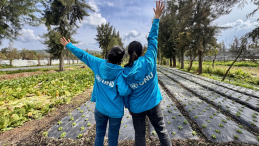
Beyond the content of the ICJ AO and the follow-up draft resolution, the story leading to it constitutes in itself a remarkable case of youth-led policy entrepreneurship translating grassroots advocacy into global institutional influence. In December 2024, Cynthia Honohui, a young Indigenous leader from the Solomon Islands, stood before the ICJ about to open her statement during these historic proceedings. She was then President of the organization Pacific Islands Students Fighting Climate Change, representing the voices of 26 other young activists from across the Pacific region, who had championed this journey for over six years. They held a ‘climate justice flotilla’ at UN headquarters in New York, urging countries to vote yes to the Vanuatu-led bid for the ICJ AO on climate change. On that day, Cynthia was not merely representing herself, or the 26 other activists, but also her ancestors and the future generations who will live with the consequences of climate change.
On that day, she was not merely representing herself, or the 26 activists from the Pacific, but multiple generations: her ancestors, present generations and those yet to be born. A year or so later, Cynthia would recount that on that day, “she was standing on the shoulders of giants”, and that she felt “the power shifted to her”, that it was her duty now to carry this effort forward (See 2026’s Fighting not Drowning documentary). Their story would inspire a global intergenerational movement, including the World Youth for Climate Justice. The challenge now is ensuring decision makers in the UN General Assembly keep their promises to future generations, and in the process become good ancestors themselves.
A defining decision
The ICJ AO on Climate Change is considered to be one of the twenty-first century’s most significant decisions and builds on the entire jurisprudence of the Court, going back to the period of the Permanent Court of International Justice, now over a century ago. Also, the ICJ AO on Climate specifically links with the ICJ AO on the legality or illegality of the use or threat of use of nuclear weapons (1996), which is considered to be one of the most important cases to come before the Court during the last century.
Solomon Yeo, one of the pioneers of the Pacific Islands Students Fighting Climate Change, when receiving the Right Livelihood Award 2025 for his brave climate activism, recalled that “Forty-two years ago, when humanity lived under the looming shadow of nuclear annihilation, the UN General Assembly convened for the 38th time in New York. In that chamber, a representative from one of the UN’s most recently admitted states - Father Walter Hayde Liñi, the first Prime Minister of the Republic of Vanuatu - voiced this simple plea in his intervention: “Let our children decide their future but let us ensure that there will be a future.”