

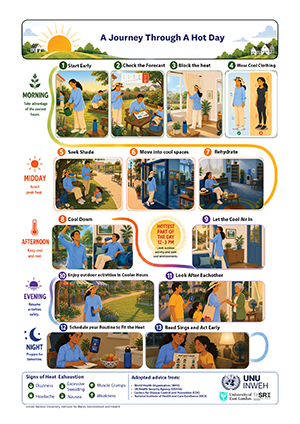
 As extreme heat events and hot days become more frequent and intense around the world, adapting our everyday behaviours can help us reduce our heat exposure to protect our health. This graphical Heat-Adaptive Behaviors (HABs) Guide presents a few simple, practical actions that people can take throughout a hot day to stay safer and cooler.
Developed in collaboration with the University of East London’s Sustainability Research Institute (SRI), this simple HABs Guide by the United Nations University Institute for Water, Environment and Health (UNU-INWEH) is based on three key principles:
Prevent heat from entering the home through shading and reducing direct sunlight during hot days even when you are not home.
Reduce the trapped heat through natural ventilation during cooler periods.
Adapt daily routines by checking forecasts, avoiding peak heat, staying hydrated, and using cooler spaces.
The guidance draws on evidence and recommendations from the World Health Organization (WHO), U.K. Health Security Agency (UKHSA), U.S. Centers for Disease Control and Prevention (CDC), and U.K. National Institute of Health and Care Excellence (NICE), and aims to support practical heat-adaptation behaviours before, during and after periods of extreme heat.
How to cite: Khosravi M., Madani K. (2026) Adapting to the Heat: Simple Actions to Protect Our Health During Heatwaves, United Nations University Institute for Water, Environment and Health (UNU-INWEH), Richmond Hill, Canada, doi: 10.53328/INP26GMK002