The right to live free from discrimination and violence is not secured simply because it is written into law. Rights are more like waves: progress can carry societies forward, but it can also stall or be pushed back. The question today is not only whether women's rights are recognised, but whether that recognition can be sustained over time and whether women can exercise those rights in their daily lives.
International commitments, national laws and public institutions have established that violence against women is not a private matter. Currently, 80% of countries have intimate partner violence legislation allowing for state intervention, and many of those countries also provide support for women to access their rights through hotlines, legal aid and women's police stations. However, 54% of countries still have legal gaps in promoting, enforcing and monitoring gender equality across overarching legal frameworks and public life, violence against women, employment and economic benefits, and marriage and family.
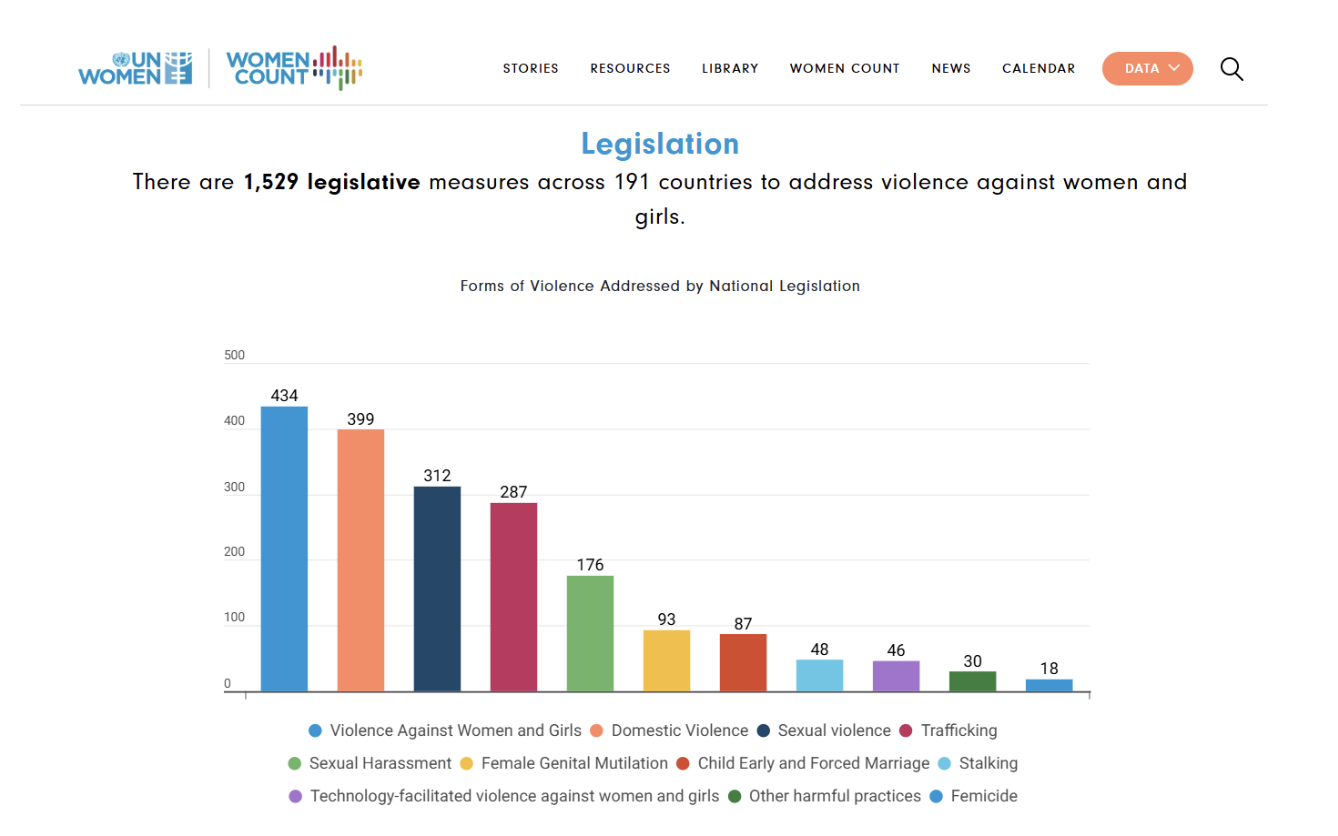
Source: UN Women, “Forms of Violence Addressed by National Legislation”, Global Database on Violence against Women and Girls (accessed 26 November 2026).
These changes matter. Laws also signal what a society will no longer tolerate and, over time, can help shift the norms that sustain violence. Yet a law or service cannot, on its own, remove the barriers that make it difficult to seek help and overcome the harm experienced by victims of domestic violence.
Access to justice is a process
Seeking help is rarely linear. Survivors may face financial dependence, limited housing, isolation, stigma, cultural acceptance of violence, distance from services or family pressure. These barriers can be particularly acute for women in poverty, older women, women in rural areas, and those facing language barriers or disability.
Upstream sits rights awareness, one of the main obstacles to legal empowerment: women who do not know what the law offers cannot use it.
Even after accessing legal services, the process is demanding: repeating stories, attending appointments across institutions and meeting multiple requirements. For a woman who is working, caring for others or trying to stay safe, each appointment can feel like another part-time job. As women gain access to justice, other problems may also arise, making it difficult to sustain a legal claim.
Research shows that a simple explanation of what the process entails, tailored to victims' different capacities, coordination among organisations supporting the process to avoid repetition and meeting overload, and psychological and economic support can build resilience, ease that burden and help women exercise greater independence from the abuser. Enforcement is another challenge, with victims often carrying much of the legal burden of responding to the process, while seeing limited active participation or penalties directed at the abuser.
Access to justice can nonetheless offer powerful elements of empowerment: women realise they are not alone and are entitled to protection, and they become more aware of the problem they face when they speak up and are heard. But being heard is not the same as being able to leave.
Turning rights into real choices depends on income, safe housing, trusted people, accessible information and ongoing support. In the capability approach, these are the conditions that determine whether formal freedom becomes a genuine opportunity. This is one of the main policy challenges the system must overcome.
So counting the success of enacted laws, increases in submitted complaints or increases in protection orders is not enough. We must also ask whether support lasts long enough to make a difference, and whether survivors are ultimately better off.
The quality of support matters
Providers shape what justice means in practice. Judges, interdisciplinary teams, therapeutic companions and lawyers can widen or narrow a woman's sense of what she can decide. Quality therefore means supporting self-determination and autonomy, having the capacity to hear the person's story, and building the basis for sustainable conflict resolution.
That also means rethinking success. As one legal professional put it:
"[As a lawyer] you need to recognise and change your idea of what a victory or win is for your client. You have got to change that. Because otherwise the attorney becomes discouraged, burns out of this kind of practice, becomes cynical. … And the attorney feels, 'Why should I put myself through this because they are going to reconcile … [A]ll this legal effort is going to be for nothing.' But it is not. It is not for anything; it is a goal. They have been safe for some time, and that is a huge accomplishment. They have become aware that there is somewhere they can go for help, so when it happens again, they know where to go and what things they ought to do. They realised, 'Hi, I survive without this person for two weeks, or a month or two months, so maybe I can, maybe he is wrong, and maybe I can actually manage on my own'. Each little step along that way is a huge accomplishment. Now, I will say this: if Argentina is going to involve social workers or counsellors, something like this will help immensely."
Time spent safe, knowing where to turn, discovering she can cope alone: each is progress.
Keep the progress moving
Integrated approaches are the next step: justice, health, education, housing and employment services working together so that women are not left to navigate a maze alone, supported by trained officials and enforcement that is restorative while still holding abusers accountable.
Rights-awareness programmes should reach families, schools and service providers alike, so that schools, health services and workplaces can help victims recognise violence and respond safely.
Collaboration across institutions, civil society and communities is a key driver of change; responsibility cannot rest on survivors alone.
For societies at large, the task is not only to defend past gains but to make rights real by challenging attitudes that excuse violence.
Women around the globe need more than a promise of rights: they need a fair chance to exercise them, safely and with dignity.
Suggested citation: Dr. Julieta Marotta., "Rights on paper, justice in practice: what it takes to end violence against women ," UNU-MERIT (blog), 2026-11-27, 2026, https://unu.edu/merit/blog-post/rights-paper-justice-practice-what-it-takes-end-violence-against-women.