

Dakar, Senegal – 27 January 2026 – The United Nations University Institute for Water, Environment and Health (UNU-INWEH) and the École Doctorale Eau, Qualité et Usages de l’Eau (EDEQUE) at Cheikh Anta Diop University (UCAD) formalized a Memorandum of Understanding on the margins of the Dakar preparatory meeting for the 2026 United Nations Water Conference.
The MoU establishes a structured collaboration to advance applied water research, strengthen advanced academic training, and support evidence-based water policymaking across Africa. Through the partnership, the two institutions will jointly design and implement research initiatives in priority areas such as water resources management, water quality and pollution control, sustainable water use, ecosystem protection, climate resilience, water governance and hydrodiplomacy. The collaboration aims to generate policy-relevant data and analytical outputs to inform decision-making at national, regional, and transboundary levels.
“Today, across Africa and globally, we have entered the era of Water Bankruptcy, where long-term withdrawals, pollution, and climate pressures have pushed many freshwater systems beyond their ability to naturally renew and return to historical baselines,” said Professor Madani, Director of UNU-INWEH. “This reality underscores the urgent need to invest in capacity building, particularly across Africa, and to strengthen partnerships that connect research institutions, governments, and international organizations. We are especially excited to collaborate with EDEQUE, which has trained and inspired many leaders in the water sector. By building on this strong foundation, we can equip current and future water professionals with the skills and tools needed to develop practical, equitable, and scientifically grounded solutions. Such collaboration is essential to safeguarding water resources, enhancing resilience, and advancing sustainable development across the continent.”
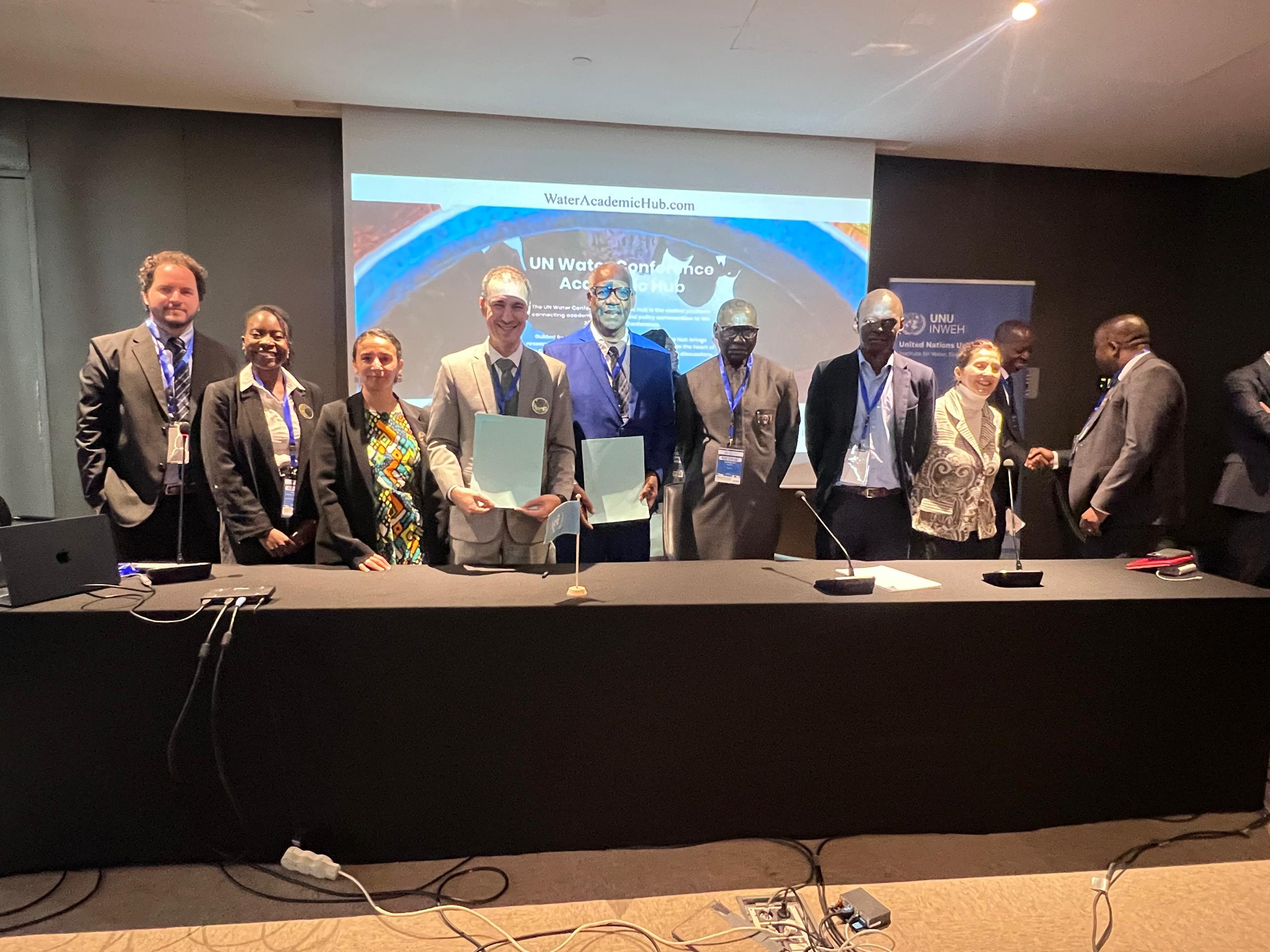
The agreement was signed by Professor Madani, Director of UNU-INWEH, and Professor of Continental Hydrology, Alioune Kane, who represented Professor Awa Niang Fall, Director of EDEQUE at the signing ceremony.
A central outcome of the agreement will be the strengthening of education and research capacity, alongside greater uptake of scientific knowledge in policy and practice, in Senegal and West Africa. Through closer academic collaboration, the partnership will expand advanced training opportunities for African researchers while ensuring that research findings are effectively disseminated and translated into practical solutions for water and sanitation management and climate adaptation.
“We now live on a planet in peril, subject to climate vulnerability, water stress, and various forms of human-induced pressure. To understand the evolution of our water resources and overcome the shocks our societies experience in the face of fragile ecosystems, developing multidisciplinary and interdisciplinary research in the field of water is crucial. Making our socio-ecological systems resilient and sustainable requires a cross-cutting approach encompassing research, training, and public policy,” stated Professor Awa Niang Fall, Director of EDEQUE, “Furthermore, the shortage of qualified human resources in the water sector in Africa is an undeniable reality. The necessary efforts to bridge these gaps and strengthen the capacities of existing personnel can only be achieved through collaboration with research institutions and universities. This collaboration is therefore timely in helping to address the acute hydro-climatic challenges facing our societies. We welcome this partnership between EDEQUE-UCAD and UNU-INWEH which will lead, we believe, to high-level training as well as research that will support the development of our institutions and our countries.”
The MoU was signed during a side event of the Dakar High-Level Preparatory Meeting for the 2026 UN Water Conference that also marked the official launch of the UN Water Conference Academic Hub.
The Academic Hub is an initiative co-led by the United Nations University (UNU), UNESCO and UNITAR, in close collaboration with the United Nations Department of Economic and Social Affairs (UN DESA) and other UN-Water members and partners. The initiative seeks to strengthen the link between scientific evidence and global policy-making. It provides a collaborative space to mobilize knowledge, expertise and diverse perspectives in preparation for the 2026 United Nations Water Conference.
Through this partnership, UNU-INWEH and EDEQUE will contribute to amplifying the voices of African scientists in the lead-up to the 2026 Conference, ensuring that research generated on the continent informs the global water agenda and international decision-making processes.
“The Academic Hub reflects a shared commitment to advancing water science as a strategic pillar for sustainable development in Africa and as a meaningful contribution to the global water agenda,” said Professor Kane. “It serves as a platform for excellence, innovation, and scientific integrity, fostering research that responds to community needs, informs policy, and supports evidence-based decision-making. At a time of escalating water and climate challenges, it is essential that African scientists participate fully and equitably in global knowledge systems. Africa must be recognized not only as a context for intervention, but as a vital partner in generating solutions. Through the Academic Hub, we reaffirm our commitment to strengthening African scientific leadership and promoting international cooperation grounded in shared knowledge and mutual accountability.”
By leveraging UNU-INWEH’s global research mandate and EDEQUE’s regional academic leadership, the partnership will strengthen the impact of research and contribute to advancing Africa’s water security and sustainable development priorities.