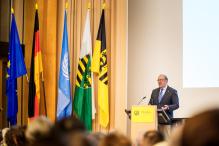
Toronto, Canada, 13 November 2026 – The United Nations University Institute for Water, Environment and Health (UNU-INWEH) and the Mortenson Center in Global Engineering and Resilience at the University of Colorado Boulder signed a Memorandum of Understanding (MoU) on the occasion of UNU-INWEH’s 30th anniversary celebration to strengthen cooperation on global water security. The MoU sets out a framework for joint research, academic programmes, capacity building and knowledge exchange.
Water security means that people can rely on enough water of acceptable quality for their health and livelihoods, and are protected from water-borne pollution and water-related disasters. Climate change, population growth and ageing infrastructure are straining that security worldwide, and the burden falls most heavily on low-income countries, where water services are least reliable and water quality data are scarcest.
Knowing whether water is safe depends on measuring it, and measurement remains uneven across the globe. Of the roughly two million measurements used in the most recent round of UN reporting on ambient water quality, only about 60,000 were collected in the lowest-income half of the world, according to the UN Sustainable Development Goals Extended Report 2025. Without that information, governments find it harder to target investment in water security, and communities may not know when their water is unsafe.
As a first step, the partnership will host the Open Water Quality Data Portal (openwaterquality.org) on global microbial water quality, built on a harmonised dataset of more than 11 million faecal indicator bacteria measurements from nearly 200,000 sites, compiled from nine public sources. The United States, Europe and Canada account for 94.5% of these records.
The collaboration will also combine these on-the-ground measurements with Earth observation and geospatial data, such as land use, livestock density, rainfall and sanitation, to estimate contamination risk in areas with no monitoring. Satellite data can show the conditions that drive contamination but cannot replace a water sample. Bringing the two together allows risk to be estimated where no one has measured, and those estimates to be checked on the ground. The results will feed a co-branded report on the state of microbial water quality, joint peer-reviewed papers and a series of policy briefs for governments planning water security investments.
“Water security cannot be planned without knowing where water is unsafe, yet many governments are asked to report on water quality without the data to do it,” said Professor Kaveh Madani, Director of UNU-INWEH. “Working with the Mortenson Center gives us a way to show decision-makers where water is likely to be unsafe and who is exposed, including in places no monitoring network reaches today.”
The partnership extends to graduate education and training. The two institutions plan to work together on a joint graduate certificate programme, which will be subject to approval by both UNU and the University of Colorado Boulder. The partnership will also offer free self-paced courses on in-situ water quality sensing and digital monitoring, reporting and verification through the UNU-INWEH Online Learning Centre, executive courses for staff of ministries, regulators and utilities, and, will explore, a joint degree programme.
“Our work starts in communities, measuring whether water services actually deliver safe water,” said Professor Evan Thomas, Director of the Mortenson Center in Global Engineering and Resilience. “The joint certificate will train engineers in that work alongside the UN system, and our shared data connect the evidence to the ministries and utilities that decide where water security investment goes.”
The agreement builds on the two institutions’ shared interest in policy-relevant research that generates data and knowledge and develops capacity, particularly for low-resource communities and countries in the Global South. Both see closer cooperation as a way to increase the impact of their work.
About UNU-INWEH
Marking its 30th anniversary of operation in 2026, the United Nations University Institute for Water, Environment and Health (UNU-INWEH) is one of 13 institutions that make up the United Nations University (UNU), the academic arm of the UN. Known as ‘The UN’s Think Tank on Water’, UNU-INWEH addresses critical water, environmental, and health challenges around the world. Through research, training, capacity development, and knowledge dissemination, the institute contributes to solving pressing global sustainability and human security issues of concern to the UN and its Member States. Headquartered in Richmond Hill, Ontario, UNU-INWEH has been hosted and supported by the Government of Canada since 1996. With a global mandate and extensive partnerships across UN entities, international organizations, and governments, UNU-INWEH operates through its UNU Hubs in Calgary, Hamburg, New York, Lund, and Pretoria, and an international network of affiliates.
About the Mortenson Center in Global Engineering and Resilience
The Mortenson Center in Global Engineering and Resilience is an interdisciplinary centre in the College of Engineering and Applied Science at the University of Colorado Boulder. It works to improve wellbeing in low-resource communities through education, research and partnerships that advance evidence-based tools, technologies and practice in water, climate, environment and health. Its graduate programmes include the Graduate Certificate in Global Engineering, and its students work with more than 80 partner organisations around the world.
Media inquiries and interview requests: media.inweh@unu.edu