

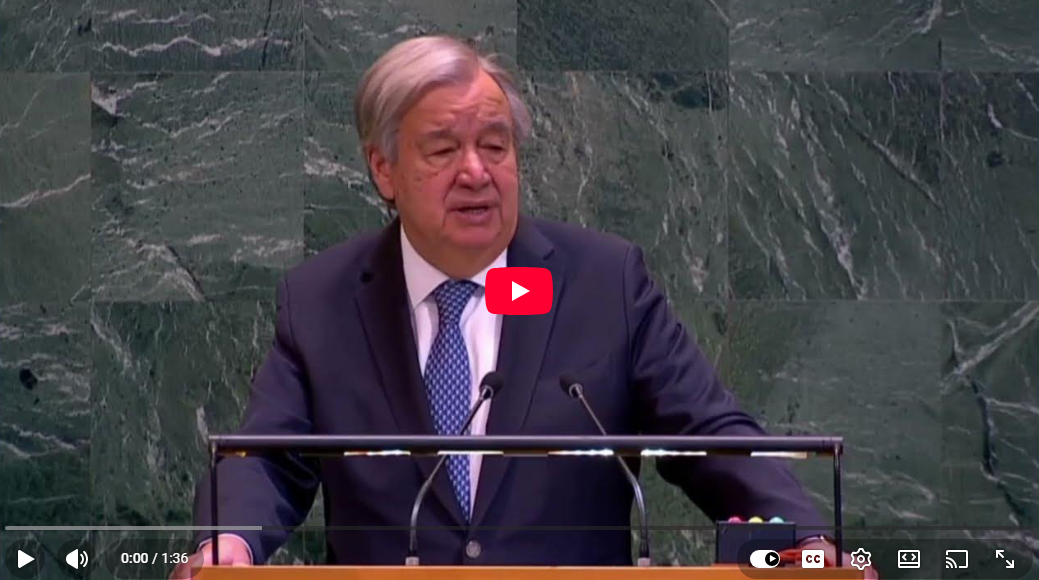
New York, United States – July 13, 2026 — United Nations Secretary-General António Guterres on Monday has warned that the world is "living beyond our hydrological means," urging governments, businesses and communities to accelerate action on water security as the international community prepares for the 2026 United Nations Water Conference.
Opening the High-Level Political Forum on Sustainable Development (HLPF 2026), Guterres acknowledged progress in expanding access to safe drinking water and sanitation but stressed that Sustainable Development Goal 6 remains far from reach. He noted that approximately 2.2 billion people still lack safely managed drinking water, while 3.5 billion people remain without safely managed sanitation services.
"We are living beyond our hydrological means," Guterres said. "Driven by overconsumption, pollution and climate change, our world is using freshwater faster than it can be replenished, with permanent, irreversible effects on many river basins, lakes, aquifers and freshwater ecosystems."
The message mirrors the findings of United Nations University Institute for Water, Environment and Health’s flagship report, “Global Water Bankruptcy: Living Beyond Our Hydrological Means in the Post-Crisis Era”, which concludes that many regions are living beyond their hydrological means and that numerous critical water systems are already effectively ‘bankrupt’. It calls for science-based adaptation to a new hydrological reality.
In his address, Guterres called for stronger collaboration across governments, the private sector and communities to close gaps in financing, innovation, infrastructure, capacity and governance. He urged countries to strengthen accountable and inclusive institutions capable of securing clean water and sanitation for all while addressing the growing risks associated with unsustainable water use and climate change.
"Water is humanity's common denominator — central to all life on Earth," Guterres said, adding that this year's UN Water Conference represents a critical opportunity to mobilize collective action toward achieving Sustainable Development Goal 6.
Co-hosted by Senegal and the United Arab Emirates (UAE), the 2026 UN Water Conference will take place from 8–10 December 2026 in Abu Dhabi. The conference aims to accelerate the implementation of Sustainable Development Goal 6 (SDG 6) by bringing together governments, scientists, civil society and international organizations to strengthen commitments to water security, resilience and the sustainable management of freshwater resources.
REPORT INFORMATION
Madani K. (2026) Global Water Bankruptcy: Living Beyond Our Hydrological Means in the Post-Crisis Era, United Nations University Institute for Water, Environment and Health (UNU-INWEH), Richmond Hill, Ontario, Canada, doi: 10.53328/INR26KAM001
AVAILABLE FOR INTERVIEW
Interview requests should be submitted to media.inweh@unu.edu
MEDIA CONTACTS
Marjan Asadullah, Communications Assistant, UNU-INWEH, marjan.asadullah@unu.edu
ABOUT UNU-INWEH
Marking its 30th anniversary of operation in 2026, the United Nations University Institute for Water, Environment and Health (UNU-INWEH) is one of 13 institutions that make up the United Nations University (UNU), the academic arm of the UN. Known as 'The UN's Think Tank on Water', UNU-INWEH addresses critical water, environmental, and health challenges around the world. Through research, training, capacity development, and knowledge dissemination, the institute contributes to solving pressing global sustainability and human security issues of concern to the UN and its Member States. Headquartered in Richmond Hill, Ontario, UNU-INWEH has been hosted and supported by the Government of Canada since 1996. With a global mandate and extensive partnerships across UN entities, international organizations, and governments, UNU-INWEH operates through its UNU Hubs in Calgary, Hamburg, New York, Lund, and Pretoria, and an international network of affiliates.