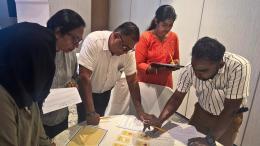
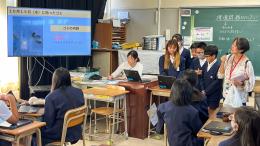
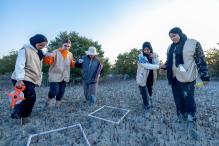
From 13 to 24 October 2026, UNU-IAS and the UNESCO Regional Office for South Asia co-organized a series of teacher training workshops on the Climate Change Competency Framework for Educators (C³FE) in Malé, Maldives, and Colombo, Sri Lanka. The sessions brought together educators, school leaders and key stakeholders to strengthen their capacity in climate change education, including teaching, learning and assessment practices across formal and non-formal settings.
In opening remarks, Jonghwi Park (Head of Innovation and Education, UNU-IAS) noted that the workshops were the first joint effort of UNU and UNESCO to support teachers in empowering learners on climate action. Dr. Park emphasized that schools should enable students to discover their power to respond to the climate crisis. Lee Chang-ju (General Manager, K-eco) pointed out that while almost all teachers recognized the importance of climate education, many felt unprepared to deliver it. Mr. Lee also stressed that climate education goes beyond scientific facts and should empower educators to help students define meaningful real-world action.
Nafissa Insebayeva (Research Fellow and Academic Associate, UNU-IAS), Sawaros Thanapornsangsuth (Adjunct Research Fellow, UNU-IAS), Gio Miole (Lecturer, the University of Tokyo) and Abhinav Kumar (Programme Coordinator for Education, UNESCO Regional Office for South Asia) facilitated the workshop sessions, which included competency stations, collaborative lesson planning, peer feedback and mock teaching exercises. The workshops guided participants through key competencies across the C³FE core domains, such as climate literacy, evidence-based reasoning, futures thinking, holistic assessment and action-oriented learning. Outcomes from the workshops will directly inform the formulation of local diagnostic tools, policy guidance and instructional resources.
The C³FE was developed to enhance the capacity building of educators in climate change education (CCE), and translate CCE goals into effective teaching and learning. It is structured around five core domains: what to teach, how to teach, how to care for learners, how to assess, and how to support action. Designed as a living reference, the C³FE draws on internationally acclaimed frameworks and identifies needed competencies that can be adapted to local readiness levels and priorities. The C³FE was developed with support from the Ministry of Environment of Japan and Korea Environment Corporation.