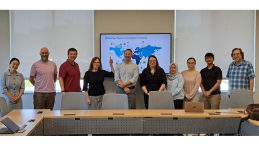


The workshop held in Maputo brought together representatives from public institutions, academia, and civil society to discuss key legal and policy frameworks shaping Mozambique’s digital future.
The event was organized under the Digital Governance Dialogues: Capacity Development and Cooperation in Digital Governance Capacities in the PALOP initiative, a partnership between UNU-EGOV and the Regional Center for Studies on the Development of the Information Society (CETIC.br) aimed at enhancing digital governance capacities across Portuguese-speaking African countries.
Hosted by the National Institute of Information and Communication Technologies (INTIC), the government body responsible for regulating, supervising, and monitoring the ICT sector in Mozambique, the workshop marked the initiative's first in-person activity.
Since its launch, the project has focused on fostering cooperation and knowledge exchange through a series of webinars addressing cross-cutting issues related to digital governance.
The workshop was jointly designed and facilitated by UNU-EGOV and CETIC.br, in close collaboration with local stakeholders. Rather than adopting a traditional conference format based on expert presentations, the event was conceived as a collaborative exercise to review and discuss four legal diplomas under preparation on digital transformation, data governance, interoperability, and Artificial Intelligence (AI).
The session brought together around 25 representatives from public institutions operating under the umbrella of the Ministry of Digital Transformation and Communications, including INTIC, government agencies from different ministries, universities, the National Institute of Statistics, and organizations working in areas such as digital inclusion, data protection, and administrative modernization.
According to the organizers, participant engagement exceeded expectations. Despite many attendees having no previous knowledge of the legal instruments under discussion, they actively contributed their experiences, ideas, and concerns throughout the sessions.
“The participants were very active, always willing to participate and bring their own experiences, ideas, and concerns. This was a particularly rewarding surprise, taking into consideration the lack of prior familiarity with the legal instruments”, noted Luís Soares Barbosa, one of the UNU-EGOV team members who facilitated the session.
Beyond generating detailed feedback on the proposed legal frameworks, the workshop was instrumental in facilitating the common appropriation of the four interrelated legal diplomas under discussion. Participants identified opportunities for improvement that will be compiled and shared with INTIC, contributing to the ongoing policy development process.
The event also highlighted the importance of institutional collaboration in translating policy ambitions into practice. By creating a space for collective reflection, the session encouraged participants to recognize the role that each individual and organization will play in implementing these frameworks and achieving their objectives.
Mozambique is currently experiencing an important period of policy and strategic consolidation in areas including digital transformation, interoperability, AI, data governance, and data protection. At the same time, efforts are underway to strengthen the country’s digital infrastructure and institutional capacities across the public sector.
According to Luís Soares Barbosa, the workshop contributed to mobilizing the public sector around these priorities while reinforcing the need for coordinated action.
“Indeed, the country faces difficult, pressing challenges in the areas of digital infrastructure, communications, literacy rates, and public policy coordination. A lot is at stake. Much will be required of all the relevant actors in the years to come. I believe the Maputo workshop played an important role in this path”, he added.