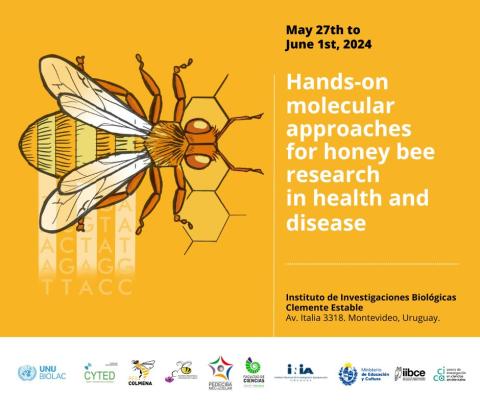


We are glad to announce the “Hands-on molecular approaches for honey bee research in health and disease” course. This activity is coordinated by Dr Karina Antúnez, Instituto de Investigaciones Biológicas Clemente Estable, from May 27th to June 1st, 2024.
Honey bees are the most commonly managed pollinators worldwide, essential for wild plant reproduction, crop production, food security and the maintenance of healthy ecosystems. However, bees are under threat. During the last 15 years, large-scale losses of honey bee colonies have been reported worldwide. Land use intensification associated to a decrease in diversity and availability of pollen, intoxication with pesticides and infection by multiple pests and pathogens have been associated with those losses.
This 6-day intensive postgraduate course will cover basic aspects related to honey bee health and disease, focusing on the main pests and pathogens that affect them and the role of gut microbiota. We will also discuss different methodologies commonly used for its study, from basic molecular biology approaches to cutting-edge techniques, such as microbiomics, viromic and transcriptomic.
The course will include lectures, workshops, laboratory sessions, presentations of students and an introduction to bioinformatic and statistical analysis.
The course will cover the following topics:
Organization and behaviour of honey bees
Pest and pathogens affecting honey bee health
Importance of gut microbiota for honey bee health
Methodologies for studying pests and pathogens, as for studying the honey bee response: from PCR and qPCR to microbiomics, viromic, genomic and transcriptomic.
The students will acquire knowledge and skills in the following practical methods:
DNA/RNA extraction
PCR/ multiplex PCR/ qPCR for detection and quantification of pathogens and members of the gut microbiota
Introduction to bioinformatic analysis of sequencing data
Introduction of statistical analysis in R
Application procedure
Complete this form to apply.
For more information, visit the course web page or send your questions to cursoabejas2024@gmail.com.
Preliminary schedule.
Deadline: April 1st, 2024.