

The transition to renewable energy is necessary to prevent severe climate change impacts, yet it also brings complex challenges related to land use. Renewable energy technologies such as solar, wind, bioenergy, hydropower and geothermal energy, interact with land systems in complex ways, influencing land health and productivity, the provision of ecosystem services and local socio-economic outcomes. However, renewable energy and sustainable land management are not competing goals. When planned together, they reinforce each other, advancing climate action, restoring land, protecting biodiversity and improving lives. Here are five strategic considerations on renewable energy and sustainable land management:
The renewable energy transition is essential, but will reshape how we use land
Rapidly scaling up renewable energy is critical. Yet solar, wind and bioenergy have a relatively higher land footprint than fossil fuels. Beyond power plants themselves, roads, transmission lines, storage facilities and mineral extraction all add to the footprint. Without careful planning, this expansion risks increasing land degradation, fragmenting ecosystems and undermining livelihoods, especially in regions that are already vulnerable.
Smart placement of renewable energy projects can avoid land degradation from the start
Many land-use conflicts can be prevented by prioritizing renewable energy development on land and water bodies already altered by human activity. Rooftops, parking areas, transport corridors, reservoirs, canals, brownfields, abandoned mines and degraded agricultural land offer major opportunities to generate clean energy with little or no additional land to take. Floating solar panel installations on reservoirs and hybrid systems that combine multiple renewables can further reduce pressure on productive and ecologically valuable land.
Dual-use systems can reduce impacts while boosting land productivity
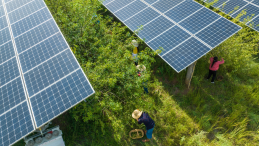
Renewable energy does not have to displace food production or nature. Dual-land-use approaches such as agrivoltaics, wind farms on rangelands, micro-hydropower and sustainable bioenergy allow energy generation to coexist with farming, grazing, biodiversity conservation and land restoration. Shading from solar panels can reduce heat and water stress, improve soil moisture and enhance crop yields, for example. When designed well, these systems can support food security, biodiversity and climate resilience at the same time.
Renewable energy can actively help reverse land degradation
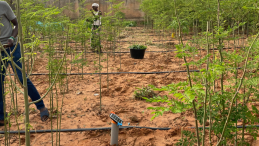
Beyond avoiding harm, renewable energy projects can contribute to land restoration. Solar and wind installations can be strategically placed on degraded or marginal land, while bioenergy can be produced from residues, invasive plant species or feedstocks grown on degraded soils. In some contexts, solar panels provide wind protection and microclimatic benefits that support vegetation recovery and soil health. When aligned with the Land Degradation Neutrality (LDN) response hierarchy (avoid, reduce, reverse), renewable energy becomes a tool for regeneration rather than degradation.
Enabling policies and fair governance determine success
Integrated land-energy planning, strong governance and inclusive decision-making are essential so governments can align energy, land, agriculture and biodiversity policies; enforce land-use regulations; and protect the land and resource rights of local and Indigenous communities. Targeted finance, incentives and carbon or biodiversity credit mechanisms can help overcome upfront costs. Capacity-building, community-based business models and meaningful stakeholder engagement ensure that renewable energy supports sustainable, equitable development and local livelihoods.
The strategic considerations are based on the findings of a recent report that was a collaboration between the International Institute for Sustainable Development, United Nations Convention to Combat Desertification, and United Nations University Vice-Rectorate in Europe.