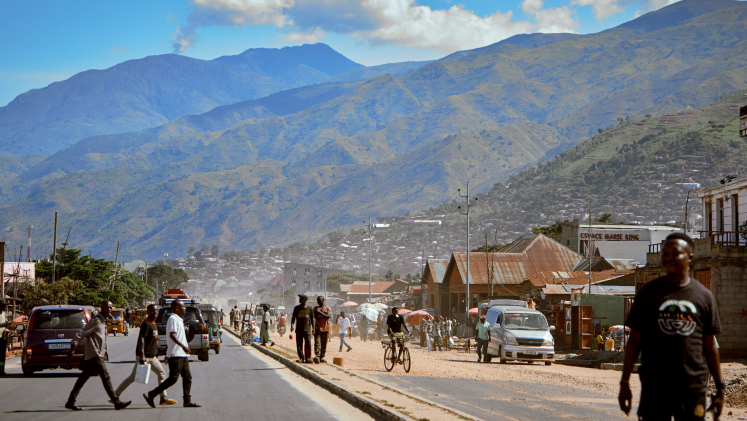
Countries in the Southern African Development Community (SADC) share more mountains as transboundary systems than those entirely within national borders. In the case of geographically large SADC countries, such as South Africa, there is also a predominance of provincial sharing of mountains in a legally federal manner – mirroring the international transboundary situation. SADC mountains occupy 10 per cent of the SADC region, yet the provision of social, ecological, and economic benefits from these mountains is highly disproportionate to their land area and extends far beyond mountain areas. For example, the transboundary Maloti-Drakensberg – one of many mountain ranges in the SADC region – provides water to over 30 million people in four SADC countries, including two hyper-arid countries, and serves as the water lifeline for major economic, industrial and agricultural regions. Although not explicitly mentioned in any SADC documentation, mountains are thus fundamental to SADC’s achievement of Vision 2050, including security, political stability, economic improvement and integration, as well as the realistic achievement of numerous international conventions and agreements – including the Sustainable Development Goals. Drawing on transboundary mountain agreement models from other parts of the world, we propose a SADC Mountain Treaty or a similar diplomatic vehicle to foster stronger transboundary mountain cooperation in SADC, thereby contributing to the achievement of Vision 2050.
Suggested citation: Raphael Lelouvier, Stefan Schneiderbauer, Steve Collins, Bulelwa Moikwatlhai, João Vidal Jr. de Deus, Lynette Jacobs and Ralph V. Clark. "Towards a Multilateral ‘Southern African Mountain Treaty/Convention’ – a Contribution to the Southern African Development Community Vision 2050," Transactions of the Royal Society of South Africa (2026): 1-13. 10.1080/0035919X.2026.2661548