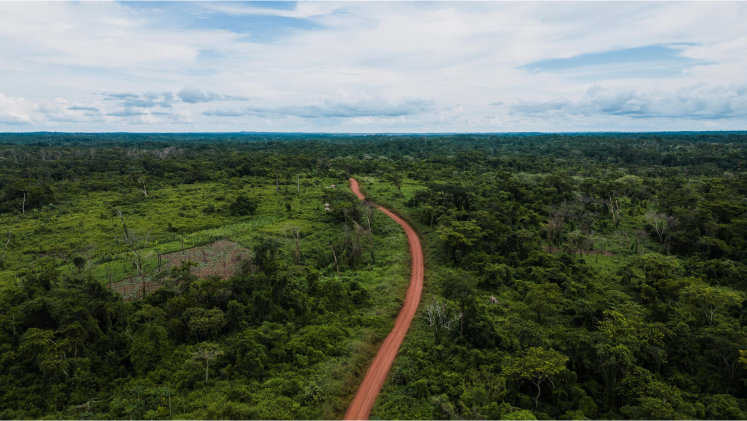
The degradation of forest landscapes in West Africa, particularly in Togo, threatens ecological and socioeconomic sustainability. This study analyses the spatio-temporal dynamics of land use in the central plains of Togo between 1991 and 2022, and projects its evolution for 2030 and 2050 to guide restoration strategies. The methodology integrates the interpretation of Landsat images (1991, 2005, 2022) and the analysis of indicators, including conversion rates and the anthropization index. Prospective modelling (Markov chains and neural networks) follows a trend scenario. The results reveal a sharp decline in natural forest formations: dense semi-deciduous and dense dry forests (−50.55 per cent) and woodlands (−62.06 per cent), converted mainly to cropland, plantations and built-up areas. Shrub/tree savannas, the dominant class, represent a transitional stage resulting from forest degradation. The average annual deforestation rate is 0.75 per cent. The ecological disturbance index increased from 0.24 (1991) to 0.45 (2005), and then to 0.56 (2022), reflecting increased human impact and fragmentation. Projections indicate that these trends will continue, highlighting the growing vulnerability of ecosystems and the need to integrate this dynamic into sustainable management and restoration policies.
Suggested citation: Katché Komlanvi Akoete, Kossi Adjonou, Atsu K. Dogbeda Hlovor, Kossi Novinyo Segla, Jana Balzer, Sally Janzen, Vincenzo Polizzi, Yvonne Walz and Kouami Kokou. "Spatio-Temporal Dynamics and Future Projection of Land Use for the Sustainable Restoration of Forest Landscapes in the Central Plains of Togo," Forests 17, no. 5 (2026) 10.3390/f17050556