


Dr. Serge Stinckwich is a Senior Research Fellow at the UNU Paris Office and a computer scientist with over sixteen years of experience at the interface of digital technologies, sustainable development, and public policy across Asia and Africa.
His work centres on the science-policy interface in two directions: how computational models like agent-based simulations, complex-systems approaches or AI models, can support evidence-based decision-making for the Sustainable Development Goals (SDGs); and how open source software and digital public goods (DPGs) can be governed to advance inclusive and sustainable digital futures.
From March 2020 to March 2026, he served as Head of Research at the UNU Institute in Macau (UNU-IIST), leading an interdisciplinary team working on responsible artificial intelligence, gender and technology, digital health, and agent-based and participatory modelling. He has led participatory modelling workshops on pandemic preparedness in Brazil, Kenya, and Vietnam, and has contributed to flagship UN policy publications, including the UNDP 2025 Human Development Report on artificial intelligence, the UNIDO report Bridging the AI Divide, and the UNU Recommendations on the Use of Synthetic Data to Train AI Models (2024).
Prior to UNU, Dr. Stinckwich was Associate Professor at Sorbonne University and researcher within UMMISCO, an international joint research unit linking the French National Research Institute for Sustainable Development (IRD), Sorbonne University, and five universities in Cameroon, Morocco, Senegal, and Vietnam. He was based in Hanoi (2008–2012), where he led the AROUND project on autonomous robots for urban network observation, and in Yaoundé (2017–2020), where he collaborated with the University of Yaoundé I, IRD, and CIRAD on complex systems modelling and artificial intelligence applied to epidemiological surveillance and environmental monitoring.
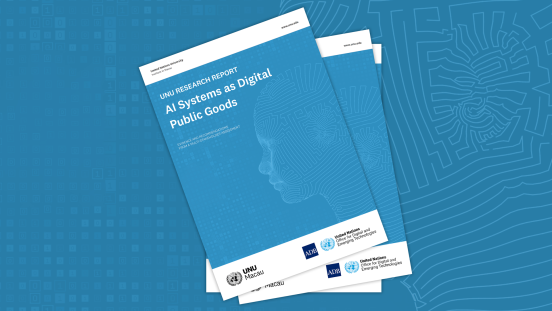
A committed advocate of open collaboration and open source, Dr. Stinckwich is a founding member of Open Source United, the United Nations network behind the UN Open Source Principles, and is currently leading a joint research report with the Asian Development Bank and the UN Office for Digital and Emerging Technologies (UN ODET) on AI as Digital Public Goods. He is the lead developer of several scientific software platforms, including Kendrick (epidemiological modelling), PolyMath (scientific computing), and CORMAS (multi-agent simulations for common-pool resources), and has supervised more than twenty PhD and MSc students from seven countries across Africa, Asia, Europe, and Latin America.