The UNU Global AI Network Insight Blog Series is launched to celebrate the Network’s two-year anniversary. In this series, members of the UNU Global AI Network share diverse insights at the intersection of artificial intelligence and sustainable development. Bringing together perspectives across regions and disciplines, the series explores both the opportunities and challenges of shaping AI for all.
The views expressed in published articles of this series are solely those of the author(s) and do not necessarily reflect the positions of the United Nations University, UNU Macau, the United Nations, or affiliated entities. Publication does not imply endorsement or institutional approval.
Authors are responsible for the accuracy and originality of their contributions. UNU reserves the right to edit, decline, or remove submissions in line with the purpose and values of the series.
For inquiries, please contact: AINetwork@unu.edu
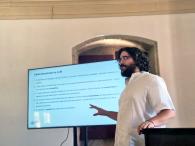
At the UNU Macau AI Conference 2025, framed by the theme 'AI for Humanity: Building an Equitable Digital Future,' I contributed to the pre-conference session 'Mindful Beginnings for AI and Humanity.' Through this session, I observed how contemplative practices offer a calmer and more reflective foundation for AI discourse. While research frequently addresses structural bias in AI data and design, the emotional and psychological states of those creating these technologies remain an under-examined dimension of AI governance [1].
The Consciousness of Creators
My personal connection with the UNU Macau AI Conference began in 2024, where I served as a project coordinator during its inaugural year. It was there that I first encountered the depth of questions surrounding AI ethics and governance—and began to sense that the most important questions were not only technical, but deeply human.
Around the same time, I had begun a daily meditation practice. When I made it a consistent habit, it profoundly transformed my mindset—helping me release the need for external validation and gain the clarity to make decisions truly aligned with my own values and sense of purpose. Through this stillness, I came to understand that amidst the fast-paced world of technology and business, one important element may be the clarity and values of the people guiding it.
This led me to a question I could not easily set aside: if the quality of our consciousness shapes the quality of our decisions in everyday life, might it also shape the technologies we build—technologies that will, in turn, shape billions of lives?
From Personal Practice to Public Interest
As AI systems are increasingly deployed at scale across sectors such as healthcare, education, and public governance, the values and mental states embedded in their design carry proportionally greater societal consequences. This makes the cultivation of inner clarity among AI practitioners not merely a personal aspiration, but a matter of broader public interest.
The founding developers of Mindfulness-Based Cognitive Therapy (MBCT)—Zindel Segal, Mark Williams, and John Teasdale—describe mindfulness not merely as stress reduction, but as a fundamental shift from habitual "doing mode" to a more intentional "being mode"—from reactive patterns to responses shaped by greater clarity and awareness [2]. For those developing AI systems, this distinction may carry practical significance. Decisions made under reactive pressure may look quite different from those made with greater spaciousness and intention—particularly when those decisions involve whose needs are centred, whose voices are included, and what values are embedded in a system's design.
This understanding is increasingly finding its way into international discourse. Dr. Myriam Oehri, who formally introduced the World Meditation Day resolution to the United Nations General Assembly in 2024, has emphasized that uplifting human consciousness through meditation may be among the most important responses to the challenges posed by rapid technological advancement and artificial intelligence [3]. The OHCHR Mindfulness Initiative's Geneva conference "United and Present: Global Solutions from Within" further reflects a growing recognition that inner well-being may serve as a valuable foundation for governance, diplomacy, and innovation [4].
Policy Considerations Worth Exploring
With appropriate humility about the complexity involved, the following directions may merit further attention:
Integrating contemplative and well-being dimensions into tech education. Current AI and computer science curricula tend to emphasise technical proficiency. It may be worth exploring how contemplative sciences, emotional intelligence, and ethics could be woven into training programs for future technologists—not as optional add-ons, but as foundational capacities for responsible innovation.
Broadening AI evaluation frameworks to include psychological and societal well-being. Most assessment metrics focus on accuracy, efficiency, and technical safety. Regulatory bodies might consider how to better capture the effects of AI systems on human attention, emotional health, and social connection—dimensions that align with WHO mental health guidelines and UN Sustainable Development Goal 3 [5].
Fostering cross-disciplinary dialogue. Effective AI governance benefits from bringing together AI engineers, neuroscientists, psychologists, ethicists, and human rights practitioners. Sustained platforms for this kind of exchange may help ensure that the human and inner dimensions of AI development are not treated as secondary concerns.
A Room of Stillness
In formally introducing the World Meditation Day resolution, Dr. Oehri recalled the words of Secretary-General Dag Hammarskjöld, who envisioned that the United Nations should have "one room dedicated to silence in the outward sense and stillness in the inner sense." That room exists at UN Headquarters in New York—a quiet space set apart from the pace and pressure of global affairs, where stillness is not an absence but an intention [3].
Perhaps what is needed now is not only to preserve such spaces, but to ask what it would mean to carry that same spirit into the culture of those building the technologies that will define our shared future. The questions may not have easy answers. But as the unanimous adoption of the World Meditation Day resolution suggests—across all 193 member states, in all their diversity—there may be more shared ground here than we sometimes assume. Inner well-being may not be only a private matter. It may be one modest, often overlooked dimension of the world we are trying to build together.
Disclosures
Conflict of Interest: The author declares no conflict of interest.
Sensitive or Controversial Issues: This article addresses the intersection of contemplative practice, neuroscience, and AI governance policy. The views expressed are those of the author and are intended to advance constructive, evidence-informed dialogue.
Use of AI Tools: This article was refined and polished with the assistance of generative AI tools.
References
[1] Tang, Y. Y., Hölzel, B. K., & Posner, M. I. (2015). The neuroscience of mindfulness meditation. Nature Reviews Neuroscience, 16(4), 213–225.
[2] Segal, Z. V., Williams, J. M. G., & Teasdale, J. D. (2002). Mindfulness-Based Cognitive Therapy for Depression. Guilford Press.
[3] Oehri, M. (2024). Statement to the United Nations General Assembly on the Introduction of the World Meditation Day Resolution (A/79/L.27). December 6, 2024.
[4] United Nations Office at Geneva (UNOG) & OHCHR. (2025). United and Present: Global Solutions from Within — A Mindful Approach to Diplomacy, UN Work, and Beyond. Geneva, Switzerland.
[5] World Health Organization (WHO). (2022). World Mental Health Report: Transforming Mental Health for All. Geneva: World Health Organization.
Suggested citation: Estephanie Chiang, Founder at Empower Tech Asia, Member of UNU Global AI Network., "Inner Peace, Global Harmony: Stillness as a Foundation for Responsible AI Development," UNU Macau (blog), 2026-10-20, 2026, https://unu.edu/macau/blog-post/inner-peace-global-harmony-stillness-foundation-responsible-ai-development.