


As the United Nations marks its 80th anniversary and the United Nations University celebrates 50 years of advancing knowledge for global good, the UNU Global AI Network continues to expand its role in shaping responsible, inclusive, and globally coordinated AI governance. Among the dedicated members driving this mission is Dr. Yik Chan Chin, whose work bridges global governance, AI regulation, digital ethics, and international standards development.
Dr. Chin’s engagement with the UNU Global AI Network began after attending the UNU Macau AI Conference 2024, where the UNU Global AI Network was launched. Inspired by the UNU Global AI Network’s alignment with the UN mission, the Sustainable Development Goals (SDGs), and the evolving agenda of the Global Digital Compact (GDC), she joined to explore collaborative research opportunities and contribute her expertise to a global community committed to ethical and human-centered AI.
Strengthening Global AI Governance Through Safety and Interoperability
With a career devoted to the governance of emerging technologies, Dr. Chin has worked across leading international institutions and multistakeholder initiatives—including the UN Internet Governance Forum (IGF), the UN Open-Ended Working Group (OEWG) on ICT Security, the Austrian Academy of Sciences (Global Digital Ethics), and the British Standards Institution’s ART/1 AI Committee.
These experiences shaped her conviction that AI safety is both a regulatory requirement and an ethical responsibility. She emphasizes that safeguarding AI systems throughout their lifecycle requires coordinated attention to risks such as algorithmic bias, misinformation, privacy leakage, deepfakes, cybersecurity threats, and unreliable automated decision-making. These challenges are especially critical in high-stakes sectors like education, autonomous driving, and cross-border data governance, where human rights, public trust, and safety are directly at stake.
For Dr. Chin, interoperability—across ethical principles, regulatory frameworks, and technical standards—is essential to addressing these risks. Public trust depends on consistent safeguards, and achieving this requires collaborative learning and alignment among jurisdictions. Her views resonate strongly with the UN’s AI Safety Framework, which calls for safe, secure, trustworthy, and human-centered AI development.
A Transnational Collaboration Model: Insights from the UNU Policy Report
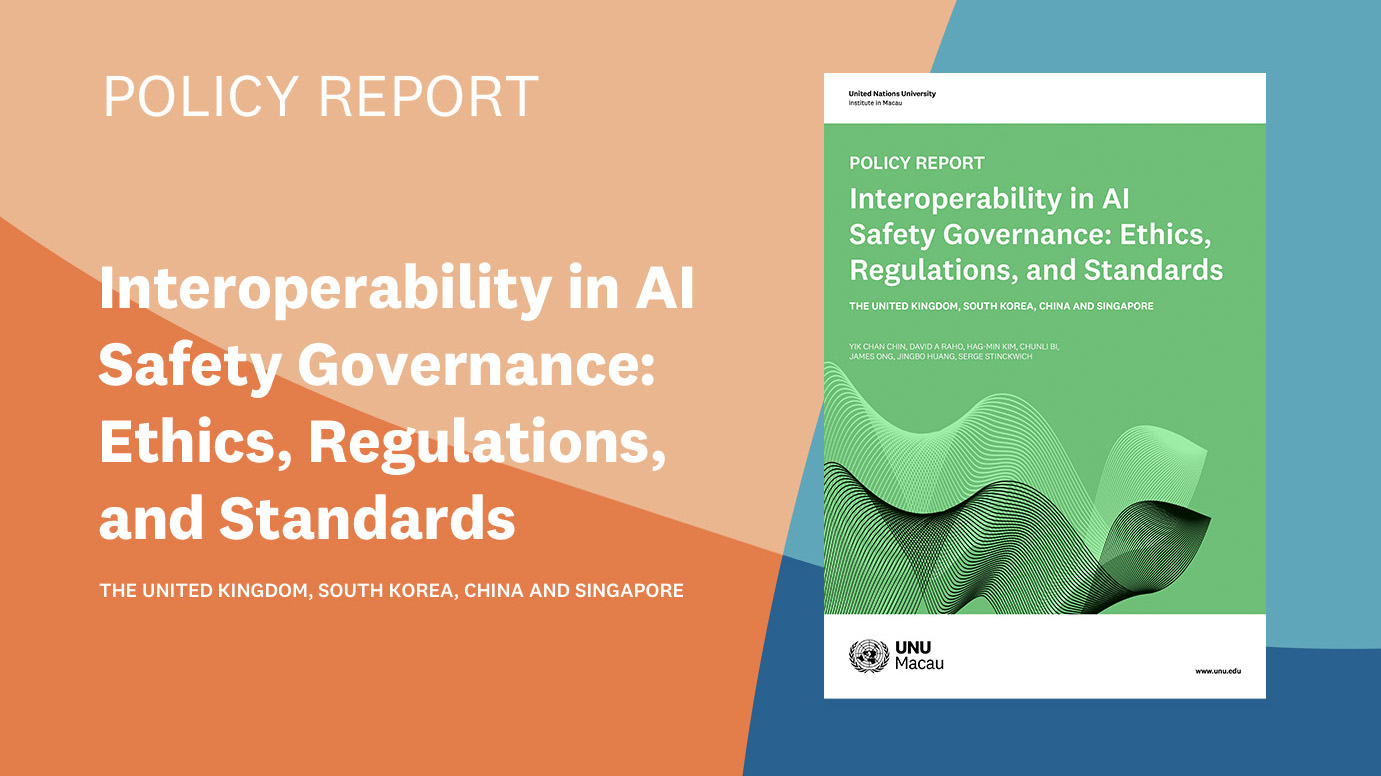
Dr. Chin’s involvement with the UNU Global AI Network deepened during the development of the UNU Policy Report “Interoperability in AI Safety Governance: Ethics, Regulations, and Standards.” This collaborative project brought together scholars and practitioners from China, South Korea, Singapore, and the United Kingdom to examine how different jurisdictions address AI governance in three critical sectors: education, cross-border data flow, and autonomous driving.
The project demonstrated how interjurisdictional learning can support globally coherent yet locally relevant regulatory strategies. Working virtually across four countries and guided by UNU Macau’s leadership, the team delivered a comparative study that reflects the UNU Global AI Network’s unique strengths: global convening power, local relevance, and broad engagement across sectors.
This experience showcased the UNU Global AI Network’s potential. With its alignment to UN values and its ability to unite diverse academic, industrial, and policy resources, the UNU Global AI Network is uniquely positioned to foster agile, multidisciplinary approaches to AI governance—approaches capable of adapting to the rapid evolution of AI systems and societal needs.
Regulatory Learning as a Foundation for Global AI Governance
One of Dr. Chin’s key insights is the importance of regulatory learning as a foundation for global AI governance. Effective regulation, she emphasizes, requires drawing lessons from domestic experiments, learning from other jurisdictions, facilitating interregional knowledge exchange, and enabling collaborative innovation.
The UNU-led project showed how identifying shared governance challenges and co-developing policy strategies can pave the way for frameworks that are globally coherent yet locally adaptable—an increasingly essential model in the face of rapidly evolving AI technologies.
A Vision for the UNU Global AI Network’s Next Phase
Looking ahead, Dr. Chin envisions the UNU Global AI Network as a central hub for multidisciplinary AI governance research and collaboration, beginning in the Asia-Pacific region and expanding globally. She highlights opportunities for the Network to:
- Convene academic, industry, and civil society partners
- Strengthen multistakeholder engagement
- Produce impactful policy and educational outputs
- Support adaptable, inclusive, and future-oriented AI governance frameworks
Her reflections underscore the Network’s potential not only to generate knowledge, but also to shape global AI policy and bolster the UNU system’s leadership in responsible AI.
Supporting the Global Digital Compact and UN Principles for Ethical AI
Dr. Chin’s contributions extend beyond academia. Through her roles in the UN IGF, UN OEWG, national standards bodies, international scientific associations, and AI governance committees, she has helped shape global discussions on digital ethics, cybersecurity, and human-centered AI.
Her work aligns closely with the priorities of the Global Digital Compact and the UN’s vision for ethical AI- ensuring that AI systems remain safe and trustworthy, inclusive and rights-based, aligned with human development, and governed through international cooperation and technical rigor.
Strengthening the UNU Global AI Network’s Leadership in Responsible AI
Through the contributions of members such as Dr. Yik Chan Chin, the UNU Global AI Network continues to solidify its role in shaping the future of responsible AI governance. Her work exemplifies how academic expertise, international collaboration, and UN-led multistakeholder engagement can come together to build frameworks that are safe, interoperable, and rooted in human values.
As UNU Macau advances its Milestone Series, Dr. Chin’s journey underscores the Network’s growing impact within the UNU system and across the global digital policy landscape—helping shape an AI future defined by trust, equity, and sustainable development.
Suggested citation: "Advancing Safe, Interoperable, and Human-Centered AI Governance," UNU Macau (blog), 2025-12-05, 2025, https://unu.edu/macau/blog-post/advancing-safe-interoperable-and-human-centered-ai-governance.