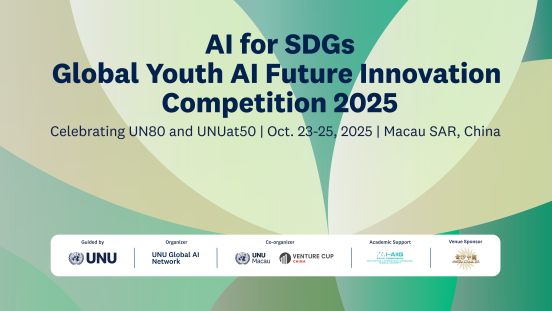


The AI for SDGs - Global Youth AI Future Innovation Competition is an international science and technology innovation competition initiated by the UNU Global AI Network. It aims to leverage artificial intelligence technology to address sustainable development challenges, while empowering social innovation and global youth development.
The 2026 theme—"AI and Education: AI Transforming the Educational Paradigm and Enhancing AI Literacy"—addresses a defining challenge of our time: how artificial intelligence is transforming the landscape of learning, teaching, and human development. This theme is approached through two complementary lenses:
- AI Transforming Educational Paradigms: Exploring how AI can reshape existing educational models, pedagogies, and systems—ranging from personalized learning and intelligent tutoring to administrative automation and curriculum innovation.
- Enhancing AI Literacy: Investigating how we can equip learners, educators, and communities with the knowledge, skills, and ethical frameworks needed to understand, utilize, and shape AI technologies responsibly and effectively.
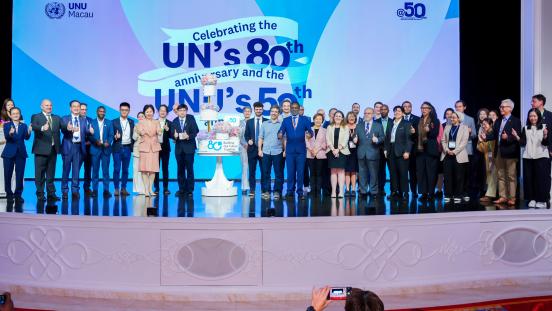
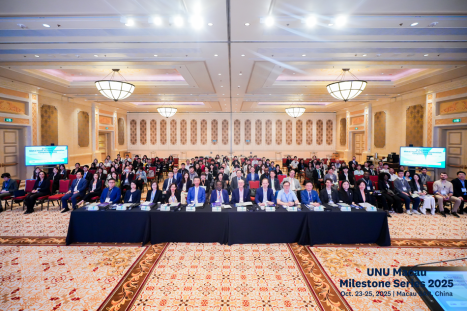
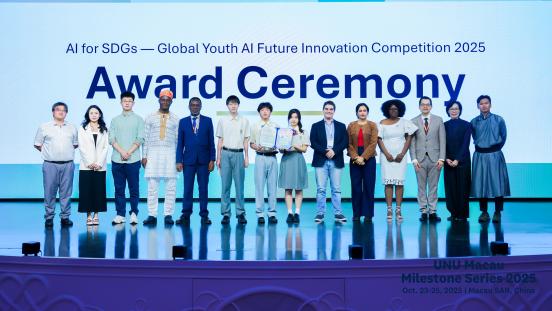
Highlights from the 2025 Competition.
Competition Tracks
The 2026 theme explores the dual role of AI in education: how it can transform educational systems and practices, and how we can equip societies with the AI literacy needed to navigate an AI-driven future. The competition focuses on AI solutions that advance SDG 4 (Quality Education), while also contributing to SDG 9 (Industry, Innovation, and Infrastructure), SDG 10 (Reduced Inequalities), and SDG 17 (Partnerships for the Goals). Track categories include:
1. AI for Education
Leveraging AI to transform teaching, learning, and educational systems—making education more personalized, accessible, inclusive, and effective.
Key AI application scenarios:
- Intelligent tutoring systems and adaptive learning platforms
- AI-assisted curriculum design and content creation
- Automated assessment and feedback systems
- Predictive analytics for student success and early intervention
- Educational administration and resource optimization
- Language learning and translation technologies
- Inclusive education technologies for learners with disabilities
- Teacher professional development and AI-assisted instruction
SDG Reference: SDG 4
2. AI for Social Innovation
Using AI to address systemic social challenges, promote equity, and foster inclusive development through educational empowerment.
Key AI application scenarios:
- AI-powered platforms for equitable access to quality education
- Technologies for bridging the digital divide in education
- AI for lifelong learning and workforce reskilling
- Community-based learning and civic education technologies
- AI tools for combating misinformation and promoting digital citizenship
- Educational technologies for gender equality and social inclusion
- AI for promoting cultural diversity and intercultural understanding
- Data-driven policy tools for educational reform
SDG Reference: SDG 4, SDG 5, SDG 10, SDG 16
3. AI for Less Developed Countries (LDCs)
Developing affordable, accessible, and context-appropriate AI solutions to strengthen education systems, build AI capacity, and bridge the digital divide in less developed countries and underserved communities.
Key AI application scenarios:
- Low-cost, offline-capable AI learning tools for resource-constrained settings
- Mobile-first educational technologies for remote and marginalized communities
- AI literacy and capacity-building programs for educators and youth
- Culturally relevant AI content and curriculum localization
- AI for teacher training and professional development in underserved regions
- Infrastructure-light AI solutions (e.g., SMS-based or voice-activated)
- Community-driven AI education initiatives
- AI for preserving and promoting local languages and knowledge
Requirements
- Global Eligibility: Registration is open to any company, group, or individual worldwide, regardless of nationality or background.
- Technology Maturity: Participating projects must have a Technology Readiness Level (TRL) of TRL 6 or above. This means they must have progressed beyond the laboratory stage, meet the conditions for on-the-ground validation in real-world scenarios, possess close-to-commercial readiness, and demonstrate clear innovation and market potential.
- Enterprise Age: For projects that have already incorporated as an enterprise, the company must have been established for less than 10 years.
- Official Language: The official language for all applications, supporting materials, and assessments is English.
- No Participation Fees: The competition does not charge any registration, training, or other participation fees.
Timeline
The 2026 Global Youth AI Future Innovation Competition consists of three progressive stages: the Initial Round, the Semi-Final Round, and the Global Final. The proposed schedule is outlined below:
- Open Application: Now to September 15th 2026
- Judge Round: September 16 – September 30, 2026 (Mainly Online)
- Semi-final Round: October 1 – October 15, 2026 (Mainly Online)
- Final competition and Award Ceremony in Macau: November 26 2026 (Offline)
Finalist Benefits: Complimentary hotel accommodation will be provided during the global final program in Macao in November 2026. Finalist teams will also have the opportunity to apply for a limited number of travel allowances, valued at up to $1,000 USD per team (before tax).
Notes
Social Innovation: Refers to the application of novel methods, concepts, or technologies to address pressing social challenges and generate positive societal impact. This form of innovation extends beyond commercial or technological boundaries to encompass policymaking, education, environmental sustainability, and social inclusion, with the ultimate goal of improving social welfare and promoting equitable development. Social innovation frequently relies on cross-sector collaboration, bringing together governments, enterprises, research institutions, and local communities to co-create sustainable and inclusive societal solutions.
Technology Readiness Levels (TRL 7–9):
TRL 7: System prototype demonstrated in an operational environment (validated in real-world scenarios).
TRL 8: Actual system completed and qualified through test and demonstration (ready for commercialization).
TRL 9: Actual system proven through successful mission operations and full-scale commercial deployment.
Contact us for more information at ai4sdgs@venturecup.cn
Guided by: United Nations University
Organizer: UNU Global AI Network
Co-organizer: UNU Macau, Venture Cup China
Outreach Partners: Members of UNU Global AI Network