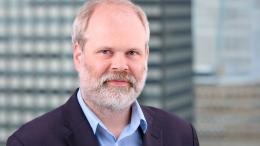


During the Royal Ceremony and Banquet in Stockholm City Hall on 26 August, as part of World Water Week, Professor Kaveh Madani, Director of the United Nations University Institute for Water, Environment and Health (UNU-INWEH), received the 2026 Stockholm Water Prize from His Majesty King Carl XVI Gustaf of Sweden. The prize was awarded to him in recognition of his pioneering contributions to water resources management, governance, diplomacy and public engagement.
Known as the ‘Nobel Prize of Water’, the Stockholm Water Prize is the world’s most prestigious international honor in the field of water. Established in 1991, the Prize is awarded annually by the Stockholm Water Foundation, in cooperation with the Royal Swedish Academy of Sciences, for outstanding contributions to the sustainable use and protection of the world’s water resources. His Majesty King Carl XVI Gustaf serves as the Prize’s official patron and presenter.
Professor Madani is the youngest recipient in the history of the Stockholm Water Prize and the first UN official and former politician receiving this prestigious award, “based on unique combination of groundbreaking research on water resources management with policy, diplomacy and global outreach, often under personal risk and political complexity", according to the Royal Swedish Academy of Sciences Prize Committee.
Professor Madani’s work has advanced the application of game theory and decision analysis to water resources management, demonstrating how competing interests, incentives and institutional constraints shape outcomes in complex water systems. He has also contributed to international understanding of transboundary water challenges and developed science-based approaches to conflict resolution and the sustainable management of shared river basins. “Professor Madani is an internationally renowned water scientist whose career uniquely combines groundbreaking research, courageous public service, and unparalleled global outreach. A rare combination has had lasting significance for water sustainability, governance, diplomacy and justice,” said Professor Ellen Moons, Secretary General of the Royal Swedish Academy of Sciences.
Professor Madani is also globally recognized as the architect of the concept of “water bankruptcy”, a novel framework he developed to describe situations in which water systems have been exploited beyond levels from which historical conditions can realistically be restored. The concept has contributed to a broader discussion on the need to move beyond short-term crisis management towards long-term adaptation, responsible governance and resilience.
“Professor Madani is an extraordinary laureate who uniquely combines the qualities we were looking for as a jury: leading science, the ability to communicate complex ideas, and, importantly, the capacity to translate science into action,” said Professor Line Gordon, Director of the Stockholm Resilience Centre and Member of the Stockholm Water Prize Committee. “His ability to generate new understanding and introduce concepts that change how we think about water challenges stands out. The concept of ‘water bankruptcy’, for example, shows that we are no longer facing only water crises that pass with time, but also systemic and potentially irreversible failures that can have profound consequences for societies. Importantly, this is not a message of despair; it is a call to action.”

Recognition of science in service of society
“Professor Kaveh Madani’s recognition with the Stockholm Water Prize is a proud moment for the scientific community and for the entire UN family,” said Professor Tshilidzi Marwala, Rector of the United Nations University and Under-Secretary-General of the United Nations. “His career demonstrates what is possible when rigorous science is connected to public service, policy and a genuine commitment to society. Professor Madani has shown that water is not only a resource to be managed; it is also a point of connection between people, communities and nations. At a time when the world is increasingly divided, his work reminds us of the importance of building bridges across disciplines, institutions and borders. This is deeply aligned with the mission of UNU: bringing knowledge to bear on the challenges that affect humanity as a whole.”
The Stockholm Water Foundation and the Royal Swedish Academy of Sciences have highlighted Professor Madani’s ability to connect water science with governance and global cooperation. In announcing the Prize, the award jury noted that his work has helped shift global water debates from infrastructure towards governance and has advanced science-based approaches to transboundary water conflict resolution and sustainable river basin management.
“Professor Madani has significantly advanced our understanding of complex water challenges. At a time of growing climate pressures, this knowledge is more important than ever,” said Anette Scheibe Lorentzi, Chair of the Stockholm Water Foundation.
For UNU-INWEH, the recognition also highlights the Institute’s role in connecting scientific research with policy and international action on water. As the UN’s Think Tank on Water, UNU-INWEH works across research, capacity development, policy engagement and knowledge dissemination to bridge the gap between scientific evidence and the practical needs of policymakers and communities.
“Professor Madani’s Stockholm Water Prize is a remarkable recognition not only of his individual achievements, but also of the importance of the work being carried out by UNU-INWEH,” said Alexandra Bugailiskis, Chair of the UNU-INWEH International Advisory Committee. “Over the past years, Professor Madani has brought together scientific excellence, policy engagement and international cooperation in ways that have strengthened the Institute’s contribution to the global water agenda. It is a tremendous moment of pride for the Institute and Canada, and an encouragement to continue building bridges between research, policy and action.”
“Receiving the Stockholm Water Prize is an extraordinary honour, but I see it above all as a recognition of the importance of the work that so many people have done with me and alongside me,” said Professor Kaveh Madani. “Water connects us all, and so should our efforts to understand, protect and govern it. I am deeply grateful to my students, colleagues, mentors, nominators and the communities around the world whose experiences and struggles have shaped my work. I hope this recognition can help reinforce the message that science, cooperation and dialogue remain essential to addressing the water challenges we share.”
The Stockholm Water Prize comes at a time when water challenges are becoming increasingly interconnected with climate change, environmental degradation, development and geopolitical pressures. Professor Madani’s recognition underscores the importance of bringing scientific evidence, policy and diplomacy together to address these challenges and strengthen cooperation around the world’s shared water resources.
For UNU-INWEH, the Prize marks a significant moment in the Institute’s 30th anniversary year and provides renewed momentum for its work to advance evidence-based solutions to global water challenges. Through its international research, partnerships and engagement with governments, UN agencies, academia and civil society, the Institute will continue working to translate knowledge into action for water security, human well-being and sustainable development.

The Stockholm Water Prize
Known as the ‘Nobel Prize of Water’, the Stockholm Water Prize is the world’s most prestigious water award. Since its inception in 1991, it has been awarded annually to individuals and organizations who have made substantial contributions to the sustainable use and protection of the world’s water resources, thereby leading to improved health and well-being of humans as well as ecosystems.
The Stockholm Water Foundation presents the Prize in collaboration with the Royal Swedish Academy of Sciences, with H.M. King Carl XVI Gustaf of Sweden serving as official patron and presenter.
Each year’s laureate is announced around World Water Day in March, then formally honoured at a royal ceremony during World Water Week in August, where the laureate plays a central role in the Week’s celebrations.
About UNU-INWEH
The United Nations University Institute for Water, Environment and Health (UNU-INWEH) is one of 13 institutes that make up the United Nations University (UNU), the academic arm of the United Nations. Known as 'The UN’s Think Tank on Water', UNU-INWEH addresses critical water, environmental and health challenges around the world. Through research, training, capacity development and knowledge dissemination, the institute contributes to solving pressing global sustainability and human security issues of concern to the UN and its Member States.
Headquartered in Richmond Hill, Ontario, UNU-INWEH has been hosted and supported by the Government of Canada since 1996. With a global mandate and extensive partnerships across UN entities, international organizations and governments, UNU-INWEH operates through its UNU Hubs in Calgary, Hamburg, New York, Lund and Pretoria, and an international network of affiliates.