

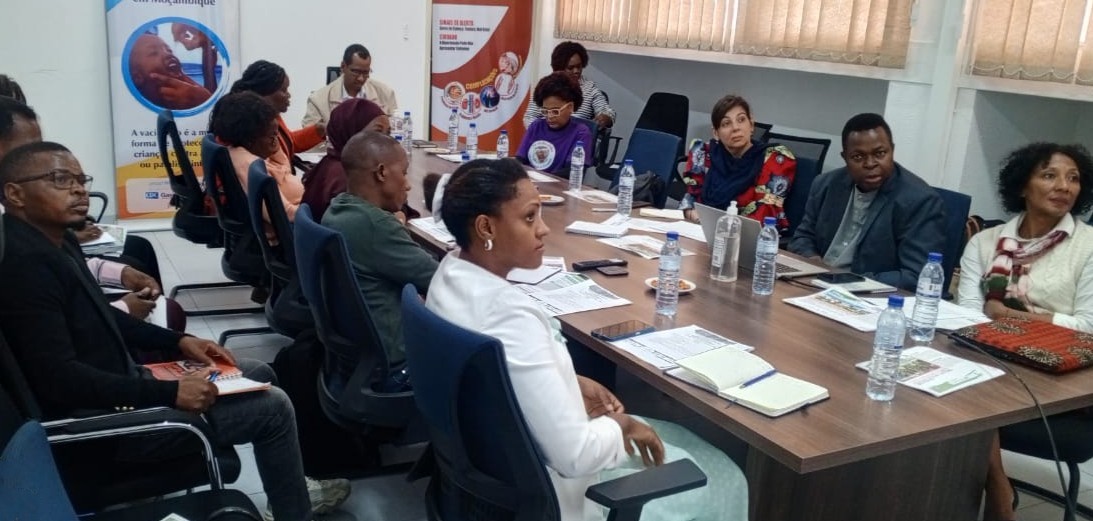
The CPIA Advisory Committee Meeting and Team Building & Advocacy Event, held on 17 November 2025 in Maputo, offered a pivotal moment to reflect on the ambitions and emerging realities of CPIA Phase 2. Bringing together the national CPIA coordination team, Master on Public Health (MHP) students conducting Implementation Research (IR), their academic mentors, senior officials from MISAU (Ministry of Health), and a representative from UNU‑IIGH, the meeting served not only as a coordination milestone—but as a living demonstration of the model CPIA seeks to strengthen.
A Moment That Embodied the CPIA Vision
A nationally led, equity‑driven initiative
Participants from across the Mozambican health system—students, mentors, district representatives, and MISAU leadership—embodied CPIA’s commitment to strengthening locally led policy improvement grounded in a decolonial, Global South–driven approach. The meeting made this especially clear: it was Mozambican actors—not external ones—who led the discussions, identified bottlenecks, and jointly set policy priorities.
Harmonising research, training, and policy engagement
The recruitment, onboarding, and IR training of the six MPH students and their mentors are fully aligned with CPIA’s core objectives. This meeting therefore captured the essence of the CPIA model—signalling a transition from capacity-building, to consolidating research, and now moving toward meaningful policy engagement.
Consolidating Foundations: Reflections From Mozambique’s Progress
During the meeting, participants reviewed the progress of CPIA implementation in Mozambique, reflecting their milestones, including:
- Establishing governance structures and the Advisory Committee
- Signing Memorandums of Understanding (MoUs) with three key partners
- Recruiting and training six MPH students and three mentors
- Delivering the IR module (‘Learn–Apply–Share’)
- Strengthening stakeholder engagement and alignment with national health priorities
- Advancing ethical submissions and preparing for fieldwork
The committee meeting reinvigorated these achievements by bringing all actors together, creating space for:
- Clarifying shared expectations
- Establishing direct feedback channels between MISAU, researchers, and students
- Validating methodological approaches in real time
- Jointly addressing challenges around ethical approvals and fieldwork timelines.
These dynamics reflect CPIA’s methodology, which emphasises participatory validation, strong stakeholder engagement, and continuous alignment with policy priorities.
Strengthening Policy Uptake: The Strategic Value of the Meeting
The meeting served as an effective precursor to one of CPIA’s key emerging outcomes: embedding pathways for policy uptake early in the research cycle. The Advisory Committee—bringing together MoH decision‑makers, partners, and academic supervisors—acted as a platform for:
- Forward‑looking policy engagement
- High‑level dialogue
- Early review of IR questions and indicators
- Ensuring that the research remains relevant and actionable for MISAU.
This committee plays a central role in fostering national ownership and increasing the likelihood that findings will be translated into policy and practice. The Advisory Committee Meeting clearly demonstrated this mechanism in action.
A Platform that Strengthened the Human Infrastructure of CPIA
Beyond technical alignment, the event also had a team-building dimension.
This personal and relational component is critical to CPIA’s model, which emphasises sustainable national leadership and cross-level collaboration.
The meeting strengthened:
- the cohesion of the national coordination team
- the confidence and visibility of MPH students
- the shared identity across researchers, MoH officials, and partners
- motivation to advance into the fieldwork phase
Such relational capital is rarely documented in technical reports yet is indispensable for long‑term CPIA success.
Beyond technical alignment, the event also played an important team‑building role. This personal and relational aspect is central to the CPIA model, which emphasises sustainable national leadership and strong collaboration across all levels of the system. The meeting helped to strengthen:
- The cohesion of the national coordination team
- The confidence and visibility of the MPH students,
- The shared sense of purpose among researchers, MoH officials, and partners, and
- The collective motivation to move into the fieldwork phase.
This kind of relational capital rarely mentioned, yet it is essential for CPIA’s long‑term success.
Conclusion
The 17 November 2025 CPIA Advisory Committee Meeting in Maputo served as a vivid illustration of the CPIA model in practice. It showcased:
- Nationally led coordination
- Embedded policy engagement
- Strengthened research capacity
- Multisectoral collaboration
- Adaptive, reflective problem‑solving, and
- The creation of sustainable and equitable pathways for Adolescent Sexual and Reproductive Health policy improvement.
This event stands out not only as an important milestone, but also as a powerful reminder that CPIA’s principles are not merely conceptual—they are actively taking root in the everyday work, relationships, and aspirations of the teams leading implementation.
For further information about CPIA project, please kindly contact UNU-IIGH's Project Coordinator Paula Morgado at: paula.morgado@unu.edu
Suggested citation: "Reflecting on the CPIA Project Through the Lens of the 17 November 2025 Maputo Advisory Committee Meeting," UNU-IIGH (blog), 2026-05-05, 2026, https://unu.edu/iigh/blog-post/reflecting-cpia-project-through-lens-17-november-2025-maputo-advisory-committee.