

The Economic Research Institute for ASEAN and East Asia (ERIA), in collaboration with the United Nations University International Institute for Global Health (UNU-IIGH), co-hosted a closed-door Roundtable Discussion on Indonesia’s Response to the Changing Global Health Landscape at the ERIA Office in Jakarta, Indonesia.
The event brought together Indonesian policymakers and selected experts to discuss recent developments in global health governance, Indonesia’s position on the mandate of the World Health Organization (WHO) and other international institutions, as well as opportunities to strengthen national health security through regional and South-South cooperation.
The roundtable was held against the backdrop of the COVID-19 pandemic and shifting geopolitical dynamics, which have underscored that resilient health systems and global health security depend on effective governance and international cooperation. This need is further amplified by interconnected challenges, including climate-related health risks, migration, antimicrobial resistance (AMR), and commercial determinants of health, amid the evolving multilateral order.
These developments demand stronger dialogue, trust, and partnerships to safeguard public health, while Indonesia’s National Health Transformation Agenda reflects the country’s commitment to advancing health cooperation.
Representing ERIA, Dr. Manami Uechi, Director of Health and Social Welfare, opened the roundtable by delivering a presentation on ERIA’s role and ongoing initiatives. She highlighted projects under ERIA’s Health and Social Welfare Unit, including diagnostics as one of the ASEAN-wide flagship health projects, social welfare programs, and Medial Excellence in Asia initiatives. Dr. Uechi also reaffirmed ERIA’s support in strengthening Indonesia’s capacity and role in global health governance as one of the ASEAN Member States.
Prof. David McCoy, Policy Research Lead at the UNU-IIGH, then provided an overview of the United Nations University. He explained that the UNU is a UN body comprising a network of 14 academic institutes that serve as a bridge between the international academic community and policy makers. He emphasized UNU-IIGH’s mission to reduce inequalities in global health and thanked ERIA for co-organizing the event.
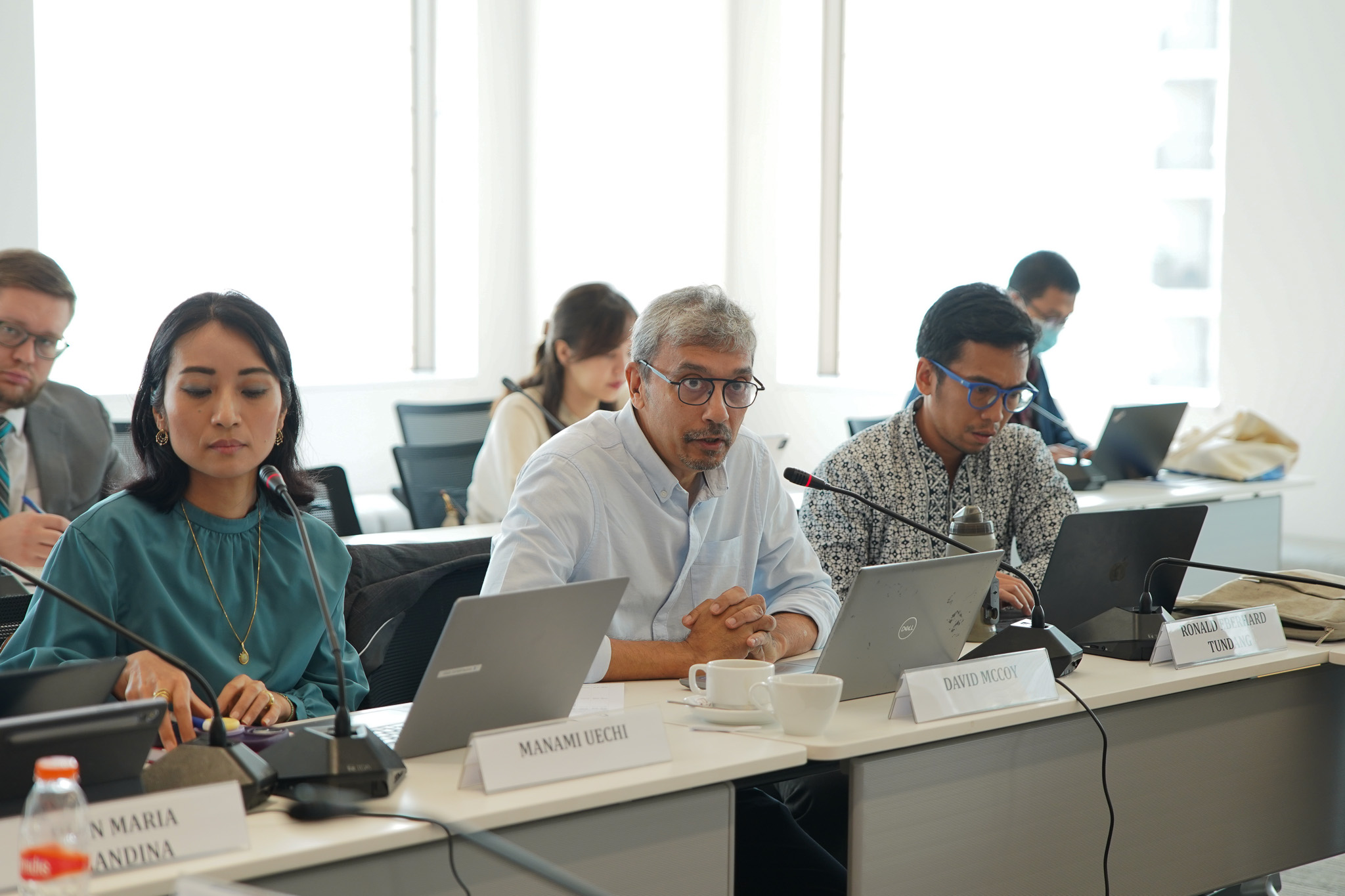
Following the opening session, UNU-IIGH led in-depth discussions on two inter-connected topics. The first was on global health governance, focusing on multilateral institutions, geopolitical dynamics, and the global health financing architecture. The second addressed regional health governance and platforms, covering the WHO South-East Asia Regional Office (SEARO) / Western Pacific Regional Office (WPRO), ASEAN, and broader Southeast Asian mechanisms.
Both sessions featured comprehensive and interactive discussions, with participants actively exchanging views and sharing perspectives. The participants also welcomed the opportunity to address the key issues and expressed a desire to continue the dialogue, so that Indonesia could maximize its full potential to be a responsible and cooperative leader in regional and global health. The workshop concluded with a summary of key themes by the moderator, followed by a networking session among participants.
Suggested citation: "ERIA and UNU-IIGH Address Indonesia’s Response and Regional Cooperation in a Changing Global Health Landscape," United Nations University, UNU-IIGH, 2026-04-28, https://unu.edu/iigh/article/eria-and-unu-iigh-address-indonesias-response-and-regional-cooperation-changing-global.