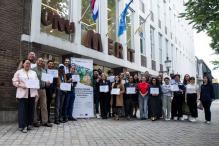


As the United Nations and international organizations face growing demands amid tightening budgets, experts gathered at a workshop convened by the United Nations University Centre for Policy Research's (UNU-CPR) Global Governance Innovation (GGI) Platform to examine practical approaches for strengthening the financial foundations of multilateral cooperation.
The discussion drew on UNU-CPR's recent report, Moving from Crisis Management to Resource Mobilization in the UN80 Process, which argues that the central challenge facing the UN is no longer simply managing recurring financial crises, but identifying sustainable and diversified ways to mobilize resources for international cooperation.
Bringing together representatives from Member States, UN entities and international organizations, the workshop explored lessons from existing financing innovations across the multilateral system and considered how these experiences could inform the UN80 process.
Participants highlighted the UN's unique role as a trusted convenor, noting that its transparency, legitimacy and convening power can help enable new financing arrangements and partnerships. Discussions also underscored the growing importance of catalytic financing mechanisms that can shift perceptions of risk and unlock investment in underserved markets and sectors.
The workshop examined a range of innovative financing approaches already being implemented across the multilateral system. These included the Office for the Coordination of Humanitarian Affairs' (OCHA) indemnity insurance initiative and emerging UN Disaster Risk Financing Platform; UN-Habitat's efforts to unlock city finance through blended partnerships and peer exchange; and the International Fund for Agricultural Development's (IFAD) pioneering AA-rated institutional bond issuance, with proceeds directed entirely to development programmes.
Participants also discussed the Climate Investment Funds' use of pass-through structures to access capital markets, the Basel, Rotterdam and Stockholm Conventions Secretariat's efforts to finance PCB elimination through capital market mechanisms, UNICEF's CryptoFund, and UNHCR's Global Islamic Fund for Refugees, which mobilizes Islamic social finance to support displaced populations.
Additional examples highlighted the experience of the United Nations Capital Development Fund (UNCDF), where relatively small catalytic interventions have helped unlock larger flows of investment in high-risk and underserved markets.
The workshop forms part of UNU-CPR's broader work on innovative resource mobilization and multilateral financing reform, contributing evidence and practical lessons to ongoing discussions about the future financing of the UN system.
Read the report, Moving from Crisis Management to Resource Mobilization in the UN80 Process, here.
Read the workshop's concept note here.