

While there are many reasons to take action now to work for a better future, it may provocatively be asked what has the future ever done for us? The Future Library project in Oslo, Norway, an art project initiated by the Scottish artist, Katie Paterson, in 2014, may offer some answers.
The library – which will operate for 100 years – carefully selects an author each year to contribute a text. The text, which will not be accessible until the year 2114, will be printed on paper produced from the wood of trees planted to the north of Oslo in 2014. In a way, as Paterson put it in Oslo, “the trees are holding the words of the authors”.
Last June, I went to find out more about this intriguing and visionary project, attending the handover ceremony of manuscripts produced by authors Tommy Orange and Amitav Ghosh to the City of Oslo. The event was held outside Oslo in the middle of the forest where the very trees used to make their books are still growing. About 150 people witnessed this event, which featured music and short speeches by Paterson, Orange, Ghosh and others. A second ceremony was held on the same day in the Deichman Public Library in central Oslo, where the texts of the Future Library are securely stored in a specially designed room on the top floor.
The Future Library project is part of the Association of Long-Term Art Projects (LTAP), comprising 29 projects around the world, which all promote long-term thinking to avert anticipated global doom and belong to a growing number of future-oriented culture and heritage projects.
Several custodians of LTAPs and committed volunteers were present in Oslo, assembling the next day for a symposium dedicated to the question: “What can art do for the future?” It became clear that this was a community full of hope and trust in the future.
Marianne Borgen, the former Mayor of Oslo, stated from the podium that “we cannot overestimate the power of culture”.
Amitav Ghosh described in a text why the Future Library project appeals to him: “It demands a conception of time that is completely different from the short-term temporal frameworks that have brought the planet to the brink of catastrophe”.
Tommy Orange (commissioned for 2024) admitted in Oslo that he wasn’t normally thinking about Norwegian readers in a hundred years. He called on his son Felix, aged 15, who stated bluntly: “I am in fact the future.” He went on to call for more kindness: “Kindness will hopefully lead to a better future.”

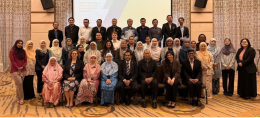
Handover ceremony of two texts by Tommy Orange and Amitav Ghosh for the Future Library, held on 28 June 2026 in the forest north of Oslo.
Indeed, there was a general sentiment in the crowd that by thinking about the long-term consequences of our actions today, and by reminding ourselves to consider the interests of future generations, we will do what we know is right. All it takes, they appeared to agree, is to feel the emotional duty to start making the necessary changes towards a better future. Maybe other emotions will also emerge when it transpires that people have different views of what is right and what changes need to be made for a better future.
The Future Library project may or may not be continued for a full century. The City of Oslo, the Deichman Public Library and the forest north of Oslo – all essential to the project’s continuation – may no longer exist in quite the same way in 2114, complicating the accomplishment of what was originally envisaged. Perhaps, for instance, the Future Library will have been abandoned by those running it when they feel the library no longer addresses a long-term future. The project in 2114 will certainly not be the same as it was in 2014 and what it is in 2026. After all, nothing ages faster than the future.
But, at least for now, the long-term future envisaged by the Future Library can clearly lift spirits, mentally inspire and emotionally engage a large community of people. Despite the uncertainty of so many essential parameters of the project, and the shared assumption of a doomed future, the project can give people a sense of hope and positivity about the future, in Oslo and elsewhere. One project volunteer left a special message on a wooden board placed in the car park from where we were hiking to the handover ceremony in the forest: “long-term art is my religion.”

The dedicated Future Library in the Deichman Public Library in Oslo contains a growing number of inaccessible manuscripts to be published in 2114.
Maybe it is the sheer audacity of daring to lock up manuscripts for a century, coupled with the gesture of planting tree seedlings and caring for growing trees, combined with well-staged regular ceremonies, that generate a strong sense of collective commitment for the present and the future. Certainly, the bonds among the group members and the sense of community that is shared among the LTAP members are significant. They have become, as somebody put it, “a wonderful family”.
The Future Library project will continue as long as the people contributing to it find it meaningful, one year at a time. “[A]s long as we feel this, we will continue,” said one of the key supporters. Maybe it is the meaning and hope created by contributing to a shared, visionary project for a future beyond our lifetime that matters the most, not a 100-year-tradition and the actual books released in 2114. The hopes and commitments of those contributing to the Future Library may be helping to shape the future they imagine – for themselves and for the audiences who follow the project during the years ahead.
As Merete Lie, Director of the Deichman Public Library, put it, this is a project about who we are, where we are heading and the kind of future we want.
That so many people continue, year after year, to invest in the Future Library project and the other LTAPs is itself a reason for optimism. If the future offers us anything in the present, perhaps it is hope – and that is no small gift.
Cornelius Holtorf is Professor and Chairholder, UNESCO Chair on Heritage Futures, Linnaeus University, Sweden.