When people talk about multilateralism, they usually think about countries working together. My experience over the past two years has reminded me that multilateralism also happens in a much more practical way: through people and institutions bringing different forms of expertise together around a shared challenge.

I have seen this firsthand through my work with the Knowledge Project of UNDP's Regional Bureau for Arab States, supported by the Mohammed bin Rashid Al Maktoum Knowledge Foundation (MBRF). In 2025, I served as Lead Knowledge Expert for the revision of the Global Knowledge Index (GKI). This year, I am continuing as Lead Expert and Strategic Adviser for the GKI 2026 report.
At first glance, revising a global index may seem like a highly technical exercise. In reality, it raises much bigger questions. What capabilities do countries need to thrive in a rapidly changing world? What roles do education, innovation, digital technologies, governance and sustainability play in development? And how can we measure progress in ways that are both analytically robust and meaningful for policymakers?
These questions are becoming increasingly important. We live in a world shaped by digital transformation, rapid technological change, climate pressures and shifting labour-market demands. Knowledge has become one of the most important resources countries possess, yet it is also one of the most difficult to measure.
One of the things I have learned through my work on the GKI is that knowledge goes far beyond education. Strong knowledge systems depend on many interconnected elements: quality schools and universities, opportunities for skills development, research and innovation capacity, digital infrastructure, economic dynamism, and institutions that enable knowledge to be created, shared and applied. The challenge is not only to understand these components individually, but also to understand how they interact.
This is what makes the Global Knowledge Index particularly valuable. Covering 195 countries, the GKI provides a framework for examining knowledge development across six dimensions: pre-university education; technical and vocational education and training and higher education; research, development and innovation; information and communication technologies; the economy; and environmental, social and governance performance.
What interested me most during the 2025 revision was not simply improving an index. It was the opportunity to rethink how we understand knowledge in today's world.
My role involved reviewing the existing framework, identifying gaps, incorporating emerging global trends, coordinating discussions among international experts, and bringing a wide range of perspectives together into a coherent methodology. The revision significantly streamlined the framework while strengthening its conceptual foundations and policy relevance.
What made the process particularly rewarding, however, was the collaboration behind it.
I worked closely with the Knowledge Project team and experts from different fields, including education, innovation, sustainability and statistical methodology. Everyone brought a different perspective. There were extensive discussions about what matters most, what can realistically be measured, and how to balance conceptual ambition with practical constraints.
Those conversations reinforced something I have observed throughout my career: complex problems rarely fit neatly within disciplinary or organisational boundaries. Some of the most valuable insights emerge precisely when different perspectives are brought together.
That is also where I see the value of the collaboration between UNU-MERIT and UNDP.
As a researcher, I bring analytical and methodological expertise, together with experience studying innovation, education, skills and knowledge systems. UNDP brings a different but equally important perspective: a deep understanding of policy challenges, close engagement with governments, and the ability to connect global evidence with real-world development priorities.
Neither perspective is sufficient on its own. Research without policy engagement risks remaining academic. Policy without strong evidence risks being driven by assumptions rather than insights. The real value emerges when the two are brought together.
This lesson has become even more apparent in my current role supporting the development of GKI 2026. The focus is increasingly not only on measurement itself, but also on understanding the broader forces shaping knowledge development and translating evidence into meaningful policy narratives.
How can countries strengthen their innovation ecosystems? How can education systems prepare learners for technological change? How can digital transformation contribute to more inclusive and sustainable development?
These are not isolated questions. They are interconnected challenges that require integrated responses.
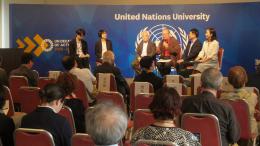
One of the highlights of this journey was participating in the Knowledge Summit in Dubai in 2025, where I moderated the session launching the revised GKI. Listening to policymakers, researchers and practitioners discuss the findings reminded me that indicators are not an end in themselves. Their value lies in stimulating dialogue, encouraging learning and helping countries reflect on their future development pathways.
Perhaps that is the most important lesson I have taken from this collaboration.
Good indicators do more than measure performance. They create a common language. They allow people from different countries, sectors and professional backgrounds to discuss shared challenges and learn from one another.
In that sense, knowledge measurement is not simply a technical exercise. It is a form of international cooperation.
My work with UNDP has shown me that some of the most meaningful forms of multilateralism happen far from negotiating tables. They happen through the patient work of building evidence, bringing together different forms of expertise, challenging assumptions and creating shared understanding around complex global challenges.
In a world that often feels increasingly fragmented, research institutions and international organisations can make an important contribution by helping to build that shared understanding. Being part of this effort has been a valuable and rewarding experience, and I look forward to continuing to contribute to this work.
Suggested citation: Hugo Hollanders., "Measuring what matters: What working with UNDP on the Global Knowledge Index taught me about multilateralism ," UNU-MERIT (blog), 2026-10-23, 2026, https://unu.edu/merit/blog-post/measuring-what-matters-what-working-undp-global-knowledge-index-taught-me-about.