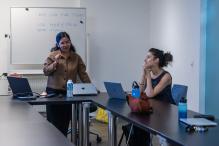
Overlooking the city of Bonn from the 23rd floor of UNU-EHS, the day started off full of energy. Prof Dr. Zita Sebesvari, Deputy Director of UNU-EHS welcomed researchers from across the UNU network, including colleagues from UNU-CRIS, UNU-EHS, UNU-IIGH and UNU-MERIT. This gathering follows in the steps of years of tradition
as colleagues both old and new reconvened at UNU-EHS to share their research across a breadth of disciplines centered on migration. The discussion from the outset was lively, fuelled by collegial familiarity and diverse backgrounds.
The day was organised into four thematic panels: Border Governance, Data and Theory in the Mapping of Mobility, Migration and Digital Technologies, and Experiences of Labour Migration. Each panel combined presentations with open Q&A, leaving room for the cross-disciplinary exchange that has become the foundation of the symposium.
Governing Borders, Framing Migration
The first panel, chaired by Rob Oakes, looked at how migration and borders are governed. Valeska Onken, presenting her research with Melissa Siegel and Dirk Jan Koch, examined EU–Africa cooperation to prevent irregular migration, tracing the gap between intended outcomes and unintended effects from the context of the Valetta Action Plan. Ishita Ishita presented a policy support system for climate displacement, tested through African case studies. Emma Clarke turned to political discourse, analysing how immigration rhetoric from the mainstream in Ireland has shifted since the pandemic, and whether the promise of a "firm and fair" system holds up. Together, the talks highlighted the various disconnects between media narratives, formal agreements and policies on the ground.
Making Mobility Visible
The second panel, chaired by Nidhi Nagabhatla, returned to a question that ran through last year's symposium: how do we capture migration in data and theory? Ann-Christine Link built on her earlier work on planned relocation in Fiji, presenting insights from global and European databases on climate-related relocation and retreat. Georgina Sturge took a historical view, showing how identity and classification have shaped the counting of migrants in the British census since 1801. Robert Oakes introduced an agent-based model of migrant aspiration and capability, offering a way to simulate how individual decisions to move or stay take shape. The panel moved from centuries of census records to computational modelling and was a reminder that what we measure determines what we can see.
Migration in a Digital World
After lunch, Melissa Siegel chaired a panel on migration and digital technologies. Claudia Abreu Lopes (on behalf of Khadijah Syed Razif, Hein Thu, Daisy Taylor and Masami Fujita) presented a scoping review of how AI and digital technologies can widen diagnostic access for migrant populations, guided by the WHO Essential Diagnostics List. Nidhi Nagabhatla and Sanae Okamoto continued their work on climate-induced mobility and mental health, now looking at transnational realities and AI-driven insights. Talitha Dubow closed the session with research on remote work among migrants fleeing conflict and political insecurity, reminding us that for some, “My work is in my pocket.”
Several of these projects were presented as early-stage ideas or pitches at last year's symposium, and it was encouraging to see them return as developed research. This is exactly the kind of continuity the network is designed to foster.
Experiences of Labour Migration
The final panel, chaired by Ann-Christine Link, centred on the lived experiences of labour migrants. Ana Filipa Candido explored the "belonging paradox," looking at how social circles and social remittances connect to development. Nidhi Nagabhatla (on behalf of Aneeta Shajan and Santosh Vijaykumar) made the case for migrant health as a governance priority, drawing lessons from South–South labour corridors. Gurbani Kaur rethought what upward mobility means for women moving from village to city life on Bangalore's peri-urban fringe. These presentations brought the day's broader questions about governance, data and technology back to the individual and community level.
Looking Ahead
The symposium closed with a discussion of next steps and opportunities for future collaboration. As in previous years, what stood out was not any single project but the conversations between them. Health researchers, climate experts, policy analysts, historians and modellers all approached migration from their own angle, and the result was a richer picture than any one perspective could offer alone, reminding us that at its core migration studies are a thread that run through countless different disciplines.
Watching ideas and outlines pitched one year return as fully fledged projects the next showed that the UNU Migration Network works as real research community, that thrives in collaboration and with the exchange of ideas. We look forward to seeing where these collaborations lead before we meet again in 2027.
Suggested citation: Emma Clarke, Gurbani Kaur., "Mapping, Governing, Connecting: Highlights from the 2026 UNU Migration Network Research Symposium ," UNU-MERIT (blog), 2026-09-25, 2026, https://unu.edu/merit/blog-post/mapping-governing-connecting-highlights-2026-unu-migration-network-research.