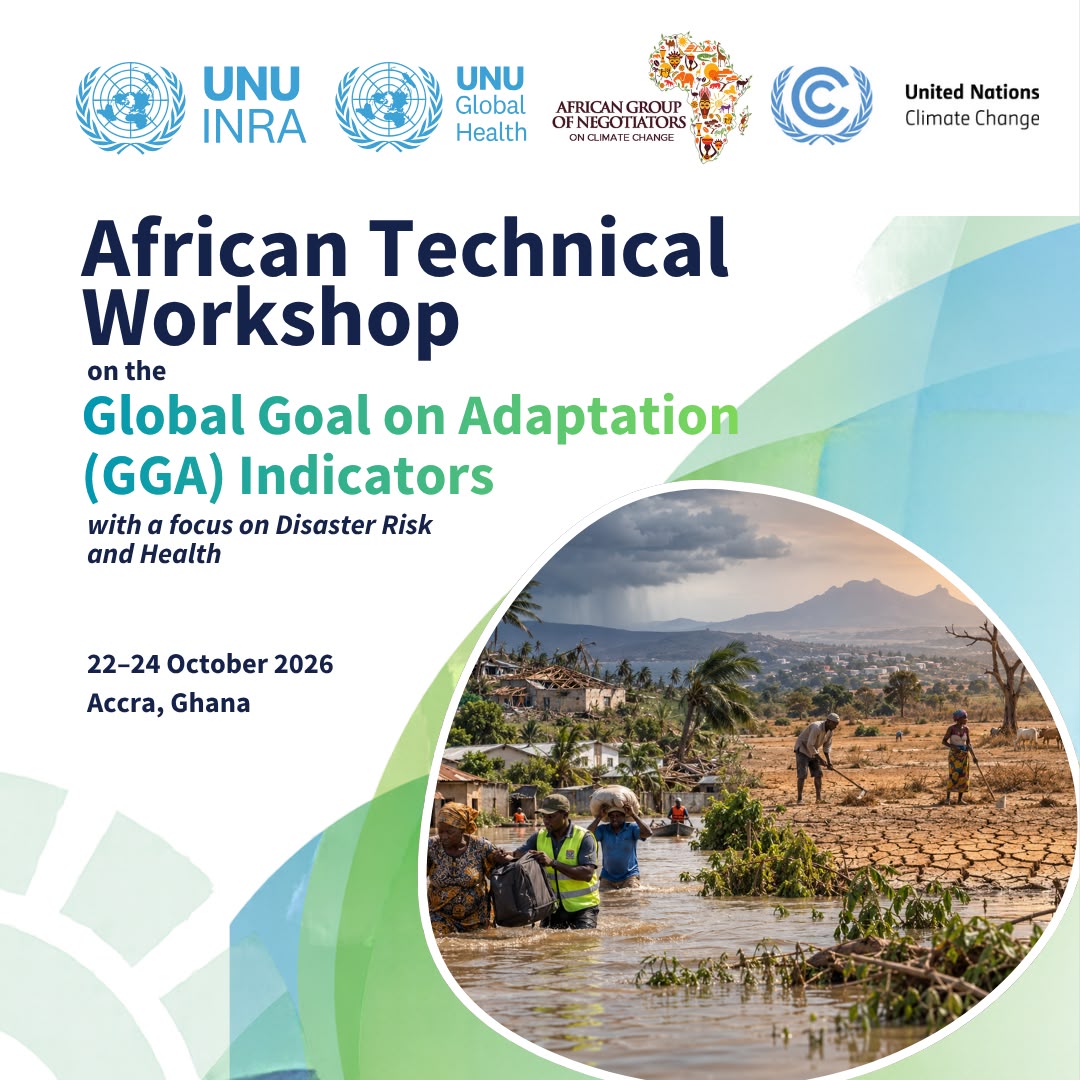
At COP30/CMA7 in Belém in November 2025, Parties adopted the 59 Belém Adaptation Indicators to support tracking of progress towards these targets.
While this provides a common framework, adaptation remains highly context-specific. Countries differ in their climate risks, development priorities, institutional capacities and data systems.
The key challenge is therefore implementation: understanding how the indicators relate to national adaptation plans, sector strategies, reporting systems and existing data; determining what can already be measured; and identifying methodological, institutional and capacity gaps. It is equally important to assess whether the indicators adequately reflect countries’ own adaptation ambitions and intended outcomes.
Against this background, UNU-INRA and UNU Global Health are proposing a technical training workshop ahead of COP31, in collaboration with , the AGN and the UNFCCC Secretariat. Ghana will serve as the pilot country, providing a practical setting to test the indicators against a national adaptation framework while strengthening the capacity of African officials and negotiators.
The workshop will also reflect a One UNU approach, combining UNU-INRA’s expertise in African climate policy, adaptation and development with UNU Global Health’s expertise in climate and health, supported by AGN and UNFCCC secretariat technical input.
Purpose
The workshop will provide a practical, country-led platform for translating the GGA indicators into national implementation. Using Ghana as the pilot, participants will assess how national adaptation ambitions reflected in the NAP and relevant datasets align with the GGA targets and indicators. The exercise will identify where the indicators are relevant and measurable, where data and institutional gaps remain, and where important national adaptation outcomes may not be fully captured.
The Ghana pilot will also provide practical lessons for officials from other African countries, helping to inform how the GGA indicators can be applied in different national contexts and support wider African engagement on GGA implementation in the lead-up to COP32.
Objectives
The workshop will:
1. Strengthen the capacity of African government officials and negotiators to understand the GGA indicators and their implications for national adaptation planning, implementation, monitoring and reporting.
2. Assess how well the GGA indicators reflect nationally determined adaptation
ambitions, using Ghana as the first pilot and drawing on its NAP and other relevant national frameworks.
3. Test the fitness and practical measurability of the indicators, including data availability, methodologies, institutional responsibilities and appropriate levels of disaggregation.
4. Identify implementation gaps and areas for refinement, including national priorities or adaptation outcomes that may not be adequately captured by the indicators.
5. Develop a replicable African methodology and training blueprint that can support subsequent country-level GGA implementation exercises across the continent.