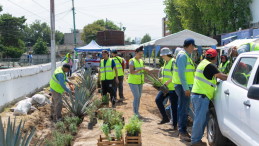


Belém, Brazil — The House of No Waste (HØW) initiative was featured prominently at a joint UNU-FLORES and UN-Habitat session at the COP30 Cities & Regions Hub, inviting next-generation architects, engineers, designers, and scientists to creatively contribute to circular and Nexus-driven urban development. Through its competition format, the initiative advances public infrastructure solutions that close material loops, prioritize sustainability from the outset, and translate circularity into practical design choices.
Opened by UNU-FLORES Director Prof. Edeltraud Guenther, the session explored among others one key question: How can cities apply the Resource Nexus approach to design integrated policies that drive climate mitigation, bolster adaptation, and advance the Sustainable Development Goals simultaneously? In her keynote, she introduced the Resource Nexus as a framework for addressing persisting fragmentation in urban planning. By integrating water, energy, land, materials, waste, and climate considerations, the Nexus enables cities to craft systemic, multi-benefit policies that respond to the interconnected challenges of rapid urbanization.
“Finally, we have to keep in mind there’s no one-size-fits-all formula - in research we call this context-specificity. The specifics will vary depending on local context, political systems, and stakeholder involvement. Culture plays a crucial role. But at the core, encouraging integrated, systems-oriented governance, enhancing equity and inclusion, and fostering participatory decision-making are key steps to leveraging the Resource Nexus to transform cities sustainably,” said Isabela de Paula Salgado, UNU-FLORES doctoral researcher who spoke on the panel alongside Edmar Almeida (PUC-Rio), Vladimir Iszlaji (ABRAINC) and Lea Ranalder (UN-Habitat).
The COP30 session, coordinated by HØW project manager, Atiqah Fairuz Salleh, on behalf of UNU-FLORES, builds on the emerging collaboration between UN-Habitat and UNU-FLORES, following the signing of the Letter of Intent at the Dresden Nexus Conference earlier this year.
Suggested citation: "Driving Circular Urban Futures: House of No Waste and the Resource Nexus in Focus at Joint UN-Habitat & UNU-FLORES COP30 Session ," United Nations University, UNU-FLORES, 2025-11-25, https://unu.edu/flores/article/driving-circular-urban-futures-house-no-waste-and-resource-nexus-focus-joint-un.