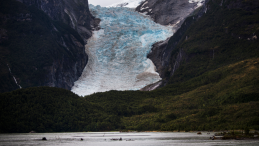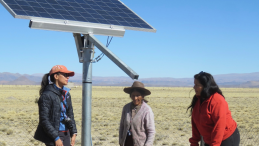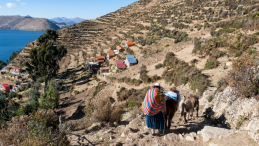


As glaciers worldwide disappear before our eyes, people everywhere are feeling the far-reaching implications, from mountain communities all the way downstream to those living in coastal areas. People experience affected water systems and livelihoods, while living with increased disaster risk.
To learn more, we talked with Dipesh Chapagain of the Global Mountain Safeguard Research programme (GLOMOS), a joint division of UNU-EHS and Eurac Research, to explore why glaciers matter to everyone and not just those living in high-altitude regions. Dipesh grew up in Nepal, giving him both scientific expertise and lived experience of how important glaciers are.
How does your work at GLOMOS relate to glaciers?
Glaciers are at the heart of what we do. We work closely with mountain communities, studying how melting ice affects their lives. Recently, we looked at glacial lake outburst flood (GLOF) risks in the Hindu Kush Himalaya, trying to understand the scale of risks and response strategies adopted by the countries. With 2025 marking the International Year of Glaciers Preservation and the start of the Decade of Action for Cryosphere Sciences, this work is only becoming more urgent.
Why are glaciers a central focus in mountain resilience discussions?
Glaciers are one of the clearest visible indicators of climate change. When they melt, they affect everything connected by water: agriculture, energy production by hydropower, ecosystems and livelihoods – both in the mountains and far downstream. Take South Asia, for instance. Countries like Nepal and Bhutan face GLOF risk, but people living in downstream areas in Bangladesh, with no glaciers of their own, depend heavily on that water and also suffer the impacts of sedimentation and even sea level rise. The melting of glaciers is a global issue, not a remote one.
What trends have you observed in glacier retreat?
Mountains warm faster than other regions, a phenomenon known as elevation-dependent warming. That leads to rapid melt. Unlike seasonal snow, glaciers are permanent ice masses. However, with more melting and less accumulation, many smaller and lower-altitude glaciers are disappearing. That initially increases river flow, but eventually leads to water scarcity, a tipping point known as peak water. Peak water has already been passed or is expected to occur within the next ten years in smaller glacier regions in Central Europe, western Canada or South America. Even glaciers on Asia’s highest peaks are predicted to reach peak water around the middle of this century. The 90,000+ glaciers of the Himalayas, Karakorum and Hindu Kush mountains are at risk, along with nearly 870 million people who rely on them.
People often see glacier melt as a distant issue. What are some of the less obvious interconnected risks?
Glacier melt is already changing how we generate energy. In countries like Bhutan and Nepal, hydropower plants can produce more electricity right now because of increased water flow from glaciers melting. However, these projects are meant to last generations. If the glaciers disappear, so will that water. GLOFs also bring debris that clogs dams and destroys infrastructure. All this increases financial risks associated with large hydropower investments and can pose significant threats to national economies.
How does the loss of glacial water storage affect agriculture and livelihoods, especially in the dry season?
Glaciers act like natural water tanks, releasing water during hot and dry seasons. Without that steady melt, both agriculture and daily water needs become harder to sustain. But warming is also turning snowfall into rain. Snow rests and slowly recharges groundwater, but rain runs off quickly. In high-altitude villages, springs are drying up and people are walking farther each day just to collect water. Some are even being forced to leave their homes altogether.
What strategies have shown promise in reducing glacier-related risks?
Monitoring and early warning systems are crucial, especially for glacial lakes. Most efforts focus on a few larger lakes, but smaller, more numerous ones pose serious risks too. The May 2025 avalanche in the Swiss Alps completely wiped out a village, yet saw zero casualties because effective monitoring allowed evacuation. If a similar event happened in the Andes or the Himalayas, where early warning systems are less advanced, the outcome could be very different. The challenge is that monitoring requires technology and funding, which many countries lack.
With glaciers retreating faster than ever, what gives you hope?
I am encouraged by growing global awareness. This sense of shared urgency is pushing stronger mitigation and adaptation efforts. We also see progress in risk assessment and future-proofing infrastructure. Early warning systems and weather forecasting are improving, and people recognize that reducing exposure and vulnerability through education, diversified livelihoods and insurance is just as important as understanding hazards. These shifts give me hope, yet the current level of action still falls short of what is truly needed.