

On Saturday, 21 March, the United Nations University – Operating Unit on Policy-driven Electronic Governance (UNU-EGOV) welcomed nearly 100 participants, including students and teachers, to the National Meeting of Junior Ambassadors (EPAS), an initiative held in Guimarães that brought together students from European Parliament Ambassador Schools across the country.
During the visit, the Director of the UNU‑EGOV, Delfina Soares, presented the Unit’s mission, key areas of work, and its contribution to digital governance at both national and international levels.
Delfina Soares also underscored the importance of the English language as a gateway to new opportunities, encouraging students to persevere and never give up on their aspirations. “It is my hope that one day, if you so choose, any one of you will be able to work at the United Nations, or at any other international institution of your choice”, she stated.
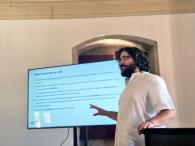
The visit also featured an interactive session designed to actively engage students and prompt reflection on contemporary challenges related to governance, civic participation, and digital transformation. Through three different scenarios, students were invited to decide how the use of Artificial Intelligence should be regulated, highlighting the importance of accountability and balance in digital governance.
The event was attended by Isabel Baltazar, National Coordinator of the EPAS Programme and holder of the UNESCO UniTwin Chair "City that Educates and Transforms".
EPAS: “Digital Transition in Europe – Innovating responsibly, deciding with knowledge”
The National Meeting of Junior Ambassadors took place on 20 and 21 March and was organised by Colégio do Ave, with the support of Guimarães City Council. Activities were primarily held at Colégio do Ave and at the Jordão Theatre, bringing together schools from across the country. The initiative was designed to strengthen young people’s connection to institutions and political life, at a time when many feel increasingly distant from civic and democratic engagement.
“We believe that visiting and becoming familiar with the UNU-EGOV plays a crucial role in achieving the objectives of this initiative, allowing participants to better understand how institutions operate, to meet those working within them, and to recognise that their voices and concerns can have a meaningful impact on society in many different ways”, explained Vítor Pereira, teacher at Colégio do Ave.
With registrations from 12 schools nationwide, the initiative provided a platform for direct dialogue among young people, schools, and the political community, promoting active, informed, and responsible citizenship. Beyond the event itself, it sought to inspire a generation of young people committed to democratic and European values.
The central theme of the programme, “Digital Transition in Europe – Innovating responsibly, deciding with knowledge”, focused on the challenges and opportunities of Digital Transformation, Artificial Intelligence, Data Protection, and Digital Literacy.
The programme included networking opportunities between schools, collaborative activities, debates and reflection sessions, as well as a thematic discussion on digital innovation and the role of the European Union.
Speakers included Luís Marques Mendes, candidate for the Presidency of the Portuguese Republic, Paulo Cunha, Member of the European Parliament (MEP), and Irene Costa, Member of the Portuguese Parliament, whose contributions helped to enrich the dialogue between young people and decision‑makers.