

Nearly a century after GDP became a shorthand for economic health and progress, its limits are becoming impossible to ignore. As its creator Simon Kuznets himself warned, "The welfare of a nation can scarcely be inferred from a measurement of national income." And in a world shaped by climate shocks, widening inequality, fragility and rapid technological change that warning appears increasingly salient; demanding a philosophical shift in how we view and measure quality of life and advancement, and develop policies in response.
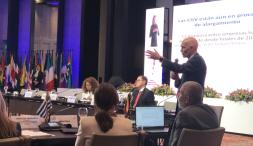
It’s a shift that appears to be gaining traction at the United Nations. At the 2025 United Nations General Assembly, for instance, in response to a call agreed by Member States in the Pact for the Future, a High-Level Expert Group (HLEG) on Beyond GDP was appointed, mandated to develop "a limited number of country-owned and universally applicable indicators of sustainable development". The Group’s interim report, published in November at the World Social Summit, argued that moving beyond GDP is not about abandoning economic measurement, but about redefining progress in a way that reflects what truly improves people’s lives, today and for future generations. Below, we share one of our principal reflections on the interim report and the second meeting of the HLEG that followed on 15–16 January in Geneva.
A Moment of Fraught Opportunity
The report’s Beyond GDP framework offers an opportunity to surface the invisible: the well-being of people, planet and future generations; a notion increasingly reflected in the policies and measurement approaches of several countries and organizations, including the Organisation for Economic Co-operation and Development.
Unfortunately, this momentum is not reflected everywhere. Some countries are questioning the very notion of sustainable development, dismissing equity objectives and prioritizing economic growth over human progress. Others fear that decentering GDP metrics signal economic weakness or reduce competitiveness, especially where well-being indicators reveal environmental or social costs not captured by traditional growth measures. Finally, there’s a risk that in contexts where holistic well-being is not yet central to policymaking, alternative metrics could be perceived as incompatible with fiscal discipline or economic performance.
This tension between momentum and resistance underscores the need for a pragmatic pathway forward. The HLEG interim report offers exactly that, addressing a long-standing dilemma: whether to replace, reform or complement GDP. Its reform proposal, which accounts for externalities while complementing GDP with a broader well-being framework, creates space for both early adopter countries and those more reluctant to embrace new approaches. In March 2025, the UN Statistical Commission reformed the System of National Accounts, which now incorporates data as an asset, depletion of natural resources as a cost, and other aspects of well-being and sustainability. This shift could help Member States consider new benchmarks, and in combination with the HLEG’s forthcoming report, encourage international alignment while providing breathing room for countries on the pathway to sustainability. It’s an individualized and flexible approach, we believe, that could prove critical in this geopolitical moment.
A Well-Being Framework Should Include Governance Metrics
Yet inherent in the proposed "dual" framework is the risk that economic indicators and well-being metrics remain disconnected in policymaking. If GDP correction and well-being measurement evolve in parallel without concrete policy linkage, economic growth may continue to be treated separately from collective well-being in policymaking, undermining the purpose of the exercise. Incorporating governance metrics could alleviate this risk. In the latest HLEG formulation, governance appears as an "enabler", along with technology and innovation, and not a metric per se. We believe it’s necessary to go further: a well-being framework should not only treat governance as an enabler to well-being, but as a measure of equity, participation and trust.
It’s important that governance metrics are not only output-oriented indicators, such as voter participation rates or the existence of accountability mechanisms (i.e. free speech), but also subjective or perception-based, including, for instance, trust in government or the use (or misuse) of public funding. More significantly, in an interconnected world, where the well-being of one nation has a direct impact on others, governance metrics should also seek to capture cross-border impacts and external cooperation, adherence to international law and diplomatic engagement.
...a well-being framework should not only treat governance as an enabler to well-being, but as a measure of equity, participation and trust.
Additionally, progress measurement should capture both outcomes and the systemic inputs that generate them. Indicators such as public investment in education, availability of digital public infrastructure, and levels of institutional trust reflect not only results but also the quality and sustainability of the systems in which they are produced. Similarly, if the Beyond GDP framework is to direct policy action, metrics of investment in resilience and the capacity to anticipate shocks should be reflected explicitly.
Finally, we must also prepare for resistance and the inevitable political barriers, which will require not only robust indicators, but also additional resources, capacity and clear narratives demonstrating that long-term well-being, resilience and sustainability are foundational to economic and social stability; not in tension with them.
Shifting the Notion of Progress
Since the Enlightenment, the notion of progress has meant improvement for future generations; today, in an era of heightened global uncertainty, that expectation appears to be eroding. Many no longer look towards the future with optimism; the future has instead become a source of intense fear and worry. And as our vision for the future shifts, so too should our notion of progress and how we measure it.
Moving beyond GDP ultimately means aligning measurement with purpose: if progress is to reflect shared prosperity, institutional resilience and respect for planetary boundaries, what is measured must reflect what truly matters. The HLEG process offers a timely opportunity to shape that shift, and with further refinement, its Beyond GDP framework could prove pivotal in helping countries steer toward a more sustainable and equitable future.
Suggested citation: Nicole Goldin, Daouia Chalali., "Moving Beyond GDP: Measuring Human and Planetary Well-being," UNU-CPR (blog), 2026-01-31, 2026, https://unu.edu/cpr/blog-post/moving-beyond-gdp-measuring-human-and-planetary-well-being.