

On 18 May 2026, the United Nations University (UNU), in collaboration with the United Nations Information Centre, Tokyo, hosted the high-level symposium “Celebrating 70: Japan-UN Cooperation, EXPO 2025 and the Future of Multilateralism” at UNU Headquarters in Tokyo. The symposium was organized to coincide with the UN System Chief Executives Board for Coordination (CEB) meeting, which was held in Tokyo from 19–20 May. This marked the first time the CEB meeting — which convenes the heads of UN system entities — was held in Asia.
Bringing together senior officials from the United Nations and the Government of Japan, as well as youth leaders from Japan, the symposium commemorated the 70th anniversary of Japan’s membership in the UN and explored how this long-standing partnership can help shape the next generation of multilateral cooperation. It also highlighted Expo 2025 Osaka, Kansai as a recent and powerful example of UN-Japan collaboration.
In his welcome remarks, UNU Rector Tshilidzi Marwala highlighted Japan’s enduring support for the United Nations, noting how “Japan has stood as a steadfast advocate for the UN and multilateralism, championing sustainable development, human security and peacebuilding”. He also emphasized the importance of the Expo 2025 as a milestone in public engagement, noting that it “reflected the power of international cooperation in inspiring and uniting people from all walks of life”.

The symposium opened with two presentations reflecting on the global significance and legacy of Expo 2025 Osaka, Kansai.
Mr. Hiroyuki Ishige, Secretary-General of the Japan Association for the 2025 World Exposition, highlighted the Expo’s overall success, attracting approximately 29 million visitors and achieving high satisfaction levels while avoiding major incidents or financial deficits. Beyond these metrics, he emphasized the Expo’s “soft legacy”, particularly its ability to foster human connections and a renewed appreciation for in-person exchange in an increasingly digital world. He also reflected on how the Expo encouraged visitors to engage with diverse perspectives on the concepts of “life” and sustainability, and that the Expo’s central message — unity in diversity — resonated strongly amid growing global fragmentation.
Mr. Maher Nasser, Director of the Outreach Division in the United Nations Department of Global Communications, then presented the United Nations Pavilion at Expo 2025, which aimed to make multilateralism more accessible and relevant to the public. The Pavilion showcased the history and achievements of the UN system through interactive exhibits and immersive storytelling, illustrating how international cooperation has shaped everyday life — from public health and aviation safety to environmental protection and cultural heritage. The award-winning Pavilion hosted more than 400,000 visitors with 96% of visitor survey respondents noting an improved perception of the United Nations and increased motivation to take action for a better future.
Together, the two presentations illustrated how Expo 2025 served not only as a platform for innovation and exchange, but also as a meaningful bridge between global institutions and citizens.


The symposium also featured keynote addresses on the evolving role of multilateralism in the face of complex global challenges.
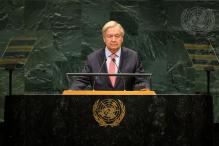
In his keynote address, United Nations Secretary-General António Guterres reflected on Japan’s longstanding partnership with the UN and the urgency of strengthening multilateralism in today’s global context, observing that “the need for multilateralism has never been greater”. He highlighted the importance of making international cooperation real and relevant to people’s everyday lives, noting lessons from Expo 2025: “When the work of the United Nations is made tangible — when people can connect it to their own lives and communities — trust grows.” He concluded by calling for renewed commitment to collective action, by urging the audience: “Let us strengthen a multilateralism that earns trust — through action, solidarity and results people can see, feel and believe in.”
In his keynote, Minister for Foreign Affairs of Japan Mr. Toshimitsu Motegi reaffirmed Japan’s longstanding commitment to multilateralism, noting that the history of Japan-UN cooperation is closely tied to the country’s consistent support for multilateral principles. He emphasized that unity among nations is essential to addressing global challenges, echoing the core message of the UN Pavilion at Expo 2025, that humanity is strongest when acting together. Looking ahead, he stressed that Japan will continue to work closely with the United Nations to promote cooperation and solidarity, particularly in times of increasing global uncertainty.


The event concluded with a panel discussion “From Legacy to Leadership: 70 Years of Japan-UN Cooperation and the Next Generation of Multilateralism”, moderated by Ms. Melissa Fleming, UN Under-Secretary-General for Global Communications.
The panel brought together distinguished speakers representing both Japan and the United Nations, including Ambassador Kazuyuki Yamazaki, Permanent Representative of Japan to the United Nations; Ms. Izumi Nakamitsu, Under-Secretary-General and High Representative for Disarmament Affairs; Mr. Guy Ryder, Under-Secretary-General for Policy; Ms. Suzuka Nakamura, SDG Young Leader; and Mr. Soichiro Chiba, Founder of Thousandleaf.

Panellists reflected on Japan’s contributions to multilateralism since its accession to the UN in 1956, including its leadership on peacebuilding, sustainable development and international cooperation. They also addressed the pressing challenges facing the multilateral system today — from geopolitical tensions and inequality to technological disruption and declining trust.
Discussions emphasized the importance of adapting the UN system to remain effective and inclusive, including through ongoing reform efforts and stronger engagement with younger generations. The role of youth as key actors in shaping future global cooperation emerged as a central theme, alongside the need to build more inclusive platforms for dialogue and participation.
The panel discussion featured a Q&A session with university students, who raised pressing issues at the intersection of geopolitics, sustainability and global governance. Their questions touched on the feasibility of achieving climate goals amid energy and security crises, the role of Japan and the United Nations in addressing rising geopolitical tensions, and the norms and values required to sustain multilateral cooperation in an increasingly fragmented international landscape.
The conversation concluded with forward-looking messages from panellists on the future of multilateralism and addressing shared global challenges. The panellists urged the audience: Don’t give up on democracy. Don’t give up on multilateralism.
As the international community confronts an increasingly complex and interconnected set of challenges, the symposium was an extraordinary opportunity to explore the importance of multilateral cooperation grounded in trust, inclusivity and shared values. Marking seven decades of partnership, participants reaffirmed the critical role of Japan-UN cooperation in advancing peace, sustainable development and human security and in shaping a more collaborative and resilient global future.