This piece was written by Shruthi Manivannan, Tejaswi Singh, and Alexander Bichler, Master of Public Policy students at UNU-MERIT.
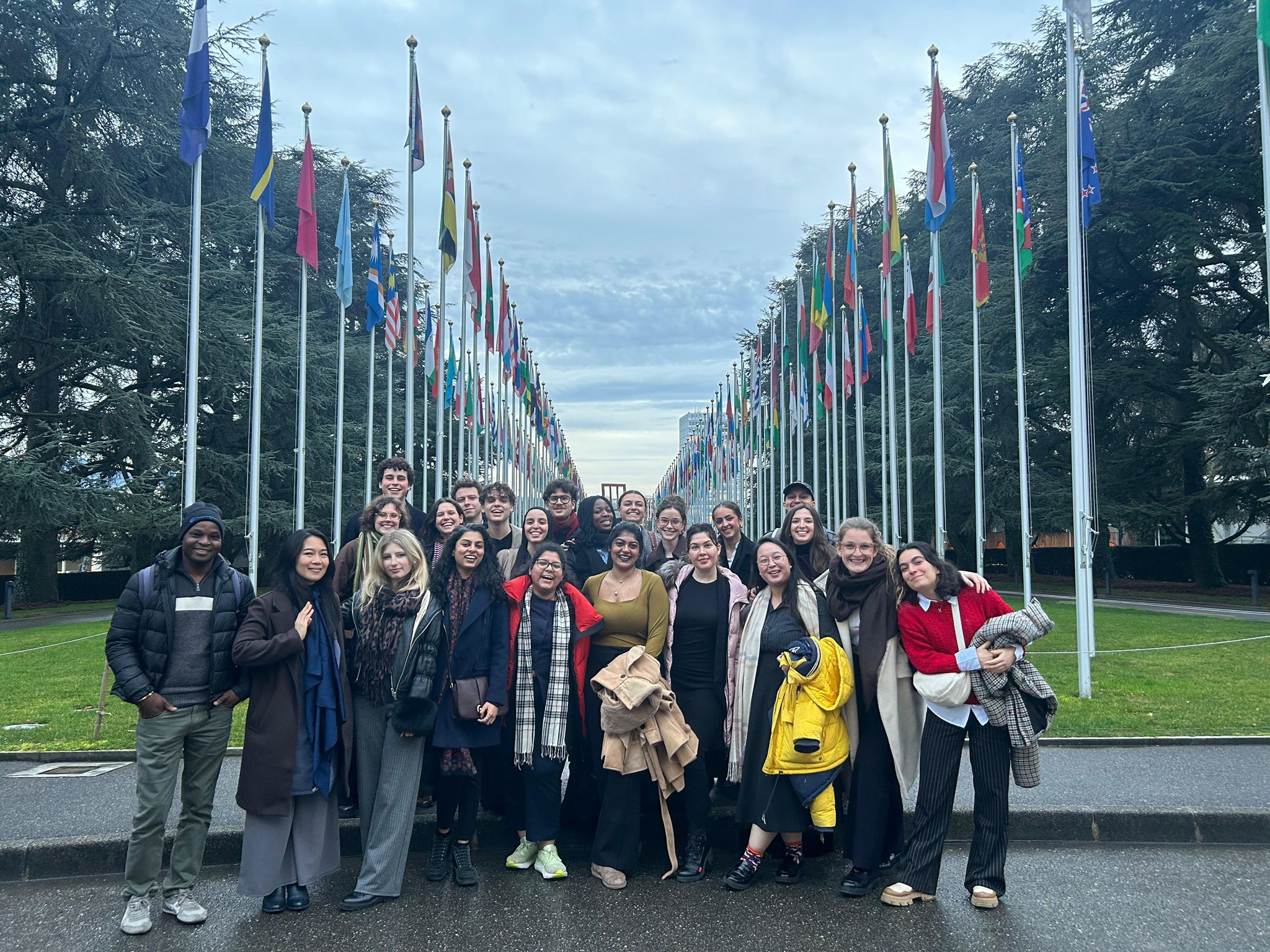
Geneva remains one of the central hubs of the multilateral system. During a recent study visit, Master of Public Policy students from UNU-MERIT travelled to the city to engage with institutions shaping global governance including UN agencies and specialised organisations to the World Intellectual Property Organisation (WIPO) and the World Trade Organisation (WTO).
Across three intensive days, students explored both the political realities of multilateralism and the technical dimensions of innovation governance. What emerged was a clearer understanding of how global institutions operate in practice, particularly at a moment when international cooperation faces growing uncertainty.
Multilateralism Up Close
For many students, visiting Geneva brought the abstract idea of the United Nations system into sharper focus... Opening my news app in the morning makes me wonder how many more cracks multilateralism can take before it truly crumbles. If the very foundational ethics of the UN is under attack, how does it continue to stand? What on earth I had got myself into, trying to wade into the international policy field when the tides were turning the wrong way?
Conversations with practitioners across the UN system highlighted the motivations that drive work in international organisations, even during periods of institutional strain.
It matters why
“He who has a why to live can bear almost any how” by Nietzsche was not just a resounding quote shared to us by Julian Caletti from UNITAR at the end of the packed three-day programme. It was an unspoken thread underlying every interaction, urging us to find pathways into the Field. Each shared story gave us a glimpse into the steady passion that carried them through a bureaucracy that was already challenging to navigate, let alone one currently in the throes of restructuring.
A session that truly pushed the message home was hearing from Carl Massonneau, of the WHO. The work involves navigating not only scientific questions but also social stigma and political resistance.
What was especially striking to me was how repeatedly frustration fuelled determination. Frustration tends to bleed into anger, but it is seldom sustainable. For those who move with the tumultuous times, their frustration at a failing system seems to have transformed into a steady determination to continue their work. When the work on the ground has such deep meaning, do the buffeting winds up high really matter?
Taking a stance
That is not to say that we did not discuss the political. However, the rules of engagement with the ongoing mess of global politics seemed to be fundamentally shaped by each UN organisation’s core mission. For organisations like the UNDP, WHO, and UNEP, whose mission is so tied with vulnerable communities on the ground, ethics is inherently tied to politics. Decisions on who is deserving of help and what help looks like is now at the forefront of political conversations, turning human rights into a numbers game.
We had impassioned calls from those like Wondwosen (Wondy) Kibaret from the UNEP to engage directly with politics, to get into rooms where decisions are made. Such frank conversations served as rousing calls to action, to get into the messy fray and do the dirty work.
On the flip side, for institutions like the WTO and the ITU, politics emerged as the background in which they functioned. Representatives chose to be explicitly neutral in message, presenting the institutions as stalwarts in maintaining global infrastructure. For especially long running institutions like the ITU, which has witnessed communications revolutions from telegraph to the internet and now AI, political change is nothing new.
Avoiding overt political stances as institutions seems to have worked in their favour in two ways. Firstly, the lack of attention has allowed them to continue their work with limited hindrance. And secondly, and perhaps more importantly, it has allowed them to bring member states to the same shared table. At a time of growing mistrust, being a conduit for communication and collaboration is invaluable. It might not be politics with a capital P, but there is certainly something quietly political in choosing to believe in building bridges.
The study visit also offered students specialising in Governance of Innovation a closer look at how international institutions shape the global innovation ecosystem.
Launch of the World Intellectual Property Report
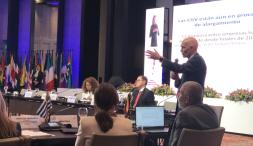
At the World Intellectual Property Organisation, students attended the launch of the World Intellectual Property Report 2026, where speakers including WIPO Assistant Director-General Marco Alemán and Chief Economist Carsten Fink discussed the dynamics of the global innovation lifecycle.
This was followed by a rich panel discussion on industry perspectives on technology diffusion, comprising the CEO of Zimi, Mr Michael Maas, and the Director of Patents at Ericsson, Mr Icaro Leonardo da Silva, and the VP of Bayer Africa, Ms Mildred Nadah Pita. At the launch, the Governance of Innovation students were able to learn how inclusive and sustainable growth depends on diffusion that acts as a bridge between invention and impact.
The Innovation Economy Section (Department for Economics and Data Analytics, IP and Innovation Ecosystems Sector) team, represented by Ms Intan Hamdan-Livramento, traced the innovation chain from R&D to patenting, emphasising the policy requirements for breakthroughs. The team expressed how digital technologies can now travel to global markets in days or months, rather than decades as it used to be the case before.
The Innovation Economy team asked the students to take part in a high-pressure pitch simulation, where they had to present complex data clearly and concisely to the fictional Director General of WIPO. This helped them to understand how the value of economic data lies not in its volume, but in its ability to inform strategic decision-making through information flow.
Discussions around the Global Innovation Index highlighted that global rankings are shaped by choices about what indicators matter.
The conversation moved from measurement to markets when Mr Alessio Muscarnera explored the creative economy dimension of intellectual property. Mr Peter Oksen from the Climate Change and Food Security Team discussed how intellectual property systems can incentivise green technologies and climate-related innovation. While it induced a certain ‘techno-optimism,’ the session with Mr Siddartha Prakash from the Global Health, Global Challenges Division complicated this optimism by referencing untreated health industry waste effluents in waters. This duality illustrates how technological progress and environmental harm can coexist.
The programme concluded on a forward-looking note. Finally, Mr Martin Correa encouraged us to think ahead. His emphasis on foresight and anticipatory governance left us reflecting on the importance of preparing institutions not just for today’s challenges, but for those still emerging.
The group visited the United Nations Human Rights Council to examine the institutional architecture of international human rights governance. While the Council is often associated with civil and political rights, our session focused on a critical intersection for our specialisation: the friction between Intellectual Property (IP) and the "Right to Development."
We learned that many developing countries view the current global IP regime with a degree of scepticism. From their perspective, strict patent protections—while great for incentivising R&D in wealthy nations—can sometimes act as a barrier to essential goods like life-saving medicines or green technologies. This brought us to the concept of the Right to Development, a principle which argues that development is an inalienable human right.
The discussion encouraged us to look at innovation not just as a technical or economic achievement, but as a human rights issue. It was eye-opening to see how "innovation governance" isn't just about protecting an idea; it’s about balancing that protection with a global responsibility to ensure that progress doesn't leave the Global South behind.
Emerging Economies and Global Trade
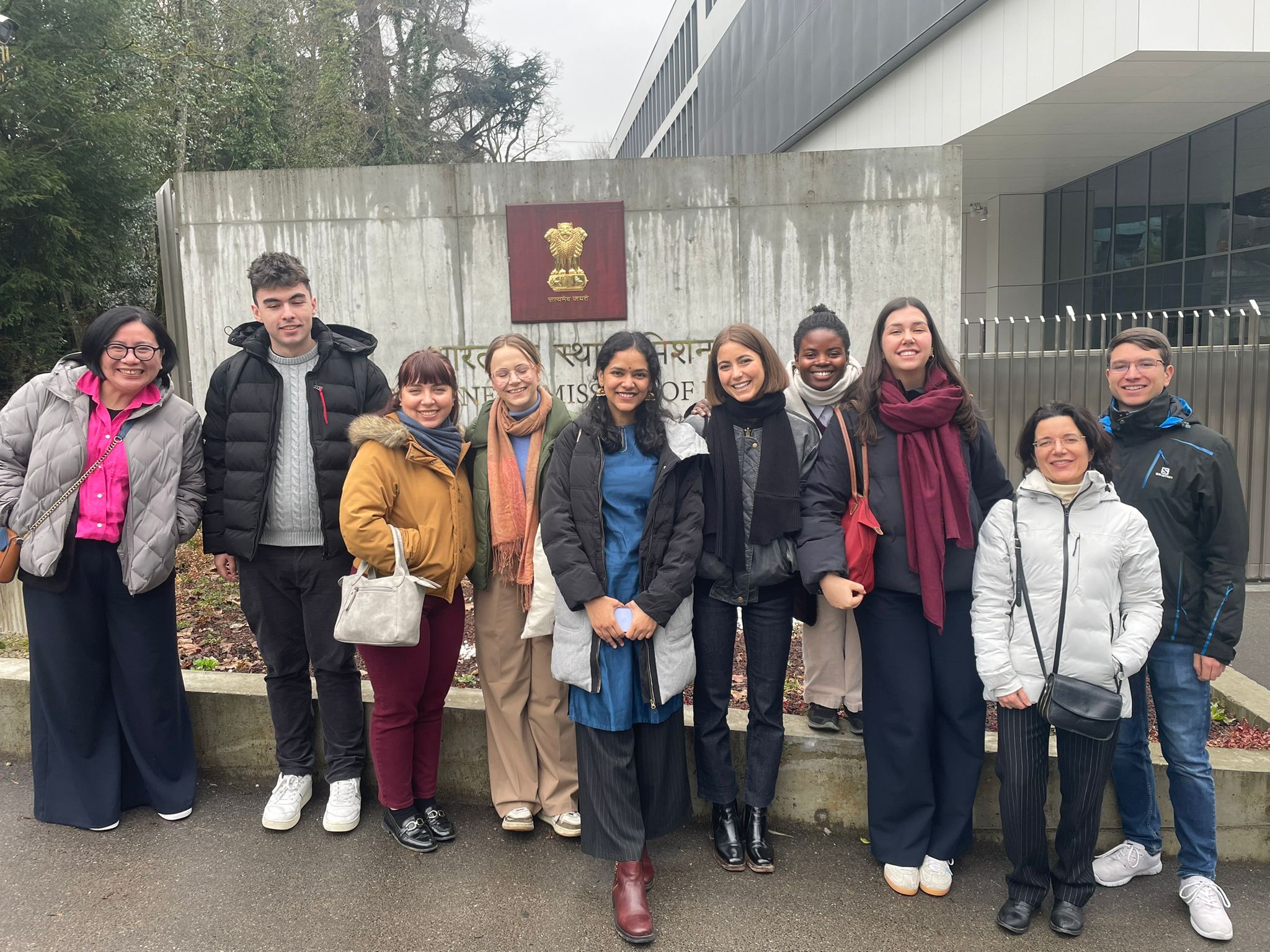
At the Indian Consulate, discussions focused on the role of emerging economies in global technology adoption. The final part of our Geneva study visit took us to the World Trade Organisation (WTO), located in the Centre William Rappard. While many UN buildings feel like modern office blocks, the WTO headquarters feels more like a grand museum. Originally built for the ILO in the 1920s, the architecture is stunning and creates a very different atmosphere than the more clinical environments of other international organisations.
What made the visit stand out was our guided tour. Rather than a professional tour guide, we were shown around by a member of the WTO staff who volunteered their time to walk us through the halls. It was fascinating to hear from someone who actually works within the machinery of global trade but has enough passion for the institution’s history to lead these tours on the side.
Walking through the building, you really see how the member countries leave their mark; the hallways are filled with an exhibition of gifts — everything from intricate mosaics to sculptures — donated by different nations over the decades. We also spent some time in the souvenir shop and the gift exhibition, which gave us a chance to see how the WTO presents its identity to the public. The mix of high-level economic negotiation and this "living gallery" of global culture made for a very memorable conclusion to our time in Geneva.
Looking Ahead
So where does that leave us? As new incomers to a changing world. Finding our feet will be tough, no doubt, but perhaps the unsteady ground will steer us to new and interesting destinations. We will have to take the path less travelled by, maybe even build the path ourselves. But what faith should keep us going? I leave that question to you, dear reader, I suspect the answer is closer than you think.
Suggested citation: "Geneva from Two Angles: Multilateralism and Innovation Governance in Practice," UNU-MERIT (blog), 2026-03-17, 2026, https://unu.edu/merit/blog-post/geneva-two-angles-multilateralism-and-innovation-governance-practice.