The talks in Antalya ended without agreement on a cover decision, and African countries left without clarity on how adaptation finance would be tripled. Yet Parties recognised sustainable industrialisation and local value addition as part of a just transition and reached an understanding on how countries would shape future trade and climate dialogues.
How just is a transition that cuts emissions while leaving intact the economic structures that constrain development? African countries have set ambitious climate targets in their nationally determined contributions (NDCs). They are equally ambitious about industrialising, reducing poverty and improving livelihoods. The test of COP31 is whether its outcomes help them pursue those ambitions together.
1. The Just Transition Work Programme was extended, while the mechanism’s design remains open
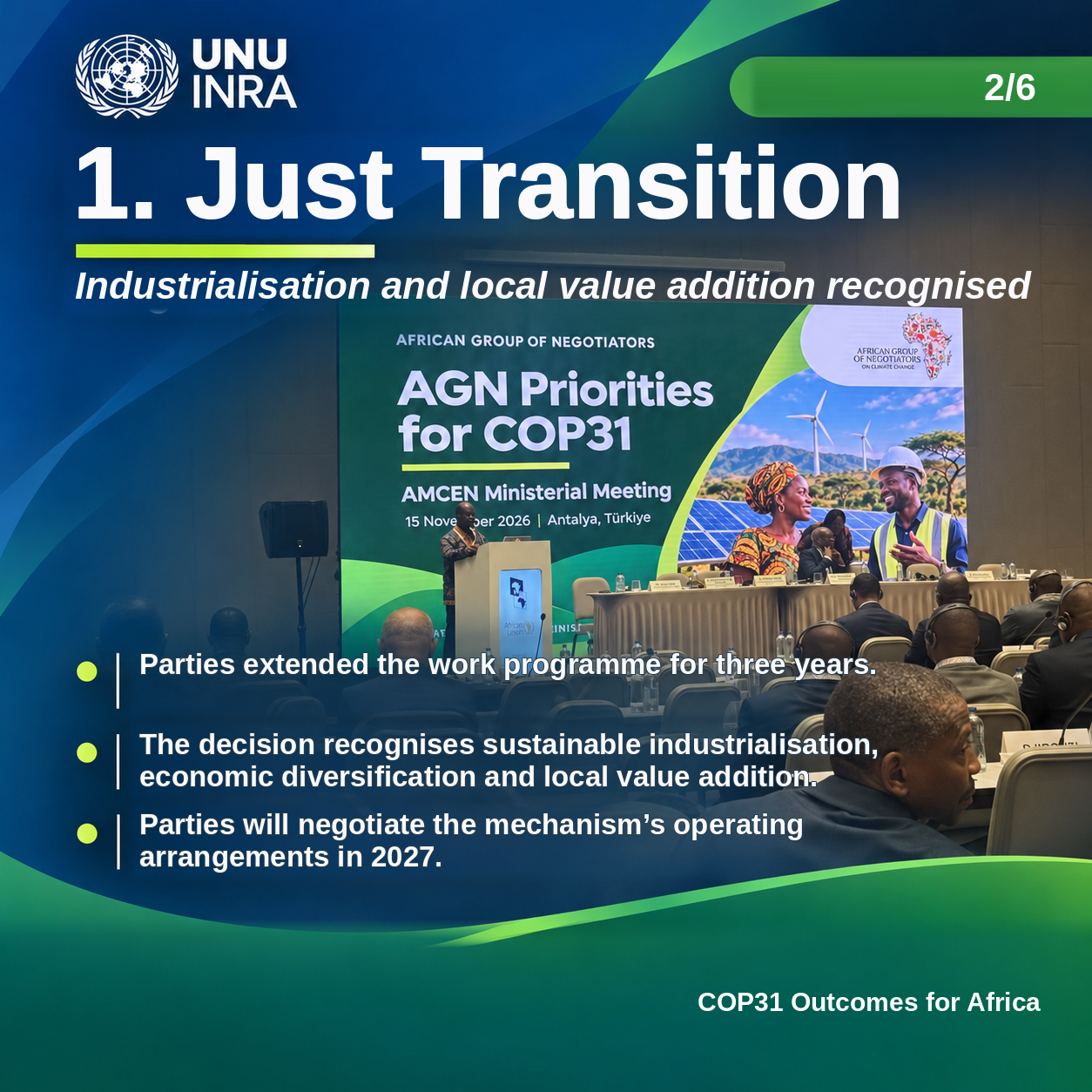
Parties extended the UAE Just Transition Work Programme for three years and recognised sustainable industrialisation, economic diversification and local value addition as part of nationally determined just transitions. They agreed to operationalise the Just Transition Mechanism in phases, with its functions and operating arrangements to be negotiated in 2027. COP31 just transition text
The transition away from fossil fuels is increasing demand for minerals used in batteries and renewable energy technologies. But whose supply security are we talking about? If mineral partnerships leave African countries dependent on exporting raw materials while processing and manufacturing take place elsewhere, the transition risks creating new forms of economic dependence. International cooperation should help African countries participate in the industries their resources make possible. That means financing reliable and affordable power, transport and skills, supporting technology transfer and building regional value chains through the African Continental Free Trade Area.
At the High-Level Ministerial Round Table on Response Measures in Antalya, Zimbabwe’s Minister of Environment spoke about processing minerals and making batteries at home. UNU-INRA’s November 2026 policy brief What Zimbabwe Keeps records an early step. From January to September 2026, lithium sulphate made in Zimbabwe earned about US$191 million of US$2,159 million in lithium export earnings: about 8.8 cents of each lithium dollar. This gives Zimbabwe a baseline for tracking domestic processing. The next test is whether processing more lithium at home raises the share of each export dollar that stays in Zimbabwe and creates jobs that pay above the applicable minimum wage.
 2. Adaptation finance remains unresolved
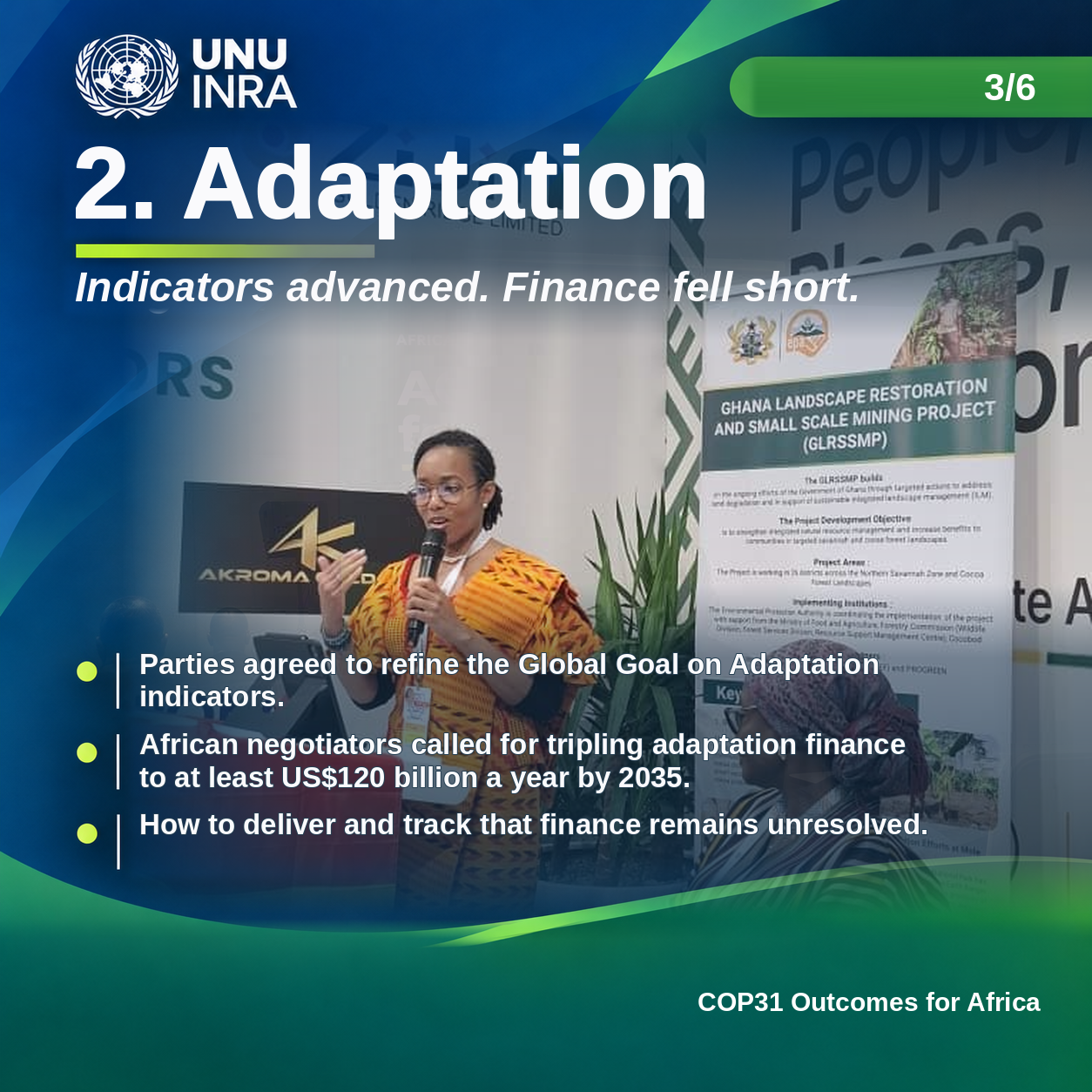
Parties agreed to continue work on the indicators for the Global Goal on Adaptation, while discussions on national adaptation plans made limited progress. African negotiators called for adaptation finance to triple to at least US$120 billion a year by 2035. COP31 left open how that finance would be delivered and how Parties would track whether it reaches the people it is meant to protect.
“You cannot triple a number nobody has written down,” says Dr Richard Munang, Director of UNU-INRA. “A baseline has two ends. One counts what was promised and sent. The other counts what arrived and protected someone. The promise will be believed when it carries both.”
African countries’ climate and development ambitions need to be matched by finance. The Paris Agreement reflects the principle of common but differentiated responsibilities and respective capabilities. Under Article 9.1, developed countries are required to provide finance to help developing countries mitigate and adapt to climate change.
Unilateral trade-related climate measures can push financial flows in the opposite direction. A carbon border charge can raise revenue in a developed market while African exporters absorb part of the cost. Buyers can pass traceability costs down to smallholders. This shifts part of the cost of climate action onto developing economies and can erode the export earnings and public revenues they need to invest in adaptation and their own transitions. Climate ambition should not come at the expense of the economic capacity needed to deliver it.
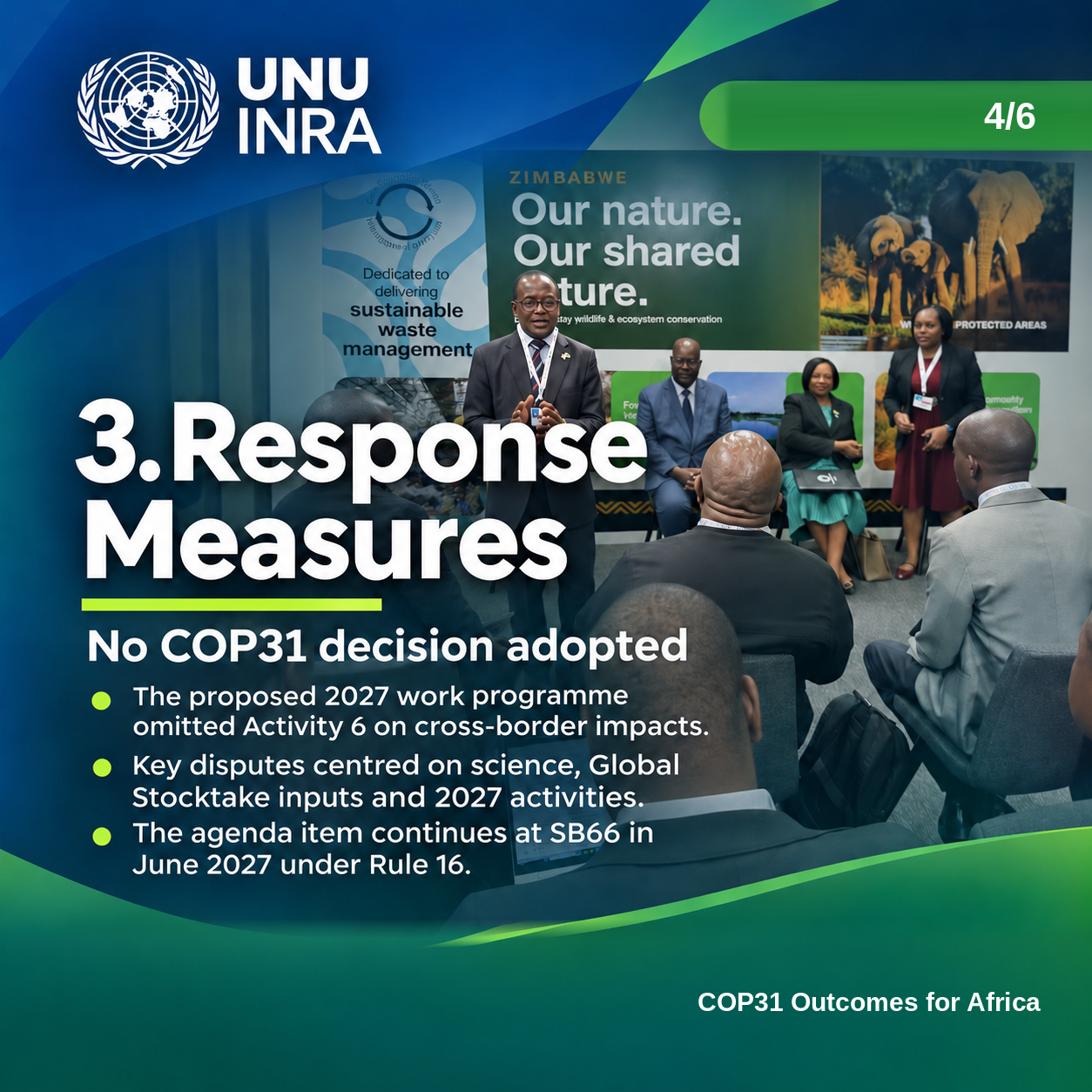 3. No deal on response measures as Rule 16 pushes talks to June 2027
Climate policies adopted in one country can affect other economies by changing production costs, influencing investment and shaping employment. The proposed 2027 work programme omitted the dedicated activity on assessing cross-border impacts (Activity 6 of the Response Measures Forum). The draft decision did not secure consensus, and the item was carried forward under Rule 16 for renewed consideration in June 2027.
One model study, by the African Climate Foundation and the London School of Economics, puts the cost of the EU’s Carbon Border Adjustment Mechanism (CBAM) to Africa at about 0.91% of GDP, roughly US$25 billion at 2021 levels (ACF and LSE, 2023). A separate UNCTAD study estimated that CBAM would cut global emissions by about 0.1% (UNCTAD, 2021). These projections show why countries need to assess cross-border impacts before measures are introduced and track what happens once they take effect. Better data and stronger national capacity would help identify which sectors face higher costs, how jobs and public revenues are affected, and where opportunities for cleaner production and local value addition are emerging.
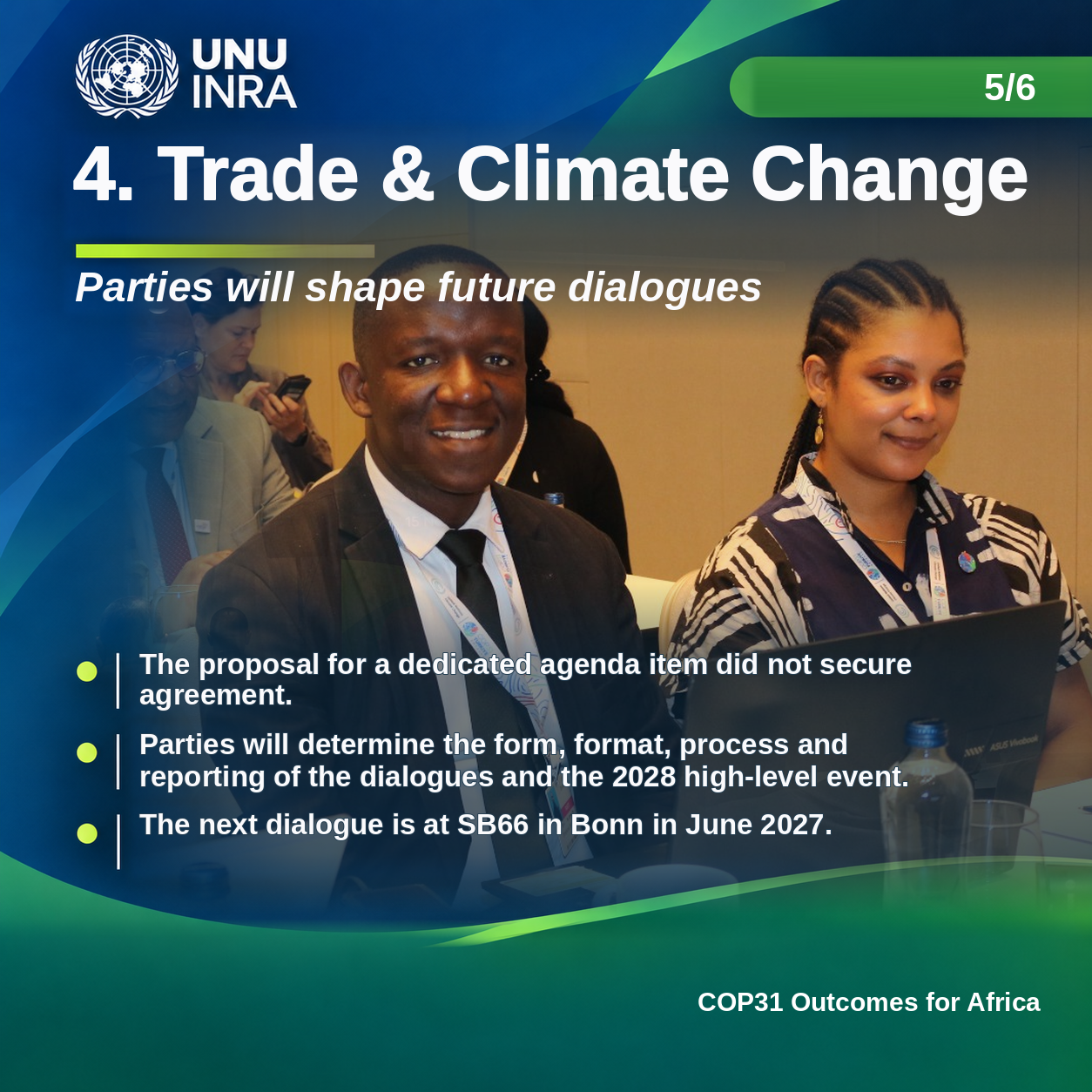 4. No dedicated trade and climate agenda item, but Parties secured a role in guiding future dialogues
The proposal for a dedicated trade and climate change agenda item did not secure agreement. Parties reached a procedural understanding that they would determine the form, format, process and reporting of the dialogues and the 2028 high-level event. The next dialogue, at the June 2027 talks in Bonn, gives countries an opportunity to bring sector-specific evidence into the discussion.
The international trade system should give African countries room to industrialise and grow their economies so they can invest in climate action. Article 3.5 of the UN Climate Convention provides a basis for that discussion. It calls for an open trading system that supports sustainable development and says climate measures, including unilateral ones, should avoid arbitrary or unjustifiable discrimination and disguised restrictions on trade.
In 2022, Ghana exported 62% of the cocoa it produced to the EU. In 2025, the EU imported €2.63 billion in cocoa and cocoa preparations from Ghana. UNU-INRA’s analysis puts that at about 23 times the value of Ghanaian goods covered by CBAM. The scale of the cocoa trade makes implementation of the EU Deforestation Regulation a priority for Ghana. If buyers pass the cost of plot-level mapping and verification down the supply chain, smallholders with limited access to finance and technical support may struggle to retain access to European buyers. The next dialogue should examine how producers can meet environmental requirements while protecting their livelihoods.
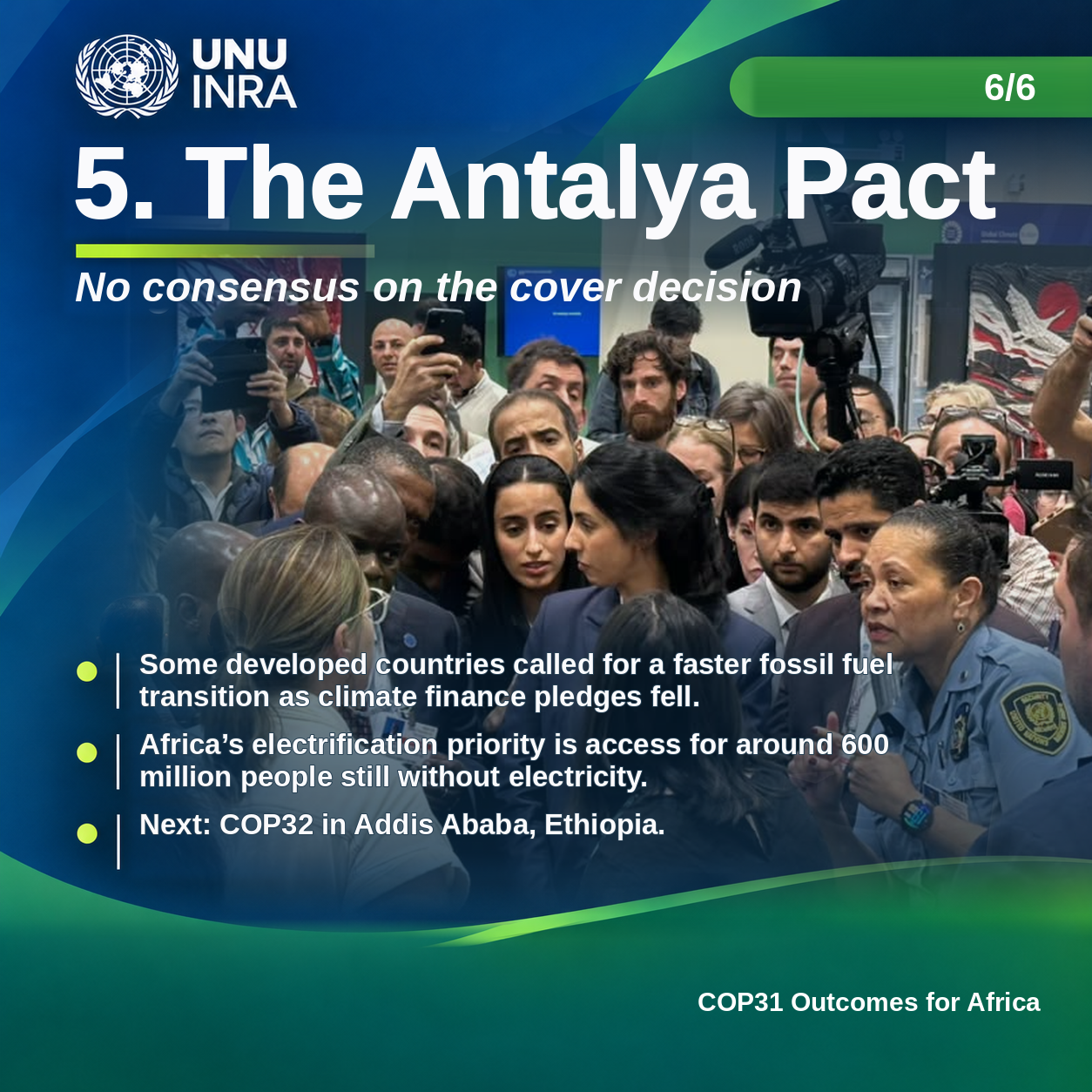 5. The Antalya Pact exposed a gap between transition ambition and finance.
Parties did not reach consensus on the proposed cover decision. Some called for stronger language on transitioning away from fossil fuels. Parties also differed over the role of renewables in the proposed electrification goal and whether the emphasis on carbon capture, utilisation and storage could prolong fossil fuel use.
Some developed countries called for a faster transition away from fossil fuels. At the same time, public climate finance pledges for developing countries fell by more than 70% in 2026. The final draft omitted the call to triple adaptation finance to at least US$120 billion a year by 2035.
The terms of finance matter alongside its volume. In Mozambique’s Zambézia programme, the World Bank agreed to pay US$5 per tonne for 10 million tonnes of carbon dioxide equivalent in emissions reductions, with 70% of projected net payments earmarked for community projects. The agreed price and planned share give communities two figures against which they can track what actually reaches them. By mid-2025, the programme’s own report showed about 89 cents of each five-dollar tonne had reached communities. Counting what arrives is how a promise becomes a payment.
The proposed “35 by 35” target aimed to raise electricity’s share of global final energy consumption to 35% by 2035. Around 600 million people in Africa lack access to electricity. For the continent, electrification should expand access to electricity and clean cooking, power productive economies and support industrial transformation.
From Antalya to Addis — Africa’s COPFrom Antalya to Addis — Africa’s COP.
COP32 in Addis Ababa, Ethiopia, will be Africa’s COP. Hosting it gives African countries, researchers, workers and producers an opportunity to shape the agenda around what a development-led transition requires. At COP31, UNU-INRA provided technical support to the African Group of Negotiators on trade and climate change and contributed technical inputs on response measures and just transitions.
The second Global Stocktake is a chance to assess whether developing countries are receiving the finance, technology and capacity-building support they need to participate in the transition. National roadmaps for transitioning away from fossil fuels can apply a similar test. Alongside emissions reductions, they should track what happens to jobs, public revenues and productive capacity, and whether economies become more diversified and resilient.
On trade, this means counting what is at stake product by product. On adaptation finance, it means tracking what was promised and sent, what arrived and whom it protected. On just transition, it means asking how many cents of each mineral dollar stay in the producing country through wages, local procurement and public revenue. That is the keep rate, a measure UNU-INRA uses across African case studies.
“Value added is not value kept,” says Dr Munang. “A transition is just when the share of each mineral dollar kept at home goes up, and the jobs it creates pay above the minimum wage. Africa is not poor. Africa is uncounted.”
The 15 March 2027 call for submissions on the Just Transition Mechanism gives UNU-INRA an opportunity to bring evidence from those case studies into the design of the mechanism. The keep rate offers one way to track progress, alongside evidence on whether jobs pay above the applicable minimum wage and where processing and manufacturing take place. As the green transition gathers pace, how much of the value it creates will stay in Africa, and who will benefit?
Suggested citation: Qondi Moyo., "Five COP31 outcomes that matter for AfricaFive COP31 outcomes that matter for Africa," UNU-INRA (blog), 2026-11-27, 2026, https://unu.edu/inra/blog-post/five-cop31-outcomes-matter-africafive-cop31-outcomes-matter-africa.