

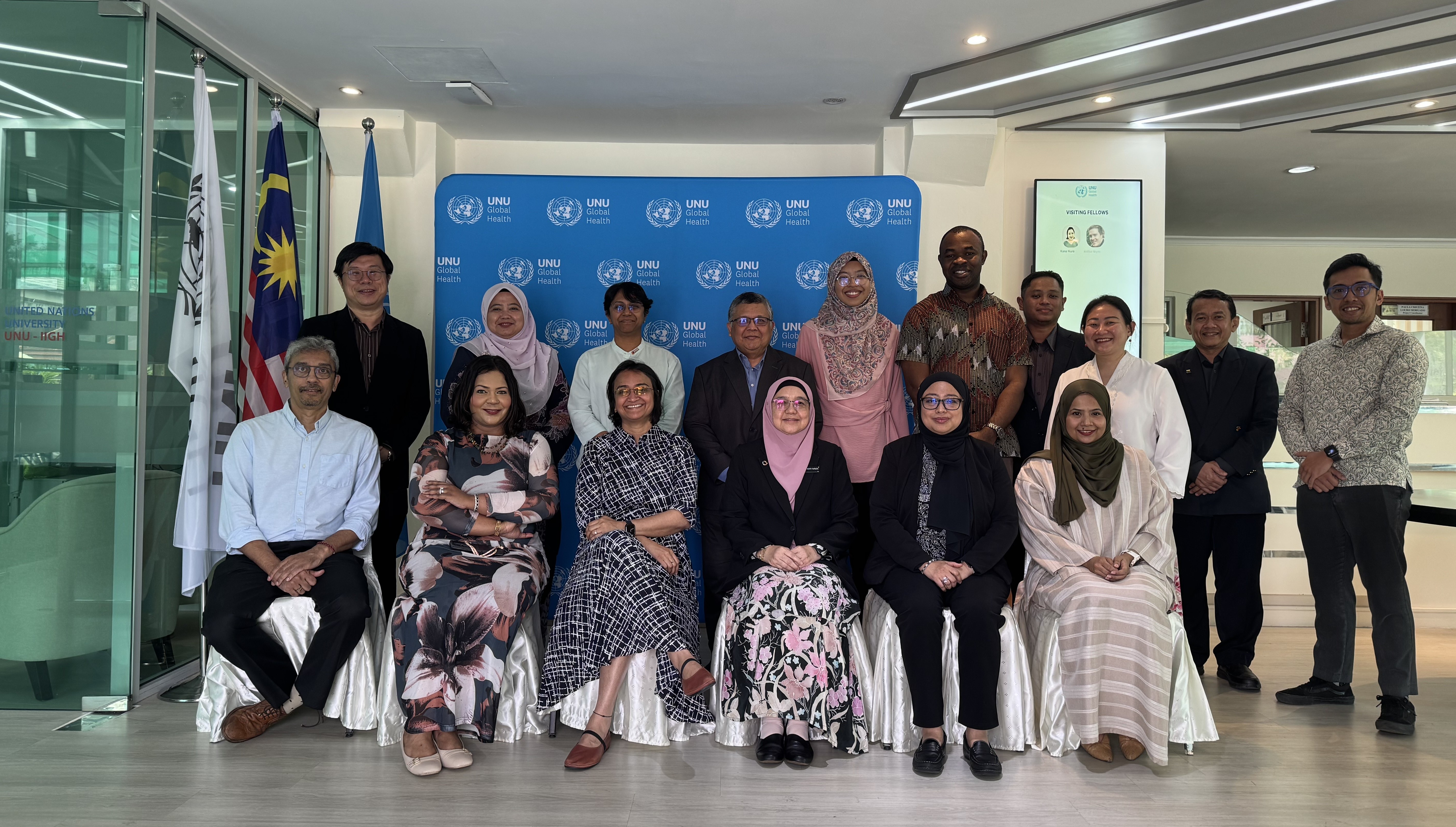
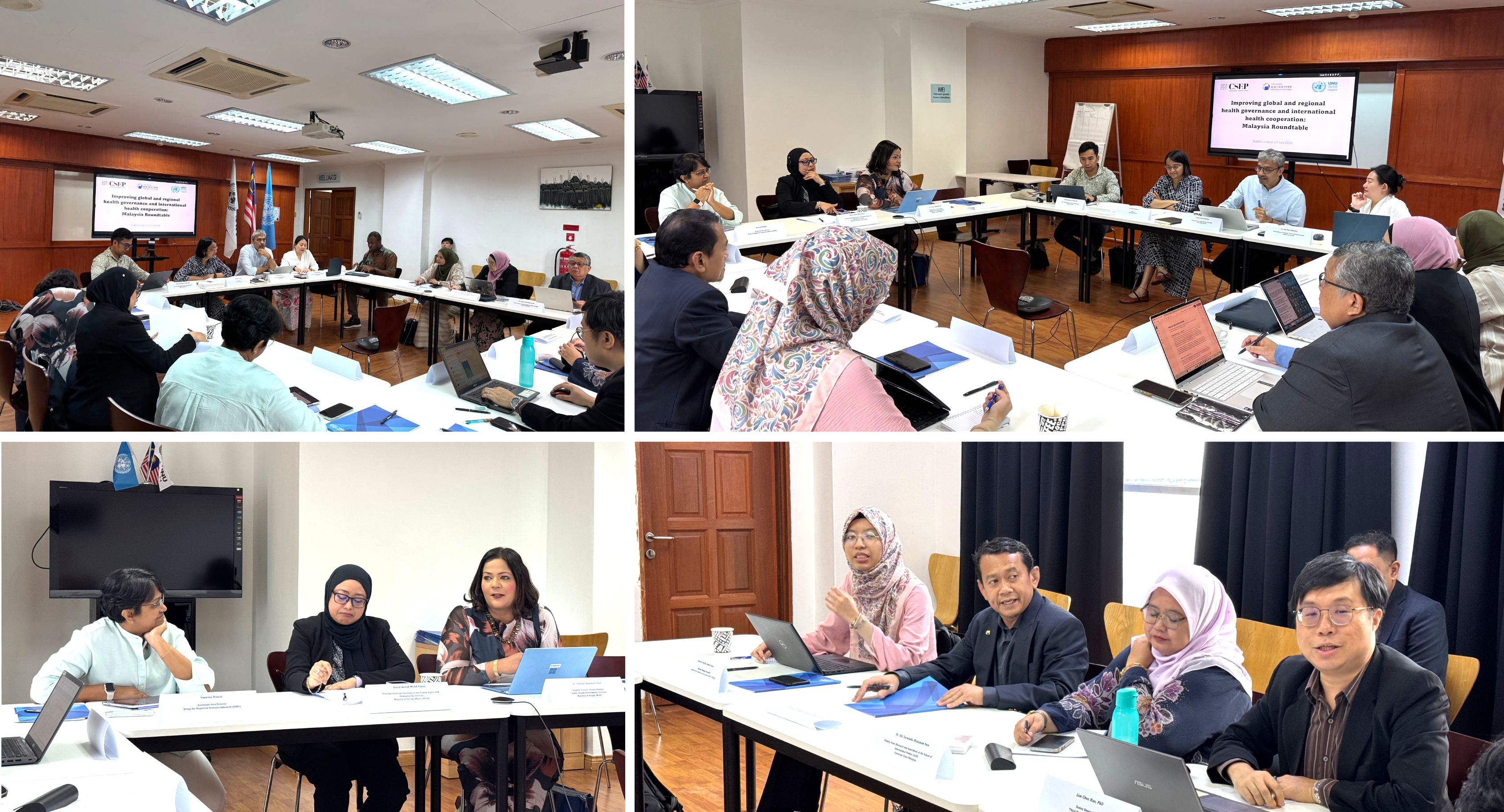
Yesterday, UNU Global Health convened a closed-door roundtable discussion in Kuala Lumpur titled “𝘔𝘢𝘭𝘢𝘺𝘴𝘪𝘢’𝘴 𝘙𝘦𝘴𝘱𝘰𝘯𝘴𝘦 𝘵𝘰 𝘢 𝘊𝘩𝘢𝘯𝘨𝘪𝘯𝘨 𝘎𝘭𝘰𝘣𝘢𝘭 𝘏𝘦𝘢𝘭𝘵𝘩 𝘓𝘢𝘯𝘥𝘴𝘤𝘢𝘱𝘦”, bringing together experts and key stakeholders to explore how Malaysia and the wider region can strengthen regional cooperation and contribute to a more equitable global health governance system.
Dr. Revati Phalkey (Director, UNU Global Health) opened the roundtable by highlighting Malaysia’s commitment to advancing global health governance and fostering global health leadership from the Global South through its support for UNU Global Health. She thanked Malaysia’s Ministries of Health and Education, as well as National University of Malaysia (UKM), for their continued support, and noted that the Institute’s 20th anniversary provides an opportunity to renew and strengthen partnerships across the country and the wider region.
Prof. David McCoy (Research Lead, UNU Global Health) emphasized that effective global health governance in an era of fragmentation requires looking not only upwards at multilateral institutions, but also diagonally at shifting bilateral alignments, sideways at regional and Global South partnerships, and downwards at the civil society and professional networks that build trust across borders. Strengthening international health cooperation demands attention to all four directions simultaneously.
dr. Dian Maria Blandina (Policy Research Associate, UNU Global Health) highlighted that the growing influence of private actors and market-based financing mechanisms in global health, while bringing additional resources, also raises important questions about fiscal prioritisation, policy coherence, and the long-term balance between investor-driven schemes and publicly funded, equity-oriented health systems.
Dr. Ronald Tundang (Policy Research Fellow, UNU Global Health) underscored that ASEAN’s relevance to health lies in its ability to convert regional trust, political centrality and growing economic weight into collective agency—particularly amid geopolitical rivalry and the retreat of multilateralism. He argued that Malaysia could help move ASEAN from frameworks to delivery through stronger national health-diplomacy coordination and practical cooperation on regulatory reliance, coordinated clinical trials, pooled procurement and distributed production, while addressing capacity gaps, divergent national priorities, financing constraints and patent-enabled market concentration.
📖 Read the working paper here: https://go.unu.edu/v8AxU
Suggested citation: " Advancing Regional Cooperation for Stronger Global Health Governance," UNU Global Health (blog), 2026-07-27, 2026, https://unu.edu/global-health/blog-post/advancing-regional-cooperation-stronger-global-health-governance.