

Project FOREST OKYEMAN (Fostering Reforestation, Environmental Sustainability and Tourism in the Okyeman Area), was started to safeguard natural resources, assist communities to revive existing resource management groups and establish landscape-level governance structures through the Community Resource Management Areas (CREMA) model. This CREMA model, made up of farmers, local chiefs, government representatives, opinion leaders, private sector, and landowners, was created to co-manage natural resources and create awareness, address violations, strengthen accountability, and build capacity on best agroforestry practices, climate smart agriculture while empowering the local communities to manage their natural resources.

Over the past 3 years, UNU-INRA and UNEP together with other development partners including UNDP, UNICEF, WHO, CSOs, OEF, A Rocha-Ghana, Forestry Commission-Wildlife Division (WD), Atiwa West District Assembly, Government ministries, Agencies and traditional authorities, collaborated to provide capacity building training workshops on sustainable ways of addressing key interconnected challenges, on environmental degradation in the Okyeman area. The capacity building programmes were geared towards addressing economic, environmental, political, educational, nutrition, and health insecurities through a human security approach.
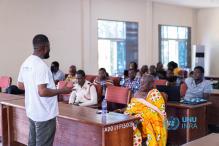
UNU-INRA’s major role, together with Forestry Commission-Wildlife Division, Okyeman Environmental Foundation and A-Rocha Ghana was to organise a series of capacity building workshops, (held in 8 communities), on legal frameworks for natural resource (water, wildlife, minerals, forest, land) management, sustainable agriculture, ecology and monitoring protocols for forests as well as identifying natural resource enterprises and value chains to improve livelihoods of the community. UNU-INRA supported by the Atewa West district assembly and community leaders then developed a CREMA by-law, which went through the necessary processes for gazetting.

In 2025, this key achievement of influencing laws for the Atewa West District, is notable because, it encompasses the work of UNU-INRA, whose objective is to bridge the gap between science and policy, by promoting sustainable development through natural resource governance that is sensitive to climate change. This extensive, inclusive and collaborative work between development partners, the Okyeman foundation, local community members and leaders of the Atewa West District, has been remarkable in that, this partnership has resulted in a local governance structure backed by by-law, to complement the efforts in protecting water bodies, forests and reclaiming degraded lands.
Over the years, Ghana’s government has made several attempts to address the issues around natural resource depletion. One of such current initiatives is the employment of Blue Water Guards, to protect natural resources (water bodies). Though applaudable, empowering local communities to steward their natural resources is key. There have also been institutional efforts around to coordinate multi-agency efforts in stopping illegal mining like the work of NAIMOS: The National Anti-Illegal Mining Operations Secretariat. Though admirable, the work of such institutions must involve local community members and leaders because, these groups are more knowledgeable about their resources and may be best in assisting the government in properly planning and implementing Natural resource management initiatives.


Till date, the issue of national resource management has remained a “government fight”. This inter-developmental human security approach and collaboration with the CREMA, provides a new and more efficient way of fighting this natural resource depletion battle. Prior to Project FOREST Okyeman, some locals and community leaders were not aware of the importance of biodiversity, rules around mining and water bodies and the importance of stewarding surrounding natural resources.
This project has been an eye opener to community members and leaders who were for a long time ignorant about their stewarding power and the importance of preserving their natural resources for economic empowerment. Learning, knowing and understanding the contents of these newly gazetted natural resource management by-laws and the importance of preserving these natural resources, as well as the effects of depleting the environment on future generations, has empowered the Atewa West District community members, to fight natural resource degradation such as illegal mining, pollution of water bodies and deforestation.