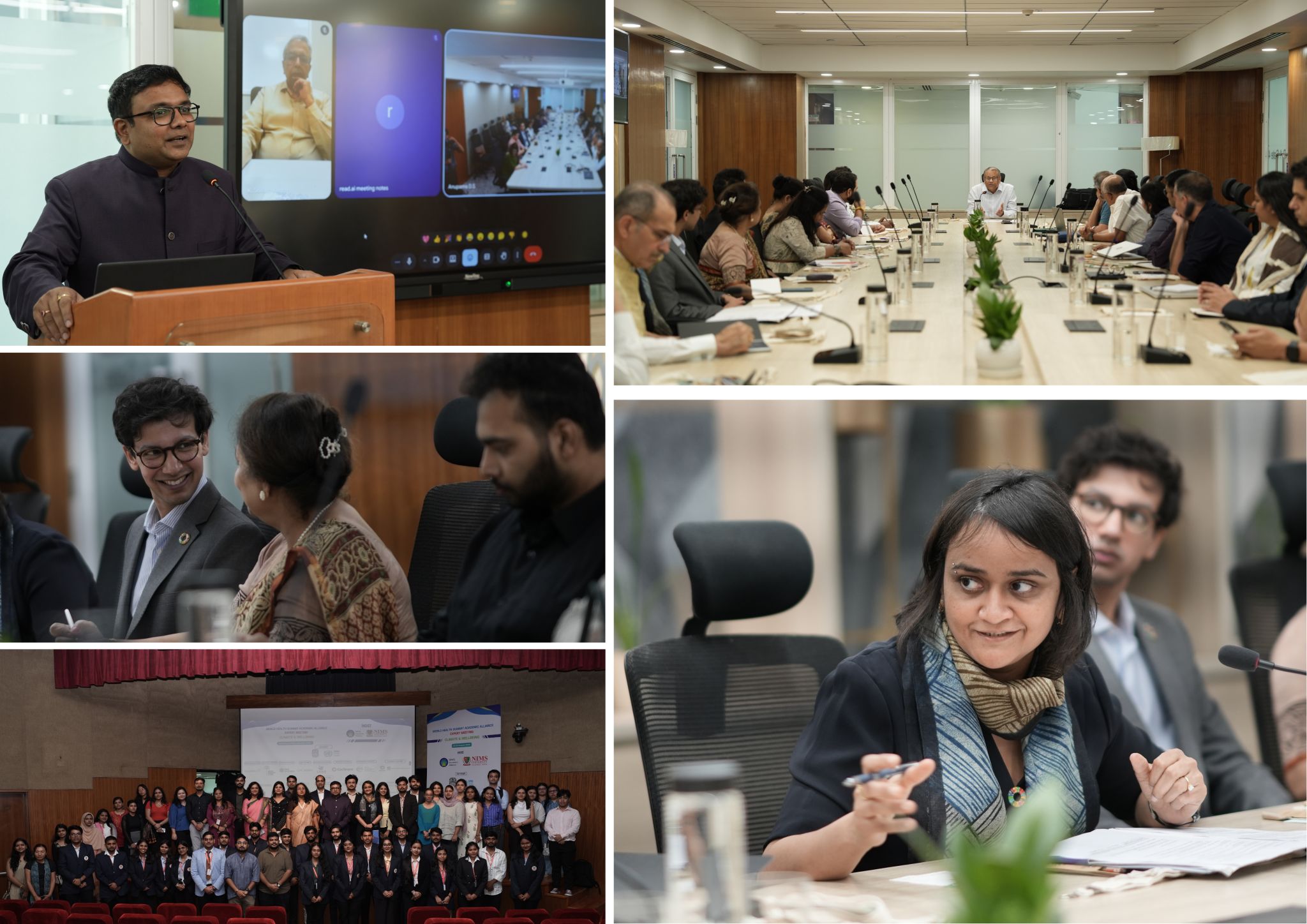


At the World Health Summit Academic Alliance Expert Meeting on Climate and Wellbeing, in New Delhi, Dr. Revati Phalkey, Director of UNU Global Health, contributed to a series of leadership discussions on how climate and health can move from evidence and global commitments towards institutional action and implementation.
During the inaugural session, Dr. Phalkey stressed that the question is no longer whether climate change affects health and well-being, but how quickly collective action can be mobilised to confront a crisis that is already affecting mortality, morbidity, nutritional security, water availability, air quality, livelihoods and ecosystems.
She also emphasised that evidence alone does not produce change: it must be translated into policy and implementation through institutions, relationships, financing, politics and power.
Across the leadership discussions on climate and health, convened by UNU Global Health, the NIMS Institute of Public Health and Governance, the National Centre for Disease Control (NCDC), the JSW Centre for Climate Change and Health, and the Public Health Foundation of India (PHFI), Dr. Phalkey highlighted the need to:
🔹 Move from evidence to action, ensuring that climate and health evidence translates into decisions, budgets, institutions and implementation at a scale that matches the challenge.
🔹 Build institutional leadership beyond individual champions, embedding climate and health within organisational mandates, financing, incentives and routine decision-making.
🔹 Connect climate and health more systematically, bringing health expertise into climate policy and strengthening the links between science, leadership and decision-making.
🔹 Translate global frameworks into institutionally owned and locally grounded action, adapting national and global ambitions to existing systems and national and subnational realities.
🔹 Strengthen accountability and long-term institutional capacity, with clear responsibilities, sustained leadership and mechanisms that allow progress to continue beyond individual champions.
The three engagements reinforced a common message: progress requires more than frameworks and commitments. It requires durable leadership, institutional capability and coordinated action across research, policy, financing and governance - while keeping the wellbeing of people and the planet at the centre.