

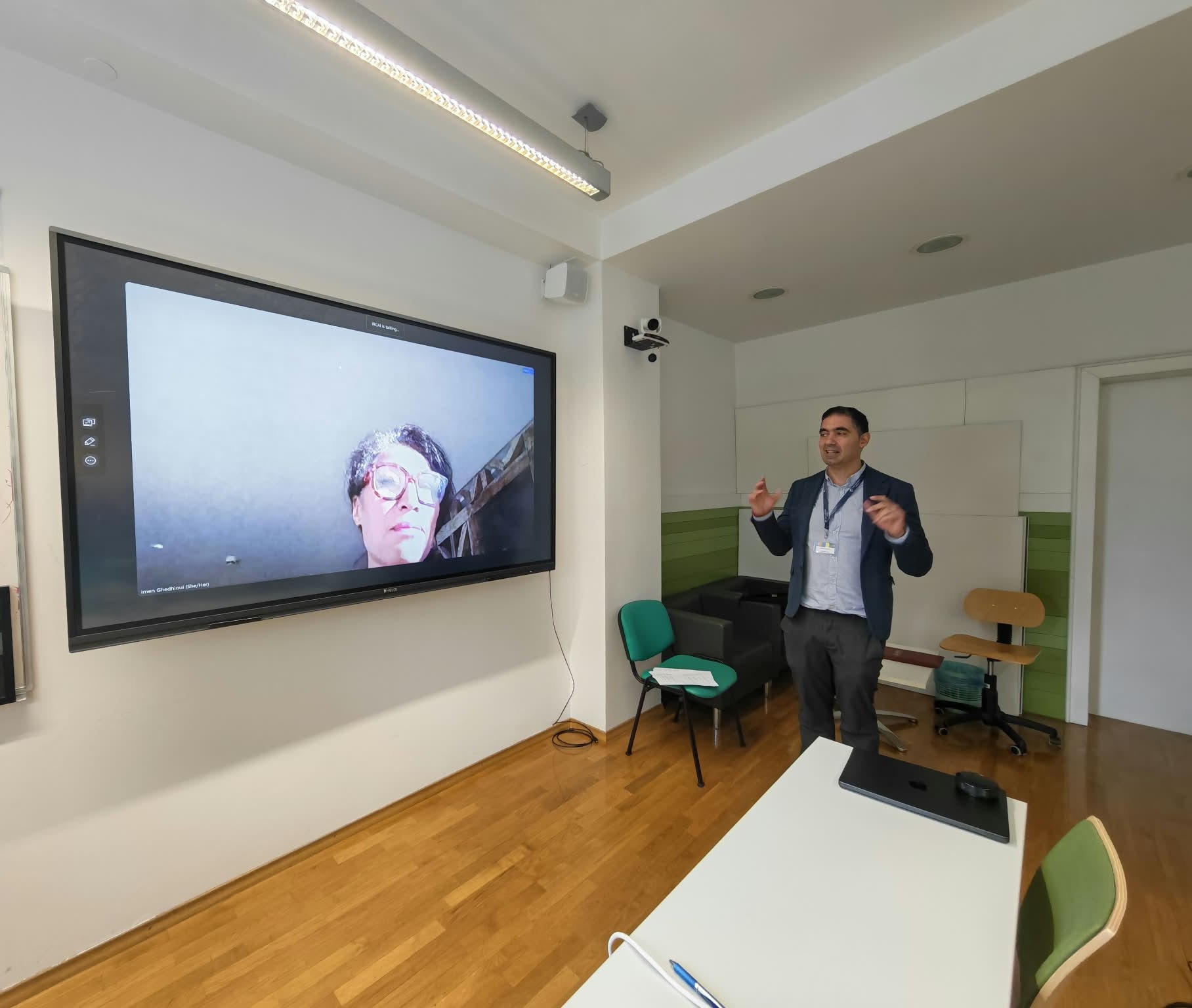
The United Nations University – Operating Unit on Policy-Driven Electronic Governance (UNU-EGOV) participated in the AI Accelerating Sustainable Development Goals (AI4SDG) 2026 Workshop, held in Ljubljana, Slovenia, on 9 October, at the Jozef Stefan Institute.
Imen Ghedhioui, Senior Research Associate at UNU-EGOV, presented the research paper “The Emerging AI Power Crisis or Collusion of Two Revolutions”, co-authored by João Martins (Senior Research Associate at UNU-EGOV), Morten Meyerhoff Nielsen (Principal Research Specialist at UNU-EGOV), and Soumaya Ben Dhaou (Research Specialist at UNU-EGOV).
The workshop, organized by the International Research Centre on Artificial Intelligence under the auspices of UNESCO (IRCAI) in cooperation with the International Center for AI Research & Ethics (ICAIRE) and the Center for Artificial Intelligence and Machine Learning (CIAAM) at the University of São Paulo, brought together researchers, policymakers, and practitioners to explore how artificial intelligence can accelerate progress toward the Sustainable Development Goals.
It was supported by the Network for Artificial Intelligence, Knowledge and Sustainable Development (NAIXUS) and the European Lighthouse of AI for Sustainability (ELIAS).
The Emerging AI Power Crisis
The research paper, “The Emerging AI Power Crisis or Collusion of Two Revolutions”, examines how nations can power Artificial Intelligence (AI) transformation without sacrificing climate commitments, energy security, or digital sovereignty.
Focusing on six countries in two strategic digital corridors, the MENA (UAE, Saudi Arabia and Oman) and the Africa Corridor (Egypt, South Africa and Ghana), the research explores the role of small modular reactors (SMRs) in supporting the growing energy demands of Artificial Intelligence (AI).
The findings suggest that the main obstacle to scaling AI is not technology or capital, but rather integrated governance. As demand for AI infrastructure grows alongside climate commitments, energy systems are coming under increasing pressure, particularly across the mentioned corridors.
While SMRs could provide a reliable source of carbon-free baseload power, their deployment is complicated by fragmented regulations, the lack of common technical standards, and competing land-use priorities.
The study also highlights the absence of planning frameworks capable of assessing land suitability, water availability and cooling requirements together. Without such mechanisms, governments face difficulties in evaluating and authorising SMR-AI projects before resource conflicts become embedded in infrastructure decisions.
Rather than a lack of energy resources, investment or technological capacity, the challenge lies in aligning energy, digital and AI governance. The research explores how a renewable energy mix supported by SMR-powered AI infrastructure could expand energy access, ease pressure on electricity grids, strengthen digital sovereignty and contribute to climate objectives. In doing so, it identifies potential pathways towards SDG 13 (Climate Action) and SDG 12 (Responsible Consumption and Production).
Connecting Research to Policy
The AI4SDG workshop provided a platform for UNU-EGOV to connect its research on digital governance with the broader AI for sustainability community. The event featured contributions from researchers across Africa, Asia, Europe, Latin America, and the Middle East.
The event is part of a series of activities that IRCAI has implemented worldwide through NAIXUS and ELIAS since 2024. The next edition will continue to build on the connections made in Ljubljana, strengthening collaboration between the AI and SDG communities worldwide.