


Suggested citation: Anjana Bhushan, Sapna Mishra, Zaida Orth and Johanna Riha. "Gender-responsive and -transformative interventions in HIV, TB and malaria programmes: a review of evidence," United Nations University, UNU Global Health, 2026-07-20, https://unu.edu/publication/gender-responsive-and-transformative-interventions-hiv-tb-and-malaria-programmes-review.
Article
Gender-responsive and -transformative interventions in HIV, TB and malaria programmes: a review of evidence
A review highlighting approaches, promising practices, lessons learned for designing and implementing more effective gender-focused interventions.
Abstract
Gender-responsive and -transformative interventions are essential for tackling harmful social norms and discriminatory laws, policies, and practices that drive gender inequalities and health inequities especially for women, girls, and gender-diverse communities. Despite a growing evidence base of interventions, no comprehensive review has synthesized gender-responsive and -transformative approaches related to Human Immunodeficiency Virus (HIV), tuberculosis (TB), and malaria. Strengthening this evidence is vital to inform strategies addressing structural drivers of gender-based vulnerability—especially amid rising backlash against gender equality and significant global health funding cuts. This rapid review addressed this gap by synthesizing evidence on changes in health- and gender-related outcomes from gender-responsive and -transformative interventions in HIV, TB, and malaria programmes. Systematic searches of PubMed and Scopus for English-language studies from low-and middle-income countries published between 2004 and 2024 were completed. Included studies clearly described gender-focused interventions and outcomes and incorporated evaluation designs or analysis frameworks. From 11,844 articles identified, 42 primary research articles were included—all focused-on HIV, with none on TB or malaria. These were categorized into five intervention types: resilient and sustainable health systems (n = 6); gender norms change (n = 9); social empowerment (n = 8); economic empowerment (n = 18); and law and policy reform (n = 1). Most interventions (n = 36) targeted HIV prevention and addressed both individual behaviours and structural factors. Multi-component, multi-level interventions using a socio-ecological framework showed more sustained improvements in health- and gender-related outcomes compared to single-component efforts. There was more evidence of couples-based approaches changing harmful gender norms than interventions engaging individuals, however these need to ensure safety and private spaces for women, especially when tests are taken and diagnosis and advice given. Given the importance of local context, identifying a universal set of priority interventions is difficult. However, this review highlights strategic approaches, promising practices, and lessons learned for designing and implementing more effective gender-focused interventions. However, this review highlights strategic approaches, promising practices, and lessons learned for designing and implementing more effective gender-focused interventions.
Related content
Policy Brief
Gender Considerations Along the HIV Treatment Cascade: An Evidence Review with Priority Actions
This brief examines gendered barriers to HIV services and treatment, providing evidence-based policy recommendations to improve access for all
Project
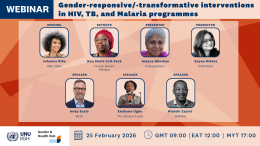
Gender-responsive/-transformative interventions in HIV, TB, and Malaria programmes
Examining changes in health- and gender-related outcomes attributable to gender-responsive and -transformative interventions in HIV, TB, & malaria
Degree Defense
PhD Defence: mHealth-Enabled Differentiated Service Delivery for HIV Care: A Case Study of The Lighthouse Trust HIV Clinic in Malawi
Christine Njoki Kiruthu-Kamamia