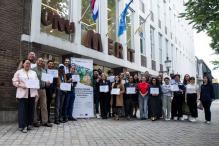


Our Director, Dr. Revati Phalkey, visited the Faculty of Medicine at Eduardo Mondlane University in Maputo, Mozambique, where she was welcomed by Prof. Jahit Sacarlal, Dean of the Faculty, and members of the 𝘊𝘢𝘵𝘢𝘭𝘺𝘴𝘪𝘯𝘨 𝘗𝘰𝘭𝘪𝘤𝘺 𝘐𝘮𝘱𝘳𝘰𝘷𝘦𝘮𝘦𝘯𝘵 𝘪𝘯 𝘈𝘧𝘳𝘪𝘤𝘢 (𝘊𝘗𝘐𝘈) 𝘱𝘳𝘰𝘫𝘦𝘤𝘵 team, including Prof. Baltazar Chilundo, Principal Investigator; Dr. Fatima Abacassamo, Project Coordinator; and researchers involved in phases 1 and 2 of the project.
The visit provided an opportunity to learn more about the Faculty’s work in postgraduate education, research, and extension activities, and to discuss the ongoing CPIA project. Implemented by Eduardo Mondlane University and other Global South partners, with support from UNU Global Health, CPIA Phase 2 is led by Prof. David McCoy and Dr. Claudia Abreu Lopes, Policy Research Leads at UNU Global Health, and Dr. Paula Morgado, Project Coordinator. The project aims to improve policy outcomes in maternal, newborn, child, adolescent sexual, and reproductive health across two African countries: 𝗠𝗼𝘇𝗮𝗺𝗯𝗶𝗾𝘂𝗲 and 𝗕𝘂𝗿𝗸𝗶𝗻𝗮 𝗙𝗮𝘀𝗼.
In Mozambique, CPIA supports six embedded implementation research projects across seven provinces addressing priority adolescent mental health and adolescent sexual and reproductive health challenges, while strengthening national implementation science capacity through the engagement of MPH students, national mentors, and implementers.
Discussions also explored a long-term strategic partnership between Eduardo Mondlane University and UNU Global Health, including opportunities to undertake multi-country implementation research, expand postgraduate education, promote faculty and student exchanges, jointly supervise Master’s, PhD, and postdoctoral researchers, and provide executive training for policymakers and health programme managers.
Further areas of potential collaboration included digital health and responsible artificial intelligence, evidence-informed policymaking, South–South cooperation, and stronger Lusophone research and policy networks.
Suggested citation: "Strengthening Collaboration for Public Health Education and Research in Mozambique," UNU Global Health (blog), 2026-07-15, 2026, https://unu.edu/global-health/blog-post/strengthening-collaboration-public-health-education-and-research-mozambique.