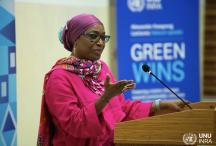


From the 11-24th of July 2024, UNU-INRA and UNEP together with other development partners including UNDP, UNICEF, WHO, CSOs OEF, A Rocha-Ghana, Forestry Commission, Government ministries and traditional authorities, collaborated to provide capacity building training workshops on sustainable ways of addressing key interconnected challenges, on forest degradation in the Okyeman area. These trainings were geared towards economic, environmental, political, educational, nutrition, and health insecurities through a human security approach.
These capacity building workshops, served as a major component of the FOREST Okyeman project, which aims at safeguarding natural resources and assisting communities to revive existing resource management groups and establish landscape-level governance structures through the Community Resource Management Areas (CREMA) model.
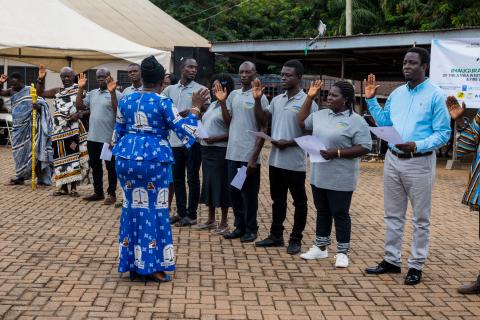
The CREMA model, made up of farmers, local chiefs, government representatives, opinion leaders, private sector, and landowners, was created to co-manage natural resources and create awareness, address violations, strengthen accountability, and build capacity on best agroforestry practices, while empowering the local communities to manage their natural resources.
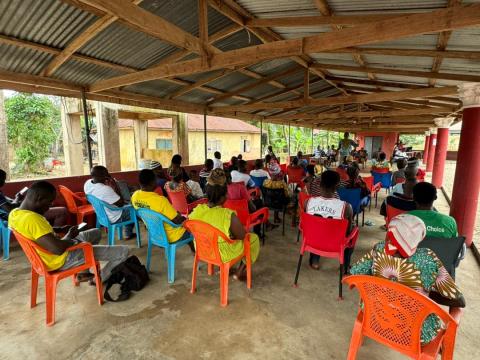
The role of UNEP, UNU-INRA, A-Rocha Ghana, Forestry Commission was to undertake capacity building workshops in 8 communities with training sessions ranging from legal frameworks for natural resource (water, wildlife, minerals, forest, land etc.) management, sustainable agriculture, ecology and monitoring protocols for forests as well as identifying natural resource enterprises and value chains to improve livelihoods of the community.
Forest Okyeman is the source of three important rivers (Ayensu, Birim, Densu)in Ghana and more than 99 smaller streams that serve the country. The forest is unique with a large number of globally threatened species in West Africa including 100 species of flora and fauna in Atewa Forest, which are threatened or near- threatened with three Critically Endangered (CR) species. The forest is rich in plants of over 1100 species, accounts for ca. 26% of Ghana’s entire flora.
The butterfly richness in the Atewa Forest accounts for over 77% of Ghana’s species and over 30% of Ghana’s bird species have been recorded in and around Atewa Forest. The forest reserve holds the Birimmian rock formations, which is endowed with minerals including gold, bauxite, diamonds and kaolin. With a rich fertile soil surrounding the Forest, food and cash crops like cocoa, oil palm, rubber, plantains, cassava, and cocoyam are also popularly grown in this area.

With a human security framework that takes into consideration the need for people-centred, context specific and empowerment of the people and communities within the Forest Okyeman Area, these capacity building workshops have played a critical role in strengthening community-led environmental governance while creating a foundation for ecotourism.
Kofi Gyimah Amoako Gyimah (Okyeman Environment Foundation Secretary)highlights that, through these natural resource management capacity building trainings, "the community members have learnt to move beyond the exploitation of their natural resources and minerals...they are now looking forward to learning more about adding value to their natural resources for ecotourism and agricultural purposes."
This series of capacity building trainings, have gone beyond expanding knowledge and teaching the importance of Community Forest Ecosystem, strengthened Community Resource Management Committees (CRMCs) and increased awareness of Legal Frameworks on stewarding natural resources. They have also, highlighted the need for collaboration between communities and relevant development partners ( and stakeholders), to conserve the Okyeman Area, its natural resources, in a way that protects generational survival, increases livelihoods and and promotes community stewardship.